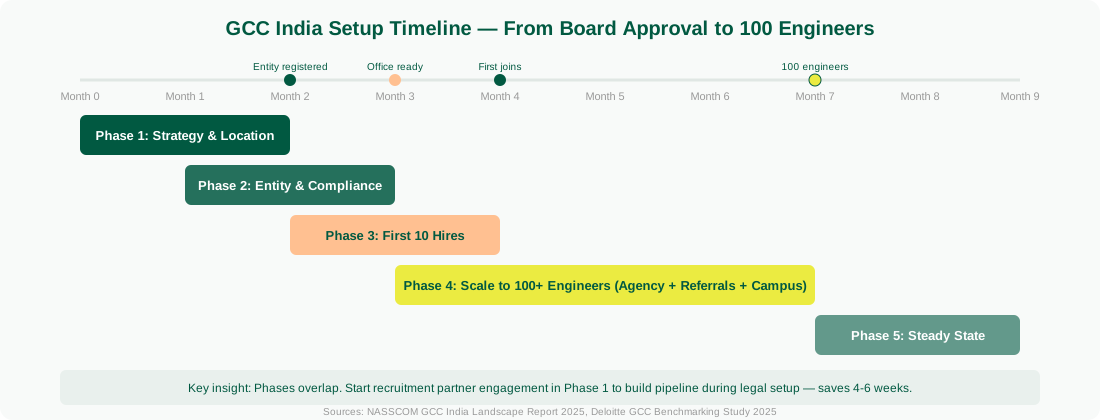
Setting up a global capability center in India requires five phases: strategy and location selection, legal entity registration, leadership hiring, team scaling, and steady-state operations. The entire process takes 4-8 months from board approval to first engineers at their desks. India hosts over 1,800 GCCs employing 1.9 million professionals in 2026, and Quantalent AI helps MNCs execute the most critical phase — hiring the founding team and scaling to 100+ engineers across Bangalore, Hyderabad, Pune, and Chennai.
How to Choose the Right City and Strategy for Your GCC (Weeks 1-4)
Before registering an entity, MNCs must answer three strategic questions that determine the GCC's long-term success: what functions will the center handle, which city offers the best talent-cost balance, and what team size is the 3-year target.
Define the GCC's mandate clearly. Centers that start as "innovation hubs" without specific product ownership struggle to attract senior talent. According to NASSCOM's 2025 GCC Evolution Report, GCCs with clearly defined product mandates retain engineers 2.3x longer than those with vague "support the HQ team" briefs. Define which products, services, or business functions the India center will own from day one.
Select the city based on talent availability, not just cost. Bangalore offers the deepest talent pool (35% of India's GCCs) but the highest salaries and attrition. Hyderabad provides 20-30% cost savings with the fastest growing GCC ecosystem (12-15% annual growth). Pune excels for automotive and manufacturing technology.
Chennai offers strong BFSI talent at lower costs. For a detailed city comparison, see our analysis of Bangalore vs Hyderabad vs Pune vs Chennai for GCC hiring.
Set a realistic 3-year headcount target. GCCs that plan to reach 200+ employees justify dedicated infrastructure (own office, internal HR, full compliance team). Centers targeting 30-50 employees may be better served by a managed ODC model initially. According to Deloitte's 2025 GCC Benchmarking Study, GCCs that reach 100 employees within 18 months have a 90% probability of becoming permanent — those that stall below 50 after 2 years face a 40% risk of closure or consolidation.
What Legal Entity and Compliance Setup Does a GCC Need in India? (Weeks 3-8)
Entity registration in India runs in parallel with Phase 1's location selection. Most GCCs register a Private Limited Company under the Companies Act 2013 — a process that takes 2-4 weeks with proper documentation.
Company registration requirements. At minimum two directors (at least one Indian resident), a registered office address, Digital Signature Certificates (DSCs) for all directors, Director Identification Numbers (DINs), and minimum authorised share capital. IT/ITES companies qualify for 100% FDI under the automatic route — no government approval needed.
Mandatory compliance registrations after incorporation:
| Registration | Timeline | Cost | Governing Body |
|---|---|---|---|
| PAN and TAN | 1-2 weeks | ₹500-1,000 | Income Tax Department |
| GST Registration | 1-2 weeks | No fee | GST Network |
| EPFO (Provident Fund) | Within 30 days of 20th employee | No fee | EPFO |
| Professional Tax | Before first payroll | ₹500-2,500 | State Government |
| Shops & Establishments | Within 30 days of operations | ₹500-5,000 | State Labour Dept |
| ESIC (if applicable) | Within 15 days | No fee | ESIC |
For a complete breakdown of India's employment compliance and CTC structure, see our guide on India's CTC structure explained for foreign employers.
Office space options for new GCCs. Managed office spaces (WeWork, Awfis, CoWrks) allow GCCs to start with 10-20 seats and scale without long-term lease commitments. Grade A office leases typically require 3-5 year commitments with 6-12 months of security deposit. According to CBRE India's 2025 Office Market Report, Bangalore Grade A space averages ₹75-120 per sq ft per month, while Hyderabad averages ₹55-85.
Transfer pricing and intercompany agreements. The India entity will operate as a subsidiary providing services to the parent company. Establish a transfer pricing policy from day one — India's tax authorities actively scrutinise GCC intercompany arrangements. Most GCCs use a cost-plus model (cost of operations plus 10-15% markup) for transfer pricing compliance. Engage a Big 4 or mid-tier accounting firm with GCC experience to set this up correctly — retroactive adjustments are expensive and trigger audits.
Data protection and cross-border data transfer. India's Digital Personal Data Protection Act 2023 (DPDPA) governs how the GCC handles employee and customer data. If the GCC processes personal data of EU citizens, GDPR compliance is also required. Establish data processing agreements between the parent entity and the India subsidiary before any data flows begin.
Most GCCs implement a combination of contractual safeguards and technical controls (VPN, encrypted storage, access controls) to satisfy both Indian and parent-country data protection requirements.
How to Hire the GCC Founding Team — First 10 Critical Hires (Weeks 4-12)
The founding team defines everything — engineering culture, coding standards, hiring bar, and operational DNA. Getting these first 10 hires right is more important than any other phase.
Hire the India Site Lead first. The ideal candidate has 15+ years of experience, has previously built or scaled a GCC team, understands both Indian talent dynamics and global corporate culture, and can operate independently during the early months when HQ oversight is limited. According to LinkedIn's 2025 India Executive Hiring Report, India Site Lead roles take 45-60 days to fill through executive search, compared to 25-35 days for standard engineering roles.
The first 10 hires should include: India Site Lead / Engineering Director (1), Senior Engineering Managers (2-3), Staff/Principal Engineers (3-4), and HR/TA Lead (1-2). Resist the temptation to hire mid-level engineers first — without senior technical leadership to set the engineering culture, early hires default to whatever practices they brought from previous employers.
Use executive search for leadership roles. Founding team hires require a different approach than bulk hiring. Candidates must combine deep technical expertise with the ability to build teams from scratch — a profile that job boards rarely surface. Quantalent AI's executive search services for GCCs identify candidates who have previously built or scaled GCC teams, reducing the 12-18 month learning curve that first-time GCC leaders face.
Compensation benchmarking for the founding team. Founding team salaries in India GCCs vary significantly by city and role seniority. Engineering Directors command ₹60-90 LPA in Bangalore and ₹50-75 LPA in Hyderabad. Senior Engineering Managers range from ₹40-60 LPA. Staff Engineers with 12+ years of experience expect ₹45-70 LPA depending on domain expertise. New GCCs typically pay a 15-25% premium over established GCC salaries to attract candidates willing to take the early-stage risk.
Set up technology infrastructure in parallel. While leadership hiring runs, the IT team should establish core infrastructure: VPN connectivity to headquarters, cloud accounts (AWS/Azure/GCP), identity and access management (SSO with parent company directory), collaboration tools, and development environments. Most GCCs achieve full IT readiness within 4-6 weeks using cloud-first architecture. Hardware procurement (laptops, monitors) takes 2-3 weeks in India through enterprise vendors like Dell or Lenovo with corporate agreements.
How to Scale a GCC From 10 to 100+ Engineers in India (Months 3-9)
Once the founding team is in place, the GCC enters the volume hiring phase. Scaling from 10 to 100 engineers within 6 months requires parallel execution across multiple channels and a systematic approach to India's 60-90 day notice period constraint.
The 100-engineer hiring math. To have 100 engineers seated by month 9, offers must go out starting month 3 (to account for 60-90 day notice periods). Assuming a 75% offer-to-join ratio (industry average for new GCCs), you need approximately 135 accepted offers to land 100 joiners. At a 3:1 interview-to-hire ratio, that means evaluating roughly 400 candidates across the 6-month hiring window.
Three channels must run simultaneously:
Channel 1 — AI-powered recruitment agency (40-50 hires). The primary channel for experienced lateral hires (3-10 years experience). Agencies with AI-powered sourcing deliver first shortlists within 5 business days, enabling the GCC to evaluate 20-30 candidates per week. Quantalent AI's GCC recruitment services deliver a 3:1 interview-to-hire ratio, meaning 120-150 candidates evaluated for 40-50 hires.
Channel 2 — Employee referral program (20-30 hires). Once the first 20-30 engineers join, each employee's professional network becomes a sourcing channel. GCCs that offer referral bonuses of ₹50,000-₹1,00,000 per successful hire generate 25-35% of total hires through referrals, according to LinkedIn's 2025 India Hiring Report. Referral hires stay 23% longer and ramp faster due to built-in cultural context.
Channel 3 — Campus hiring pipeline (15-20 hires). Partnerships with IITs, NITs, and IIIT Hyderabad for intern-to-full-time programs fill entry-level positions at 40-60% lower cost than lateral hiring. Campus hires require 6-9 months of pipeline building before results materialise, so GCCs should begin campus outreach in Phase 1.
The remaining 10-15 hires come from direct applications through job boards (Naukri.com, LinkedIn), the company careers page, and inbound interest from employer branding efforts.
Notice period management is the critical bottleneck. With 60-90 day notice periods standard in India, the gap between accepted offer and day-one joining is the longest in any major tech market. During this window, 22-28% of candidates drop out due to counter-offers, competing opportunities, or personal reasons. For detailed strategies on managing this risk, see our FAQ on notice periods and offer dropouts in India.
What Does Steady-State GCC Operations Look Like After Launch? (Month 9+)
Once the GCC reaches 100+ employees, hiring shifts from startup-mode urgency to sustainable pipeline management. The internal TA team (built during Phase 3-4) takes ownership of most hiring, with external agency support for senior, niche, or surge-capacity roles.
Build the internal TA function by month 6. A TA team of 3-5 recruiters can handle 8-12 hires per month sustainably. Internal recruiters cost 60-70% less per hire than agency fees but require 2-3 months to ramp. The optimal model is to run agency-heavy hiring during months 3-6 while the internal team ramps, then shift to 70% internal / 30% agency by month 9.
Retention becomes the priority. According to NASSCOM's 2025 GCC Workforce Report, GCC attrition in India averages 18-22%. At 100+ employees, losing 20 engineers per year means perpetual backfill hiring that drains TA resources. Structured career ladders, competitive semi-annual compensation reviews, and learning budgets of ₹1.5-2.5 LPA per engineer are the proven retention strategies for GCCs in India.
Employer branding compounds over time. GCCs that invest in engineering blog content, tech meetup sponsorship, and campus programs during Year 1 see 40% higher inbound applications by Year 2. The long-term goal is reducing agency dependency to 15-20% of total hires — achievable only when the GCC has genuine employer brand recognition in India's tech community.
Establish governance and reporting cadences. By month 9, formalise weekly leadership syncs between the India site lead and headquarters engineering leadership. Monthly business reviews should cover headcount vs plan, attrition metrics, project delivery velocity, and budget utilisation. Quarterly talent reviews assess the pipeline health, succession planning for critical roles, and compensation competitiveness against market benchmarks. GCCs that establish these governance rhythms early avoid the "out of sight, out of mind" dynamic that causes many offshore centers to underperform.
GCC vs ODC: When Does Each Model Make Sense?
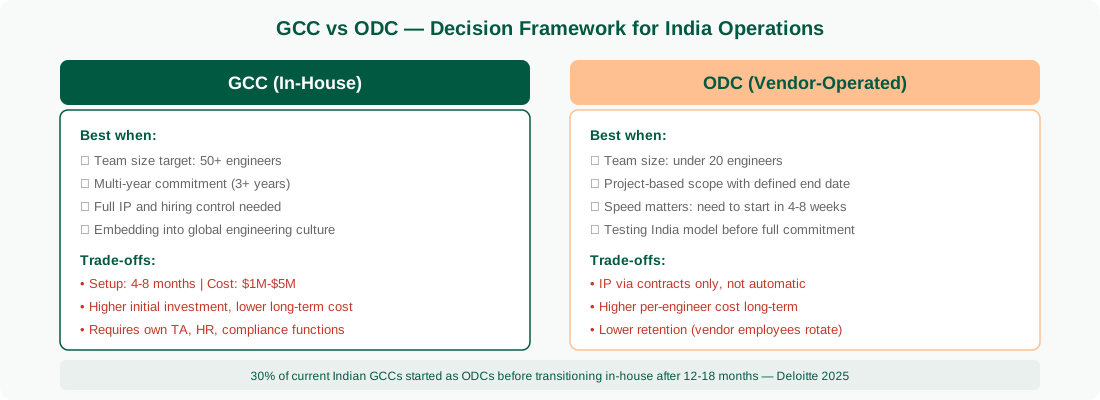
MNCs evaluating India operations must choose between a fully owned GCC and a vendor-operated Offshore Development Center (ODC). The decision depends on team size, timeline, and strategic commitment.
| Factor | GCC (In-House) | ODC (Vendor-Operated) |
|---|---|---|
| Ownership | Parent company | Third-party vendor |
| Setup time | 4-8 months | 4-8 weeks |
| First-year cost | $1M-$5M | $300K-$1M |
| IP ownership | Automatic | Contractual |
| Talent retention | Higher (direct employment) | Lower (vendor rotation) |
| Control over hiring | Full | Limited |
| Best for | 50+ engineers, multi-year | Under 20 engineers, project-based |
Choose a GCC when the India operation is strategic (multi-year commitment), team size will exceed 50, intellectual property sensitivity is high, and the company wants to embed India engineers into its global culture.
Choose an ODC when speed-to-start matters more than long-term cost optimisation, the scope is project-based with a defined end date, team size will remain under 20, or the company wants to validate the India model before full commitment.
The hybrid approach works for many MNCs. Start with a vendor-operated ODC (4-8 weeks to launch), then transition to a fully owned GCC after 12-18 months once the India operation proves viable. Deloitte's 2025 GCC Evolution Study found that 30% of current Indian GCCs began as ODCs before being brought in-house.
Common GCC Setup Mistakes and How to Avoid Them
Mistake 1: Hiring mid-level engineers before senior leadership. Without a strong engineering director and staff engineers to define architecture standards, code review practices, and hiring bar, the first 20 engineers create fragmented engineering cultures that are expensive to correct later. Always hire top-down.
Mistake 2: Underestimating India's notice period impact on timelines. MNCs accustomed to 2-week notice periods in the US or Europe are surprised when Indian candidates need 60-90 days before joining. Factor this into every hiring timeline — if you need engineers seated by month 6, offers must go out by month 3.
Mistake 3: Choosing a city based only on cost. The cheapest city is rarely the best choice. Tier-2 cities offer 30-40% savings but have significantly smaller talent pools for specialised roles like machine learning, cloud infrastructure, or SRE. Match city selection to the specific technical skills your GCC needs, not just salary benchmarks. A GCC focused on AI/ML engineering will find 5x more qualified candidates in Bangalore than in any other Indian city.
Mistake 4: Delaying employer branding until after launch. GCCs that start employer branding activities (tech blog, conference sponsorships, campus partnerships) during setup — not after — see 30-40% higher inbound applications within the first year. Your employer brand pipeline takes 6-12 months to produce results, so starting early is critical.
Key Takeaways
- GCC setup in India takes 4-8 months end-to-end — entity registration (2-4 weeks), office setup (6-12 weeks), and founding team hiring (8-14 weeks) should run in parallel
- The first 10 hires define the GCC's engineering culture — invest in senior leadership before hiring mid-level engineers
- Scaling to 100 engineers in 6 months requires 135+ accepted offers across three parallel channels (agency, referrals, campus) due to 75% offer-to-join ratios
- Hyderabad offers 20-30% cost savings over Bangalore with the fastest GCC growth rate — evaluate all four major cities before committing
- Start with a managed office to avoid 3-5 year lease commitments until headcount exceeds 50
- GCC vs ODC is not binary — start with an ODC to validate the model, then transition to a GCC after 12-18 months
Email contact@quantalent.ai or get in touch to discuss hiring for your India GCC. Quantalent AI supports capability centers from founding team executive search through volume hiring across Bangalore, Hyderabad, Pune, and Chennai — with an average time-to-close of 12 days.