The average notice period for tech employees in India is 60-90 days in 2026, creating a 2-3 month gap between offer acceptance and joining that drives offer dropout rates of 22-28% at GCCs. Quantalent AI helps global capability centers across Bangalore, Hyderabad, Pune, and Chennai mitigate both problems — our pre-vetting for career alignment and notice period engagement reduces dropout rates below 10%.
What Is the Average Notice Period for Tech Employees in India?
Notice periods in India's tech sector vary by seniority and employer, but the median has risen steadily since 2020 as companies use longer notice periods as a retention tool.
| Seniority Level | Typical Notice Period | Common At |
|---|---|---|
| Entry-level (0-2 years) | 30 days | Startups, smaller IT firms |
| Mid-level (3-7 years) | 60 days | GCCs, mid-size product companies |
| Senior (8-12 years) | 60-90 days | Large IT services, established GCCs |
| Leadership (12+ years) | 90 days | Enterprise IT, top-tier GCCs, consulting |
According to NASSCOM's 2025 India Tech Employment Survey, 68% of Indian tech companies now mandate 60-day notice periods for mid-level engineers — up from 52% in 2022. Companies like Infosys, Wipro, and TCS enforce 90-day periods for employees at senior bands, making it nearly impossible for GCCs to hire experienced talent from IT services firms in under 3 months.
Notice periods in India are contractual obligations defined in the employment agreement, not statutory requirements under Indian labour law. The Industrial Disputes Act and state-specific Shops and Establishments Acts set minimum notice periods of 30 days for workmen, but tech employees' contracts routinely exceed these statutory minimums.
Can You Negotiate or Buy Out a Notice Period in India?
Notice period negotiation is common in Indian tech hiring, but success depends on the current employer's willingness to release the employee early. Three approaches exist.
Requesting early release from the current employer. The candidate submits a formal request to their HR department asking to be relieved before the contractual notice period ends. According to Aon's 2025 India Workforce Study, approximately 40% of tech companies grant early release requests — typically reducing 60-day periods to 30-45 days. Companies are more likely to grant early release if the employee has completed all knowledge transfer and handover documentation.
Notice period buyout by the hiring company. The new employer pays the candidate's current employer an amount equivalent to the remaining notice period salary. Buyout costs for a mid-level engineer earning ₹25 LPA with 45 days remaining would be approximately ₹3.1 lakhs. Not all employers accept buyouts — large IT services firms like TCS and Infosys rarely agree to notice period buyouts as a policy, regardless of the amount offered.
Candidate forfeiting salary for the unserved period. The employee leaves before completing the notice period and forfeits salary for the remaining days. While legally straightforward, this approach risks the current employer withholding the experience letter or full-and-final settlement, which can delay the candidate's onboarding at the new company. GCCs should understand that some candidates will refuse this option to protect their relationship with the previous employer.
For GCCs unfamiliar with how Indian compensation and notice periods interact, our guide on India's CTC structure for foreign employers explains the full pay framework.
Why Do Candidates Drop Out After Accepting Offers in India?
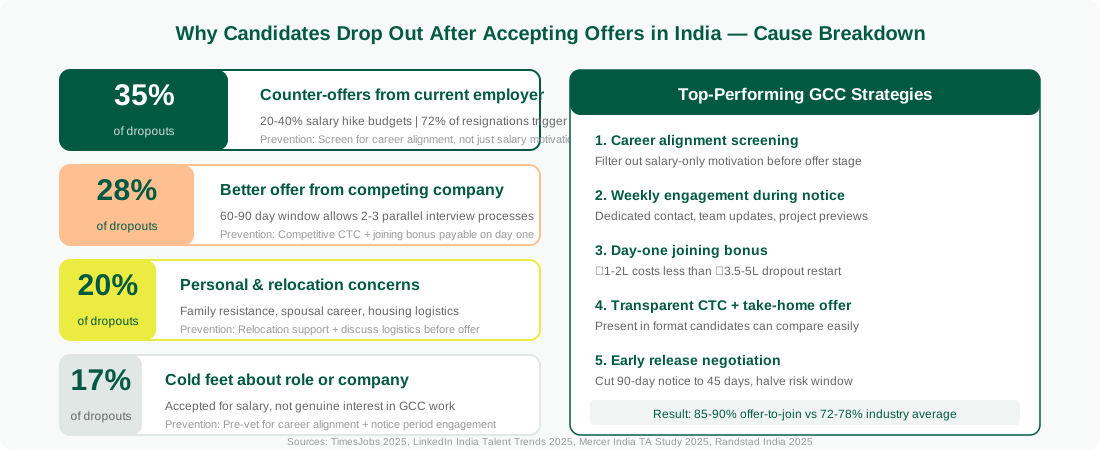
Offer dropouts — where a candidate accepts the offer letter but never joins — are the most expensive failure mode in Indian tech hiring. Each dropout costs GCCs ₹3.5-5 lakhs in wasted recruiter time, interview panel hours, and restarted searches, according to Mercer's 2025 India TA Study.
Counter-offers from the current employer (35% of dropouts). Once a candidate resigns, the current employer has 60-90 days to present a counter-offer. Indian IT managers routinely receive "save" budgets of 20-40% salary increase authority to retain resigned employees. Engineers in the 3-7 year experience band — the most in-demand cohort — receive counter-offers in 72% of resignation cases according to LinkedIn's 2025 India Talent Trends report.
Better offers from competing companies (28% of dropouts). Candidates who are interviewing with multiple companies simultaneously may accept the first offer that arrives, then switch to a better one during the notice period. The 60-90 day window gives candidates ample time to complete interview processes with 2-3 additional companies. GCCs competing against funded startups or FAANG-tier companies lose candidates at this stage when the competing offer includes a 30-40% salary premium.
Personal and relocation concerns (20% of dropouts). Engineers offered roles in different cities face family resistance, spousal career considerations, and housing logistics that intensify during the notice period. Hyderabad-to-Bangalore and Pune-to-Bangalore relocations account for the highest dropout rates among inter-city hires, according to TeamLease's 2025 India Mobility Report.
Cold feet about the role or company (17% of dropouts). Candidates who accepted based on compensation alone — without genuine interest in the GCC's work, culture, or growth trajectory — reconsider during the notice period when the financial excitement fades. Screening for career alignment during the interview process is the strongest preventive measure for this category.
How Do You Reduce Offer Dropout Rates for GCC Hiring in India?
Top-performing GCCs achieve offer-to-join ratios of 85-90%, compared to the industry average of 72-78%. Five strategies drive the gap.
Screen for career alignment, not just technical skills. Engineers who join a GCC because the role matches their career goals — global product exposure, structured learning, technical depth — stay through counter-offers at 3x the rate of those who joined primarily for salary. Quantalent AI's dual-validation process includes career alignment as a core evaluation criterion, specifically to reduce post-offer attrition.
Assign a dedicated engagement contact during the notice period. A named person (not a generic HR inbox) who contacts the candidate weekly with team updates, project previews, and onboarding logistics creates accountability on both sides. GCCs that implement structured notice period engagement see 40% lower ghosting rates than those that go silent after the offer letter, according to Randstad's 2025 India Employer Study.
Front-load tangible commitment anchors. Joining bonuses payable on day one, equipment shipped during the notice period, and invitations to team events before the start date create sunk-cost dynamics that counter-offers cannot easily match. A ₹1-2 lakh joining bonus costs far less than the ₹3.5-5 lakh cost of a dropout and restart.
Present competitive, transparent offers. Candidates who receive offers in a format they cannot easily compare with competing offers are more likely to switch. Always present both CTC and monthly take-home figures, include a clear variable pay component of 10-15%, and benchmark against current GCC hiring trends in India to ensure competitiveness.
Close the notice period gap where possible. Negotiate early release or offer notice period buyouts for critical hires. Reducing a 90-day notice to 45 days cuts the dropout risk window in half.
What Is a Reasonable Offer-to-Join Ratio to Expect in India?
Industry benchmarks for offer-to-join ratios in Indian tech hiring vary by company type and seniority level.
| Company Type | Average Offer-to-Join Ratio | Top Quartile |
|---|---|---|
| GCCs (established, 500+ employees) | 78-82% | 88-92% |
| GCCs (new, under 100 employees) | 68-75% | 80-85% |
| IT services (TCS, Infosys, Wipro) | 82-85% | 90%+ |
| Funded startups (Series B+) | 70-75% | 82-85% |
| FAANG / top-tier product companies | 88-92% | 95%+ |
Source: LinkedIn India Hiring Report 2025, Aon India Compensation Trends 2025.
New GCCs face the lowest offer-to-join ratios because they lack employer brand recognition in India. Candidates accept offers from unknown GCCs as a safety net while continuing to interview with better-known companies. Building employer brand through talent retention and employer branding strategies is the medium-term solution; using pre-vetted candidates screened for genuine career alignment is the immediate fix.
How Does Pre-Vetting Reduce Offer Dropouts at GCCs?
Pre-vetting candidates for career alignment — not just technical competence — eliminates the 17% of dropouts caused by cold feet and reduces the 28% caused by competing offers by filtering out candidates who are passively exploring rather than genuinely committed to the GCC model.
Mercer's 2025 India Talent Study found that candidates hired through structured technical and career alignment assessments show 2.1x higher offer-to-join rates compared to those hired through resume screening and unstructured interviews alone. The rigour of the evaluation process itself signals team quality — strong engineers want to work alongside peers who cleared the same bar.
Quantalent AI's approach screens every candidate for both technical competence (AI assessment across 200+ parameters) and career alignment (domain expert evaluation of 3-5 year goals against the GCC's trajectory). Candidates who pass both gates have already invested meaningful effort in the process, creating commitment that casual job-seekers do not develop.
Still Have Questions About India Notice Periods or Offer Dropouts?
Email contact@quantalent.ai or get in touch for practical advice on managing notice periods and reducing offer dropouts at your India GCC. Quantalent AI delivers pre-vetted, career-aligned candidates with a 98% profiles-to-interview rate across Bangalore, Hyderabad, Pune, and Chennai.