India's GCC hiring landscape in 2026 is defined by five shifts: tier-2 city expansion accelerating beyond metros, AI/ML talent demand outstripping supply by 3x, GCCs competing directly with funded startups for senior engineers, employer branding becoming a hiring bottleneck, and the transition from cost arbitrage to innovation-led mandates. Quantalent AI tracks these trends across 1,800+ capability centers to help GCC leaders plan hiring ramps that account for where the market is heading — not where it was last year.
How Many GCCs Operate in India in 2026?
India hosts over 1,800 global capability centers in 2026, employing 1.9 million professionals and generating $64 billion in annual revenue. According to NASSCOM's 2025 GCC India Report, the sector added 200+ new centers between 2024 and 2026, with financial services, technology, and healthcare leading new setups.
The concentration is shifting. Bangalore still houses 40% of all GCCs, but its share has dropped from 45% in 2023 as Hyderabad (20%), Pune (12%), and Chennai (10%) absorb a larger portion of new mandates. The remaining 18% is split across Gurugram, Noida, and emerging tier-2 locations — the fastest-growing segment.
What Is Driving Tier-2 City Expansion for GCCs in India?
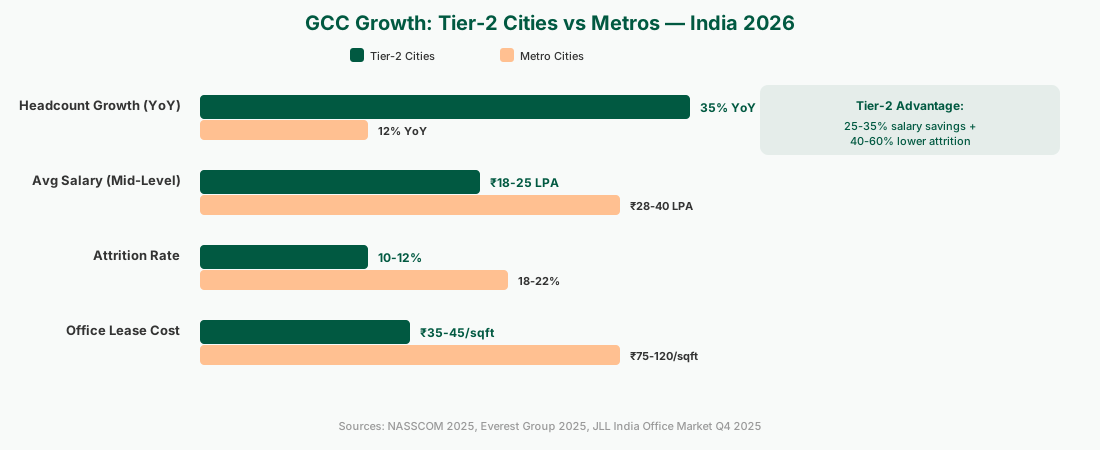
Tier-2 cities are the defining GCC hiring trend of 2026. According to the Everest Group's 2025 GCC Talent Report, tier-2 city GCC headcount grew 35% year-over-year compared to 12% in established metros — a gap that has widened for three consecutive years.
Three factors are driving expansion beyond metros. Salary arbitrage remains significant: mid-level engineers in Coimbatore, Jaipur, and Kochi command 25-35% less than Bangalore equivalents for comparable technical depth. Attrition is structurally lower — 10-12% in tier-2 cities versus 18-22% in metros — because fewer competing employers exist. Infrastructure has caught up, with Coimbatore's TIDEL Park and Jaipur's Mahindra World City offering Grade A office space at 40% lower lease costs than Bangalore's Outer Ring Road.
Coimbatore and Kochi lead the tier-2 surge. Coimbatore's engineering college density (40+ institutions within 100 km) creates a self-replenishing talent pipeline, while Kochi's Infopark hosts 350+ IT companies and offers direct international connectivity through Cochin International Airport. Jaipur is emerging as a preferred location for GCCs with customer-facing functions — its time zone alignment with Europe and growing BPO ecosystem make it a natural fit for service delivery centers.
How Is the AI/ML Talent Shortage Affecting GCC Hiring?
AI and machine learning talent demand is the most acute pressure point for GCC hiring in India in 2026. NASSCOM estimates that demand for AI/ML professionals exceeds supply by 3x nationally, with the gap widening to 4x for senior roles (8+ years experience) in specialisations like NLP, computer vision, and MLOps.
GCCs are responding by building dedicated AI centers of excellence. According to Deloitte's 2025 Global Shared Services Survey, 58% of India GCCs now have a standalone AI/ML team — up from 31% in 2023. Compensation for these roles has surged accordingly: senior ML engineers command INR 55-80 LPA in Bangalore GCCs, a 25-30% premium over equivalent non-AI engineering roles.
The supply constraint is reshaping hiring strategy. GCCs that previously sourced exclusively from top-tier IITs and IIMs are now recruiting from tier-2 engineering colleges with strong data science programs — IIT Hyderabad, IIIT Bangalore, and PSG Tech Coimbatore have become key feeders. Quantalent AI's sourcing across 25+ platforms identifies AI/ML candidates in non-traditional talent pools — research labs, open-source contributors, and kaggle competition winners — that traditional agency sourcing misses entirely.
Why Are GCCs Losing Senior Engineers to Startups?
Funded Indian startups have become the primary competition for GCC senior engineering hires in 2026. According to PwC's 2025 India Workforce Study, 34% of engineers who declined GCC offers in 2025 cited startup ESOP packages as the decisive factor — up from 19% in 2023.
The compensation gap is structural, not just monetary. Startups offer 0.1-0.5% equity to senior engineers, which at a Series C valuation translates to INR 50 LPA-2 Cr in paper value. GCCs counter with stability, global exposure, and 15-20% higher base CTC — but these advantages are losing weight with engineers under 35 who prioritise wealth creation over career stability.
GCCs winning the talent war are adapting in three ways. Performance-linked bonuses tied to product outcomes (not just tenure) have increased offer acceptance by 18% according to Mercer's 2025 India TA Study. Internal mobility programs that rotate engineers across global offices address the "career ceiling" perception — 42% of senior engineers cite limited growth as their top concern with GCCs. Quantalent AI helps GCCs craft competitive offers by benchmarking total compensation against both startup and big-tech alternatives in real time.
How Important Is Employer Branding for GCC Hiring in 2026?
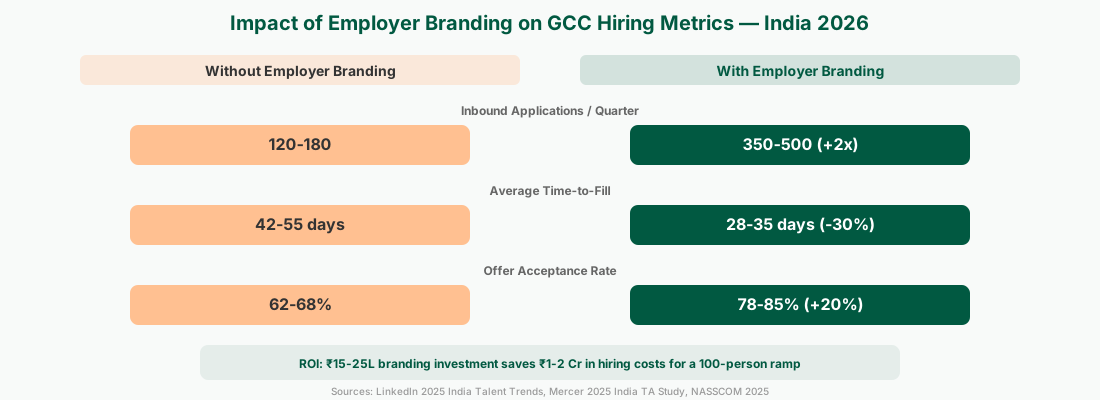
Employer branding has shifted from a "nice to have" to a hiring bottleneck for GCCs in 2026. According to LinkedIn's 2025 India Talent Trends report, 45% of mid-level engineers cannot name more than three GCCs as desirable employers — despite over 1,800 centers operating in the country. GCCs that invest in employer branding see 2x more inbound applications and 30% faster time-to-fill.
The branding gap exists because most GCCs operate under their parent company's global brand, which may have strong consumer recognition but weak employer visibility in India. A European bank's GCC in Hyderabad competes for the same engineers as Google, Flipkart, and CRED — but appears in far fewer "dream company" lists.
Effective GCC employer branding in 2026 focuses on three channels. Engineering blog content showcasing technical challenges (not corporate PR) generates 3x more candidate engagement than job postings. Hackathon sponsorships and open-source contributions build credibility with the developer community. Campus ambassador programs at target engineering colleges create early-career pipelines that reduce dependency on lateral hiring.
How Are GCCs Transitioning From Cost Centers to Innovation Hubs?
The cost-arbitrage model that defined India GCCs for two decades is giving way to innovation-led mandates in 2026. According to Deloitte's 2025 Global Shared Services Survey, 62% of India GCCs now own end-to-end product development — not just maintenance or support. GCCs filed over 12,000 patents from India in 2025, a 40% increase over 2023.
The shift from cost-arbitrage to innovation-led GCC mandates changes hiring priorities fundamentally. GCCs building innovation hubs need product managers, UX researchers, and system architects — not just backend engineers executing specifications from headquarters. Hiring for these roles requires a different sourcing strategy: candidates must demonstrate product thinking and cross-functional leadership, not just technical depth.
For a comprehensive analysis of the GCC talent landscape including city-by-city breakdowns and role-specific supply data, see our GCC tech talent landscape report.
What Should GCC Leaders Do About These Trends?
GCC leaders planning 2026-2027 hiring ramps should act on these trends now — not after they become constraints.
Diversify location strategy. Evaluate Coimbatore, Kochi, or Jaipur for at least 20-30% of new headcount. The salary and attrition advantages compound at scale — a 100-person team in a tier-2 city saves INR 3-5 Cr annually in compensation costs alone compared to a Bangalore equivalent.
Build AI/ML pipelines early. AI/ML roles take 2-3x longer to fill than standard engineering positions. Start sourcing 6 months before you need engineers seated. Quantalent AI's GCC recruitment services include dedicated AI/ML sourcing tracks that maintain active candidate pipelines across specialisations.
Invest in employer branding before scaling. GCCs planning 50+ hires should invest 3-6 months in engineering brand building before launching the hiring ramp. The cost of employer branding is a fraction of the premium you pay when candidates don't know who you are.
Benchmark compensation against startups, not just other GCCs. The relevant comparison set has changed. Engineers evaluate GCC offers against startup equity packages — your compensation team needs startup ESOP data, not just industry salary surveys.
Key Takeaways
- India hosts 1,800+ GCCs in 2026 employing 1.9 million professionals — the sector continues growing at 12-15% annually
- Tier-2 cities (Coimbatore, Kochi, Jaipur) are growing 3x faster than metros for GCC headcount, driven by 25-35% salary savings and structurally lower attrition
- AI/ML talent demand exceeds supply by 3x nationally, making early pipeline building critical for GCCs planning AI centers of excellence
- 34% of senior engineers who decline GCC offers cite startup ESOPs as the deciding factor — GCCs must benchmark against startup compensation, not just peer GCCs
- Employer branding delivers 2x inbound applications and 30% faster time-to-fill — a prerequisite for any GCC planning a large hiring ramp in 2026
Email contact@quantalent.ai or book a free consultation to discuss how these trends affect your specific hiring plan. Quantalent AI provides trend-adjusted hiring strategies for GCCs across Bangalore, Hyderabad, Pune, Chennai, and emerging tier-2 cities.