Quantalent AI is a recruitment agency specialising in global capability center (GCC) hiring across India. We combine AI-powered sourcing across 25+ platforms with domain expert validation to deliver qualified tech candidates at GCC scale — whether you're hiring 5 engineers or 50. With a 3:1 interview-to-hire ratio and 12-day average time-to-shortlist, Quantalent AI helps GCCs in Bangalore, Hyderabad, Pune, Chennai, and Gurugram build engineering teams faster without compromising quality.
Why Is GCC Hiring in India So Competitive?
India now hosts over 1,800 global capability centers — up from 1,580 in 2024 — according to NASSCOM's 2025 GCC Annual Report. These centres employ 1.9 million professionals and are growing at 12-15% annually. The explosion of GCCs has created intense competition for tech talent, particularly in Bangalore and Hyderabad where multiple MNCs compete for the same candidate pool. For a comprehensive view of talent supply, salaries, and hiring challenges across all six Gulf states, see our GCC tech talent landscape 2026 guide.
Three factors make GCC recruitment uniquely challenging in 2026:
Scale with quality. GCCs don't hire one engineer at a time — typical mandates involve 10-50 positions across multiple technology clusters simultaneously. Traditional agencies struggle to maintain candidate quality at this volume. According to the Everest Group's 2025 GCC Talent Report, 62% of GCC leaders cite "maintaining quality at scale" as their top recruitment challenge. For GCCs evaluating delivery models, our RPO vs recruitment agency comparison for GCC India breaks down which model works best at each hiring volume.
Competition from funded startups. Indian startups raised USD 12.5 billion in 2025 according to the Tracxn India Tech Startup Report. These startups offer equity, faster career growth, and product-building opportunities that attract senior engineers away from GCC roles. GCCs must compete on total package value — not just salary — to win top candidates.
90-day notice periods. Most Indian IT companies enforce 60-90 day notice periods, meaning GCCs must plan hiring pipelines 3-4 months ahead. According to NASSCOM's 2025 Industry Report, 67% of Indian IT companies require a minimum 60-day notice. Candidates who accept offers during this window receive counter-offers from their current employer — resulting in offer dropout rates of 15-25% across the industry.
How Quantalent AI Solves the GCC Hiring Challenge
GCC recruitment requires a fundamentally different approach from single-role hiring. Volume mandates demand parallel processing, consistent quality bars, and deep technology-specific expertise across multiple domains simultaneously.
AI sourcing at GCC scale. Quantalent AI's engine scans 25+ platforms — LinkedIn, GitHub, Stack Overflow, Naukri, specialist Slack communities, and tier-2 city talent pools — evaluating candidates across 200+ parameters for each open role. For a GCC hiring 20 backend engineers and 10 data engineers simultaneously, the AI runs both searches in parallel, producing independent shortlists optimised for each role's specific requirements.
Domain expert validation by technology cluster. Each candidate on the AI shortlist undergoes evaluation by a domain expert who has built production systems in that specific technology area. Backend candidates are assessed by backend specialists. Data engineering candidates are assessed by data engineering specialists. The dual-validation approach — AI assessment plus human expert evaluation — maintains the 3:1 interview-to-hire ratio even when filling 30+ roles simultaneously.
Dedicated recruitment pods. For GCCs with ongoing hiring needs, Quantalent AI assigns dedicated pods — recruitment specialists mapped to specific technology clusters within your organisation. Pod members build deep understanding of your engineering culture, technical standards, and team dynamics over time, improving candidate-team fit with each successive hire.
"Quantalent was instrumental in filling our niche roles by tapping into talent from diverse communities and unconventional platforms." — Harsha Kadimisetty, CEO, Aerchain
Which Industries Do GCCs Hire For Most in India?
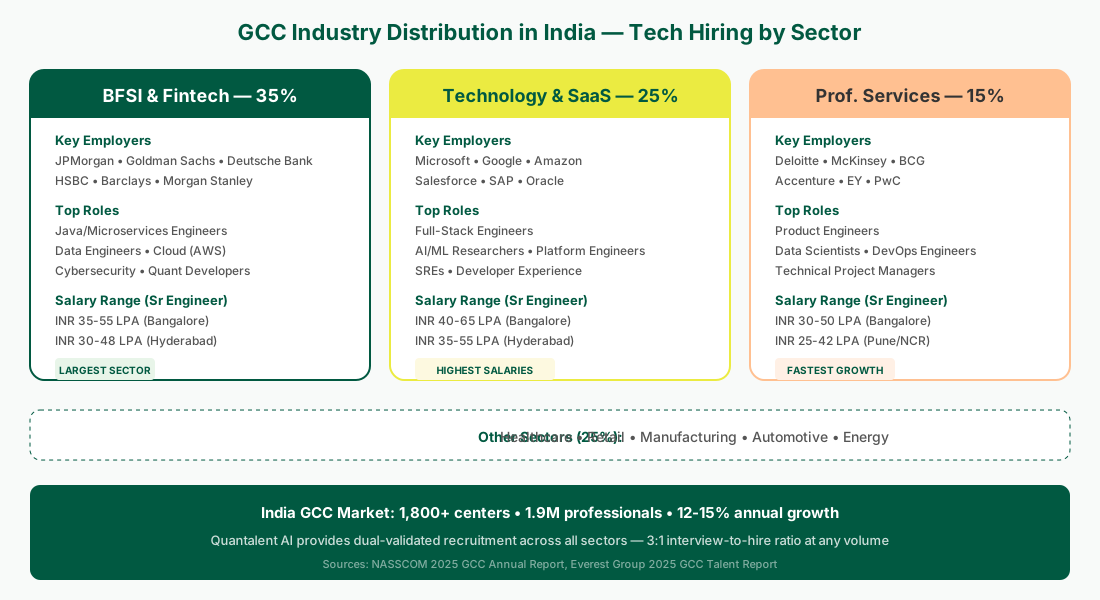
GCCs span every major industry, but technology hiring patterns differ significantly by sector. According to NASSCOM's 2025 GCC Annual Report, BFSI (Banking, Financial Services, and Insurance) accounts for 35% of all GCC tech employment in India, followed by technology and SaaS (25%), and professional services (15%).
BFSI and Fintech GCCs. Banks like JPMorgan, Goldman Sachs, and Deutsche Bank operate India's largest GCCs, each employing 5,000-50,000 technology professionals. Hiring focus: Java/microservices engineers, data engineers, cloud infrastructure (primarily AWS), cybersecurity specialists, and quantitative developers. Bangalore and Hyderabad are primary locations. Quantalent AI's BFSI recruitment coverage includes fintech-specific expertise applicable to both Gulf and India operations.
Technology and SaaS GCCs. Companies like Microsoft, Google, Amazon, Salesforce, and SAP run significant R&D operations in India. Hiring focus: full-stack engineers, AI/ML researchers, platform engineers, and SREs. These GCCs compete directly with Indian startups for top-tier talent, requiring premium compensation and strong employer branding.
Professional Services GCCs. Consulting firms (Deloitte, McKinsey, BCG) and services companies run technology centres focused on internal tools, client delivery platforms, and AI-driven consulting products. Hiring focus: product engineers, data scientists, DevOps engineers, and technical project managers.
Where Are India's GCC Talent Hubs?
India's five major GCC cities each have distinct talent profiles, salary ranges, and competitive dynamics. Choosing the right city — or combination of cities — significantly affects hiring speed, cost, and candidate quality.
Bangalore (Bengaluru). India's largest tech hub with 2M+ tech professionals. Deepest talent pool across all technologies. Highest salaries (senior engineers: INR 35-55 LPA) and most competition from startups. According to NASSCOM's 2025 data, 38% of all GCC employees in India are based in Bangalore. Best for: AI/ML, cloud, full-stack, and any role where depth of talent pool matters more than cost.
Hyderabad. India's fastest-growing GCC hub, driven by Amazon, Google, Microsoft, and financial services GCCs. Strong cloud and enterprise technology talent. Salaries 15-20% below Bangalore for equivalent roles. According to the Telangana IT Department's 2025 report, Hyderabad's tech workforce grew 18% year-over-year. Best for: cloud infrastructure, enterprise Java, data engineering.
Pune. Strong in automotive technology, manufacturing tech, and enterprise software. Home to major GCCs from Volkswagen, Cummins, and ThoughtWorks. Salaries 15-25% below Bangalore. Best for: embedded systems, IoT, automotive software, and enterprise applications.
Chennai. India's semiconductor and embedded systems capital. Home to Qualcomm, Texas Instruments, and Zoho's massive engineering teams. Strong in VLSI design, embedded C/C++, and telecom technology. Best for: semiconductor, embedded systems, telecom, and hardware-adjacent software.
Gurugram (NCR). Hub for BFSI GCCs, consulting firms, and e-commerce technology. Proximity to Delhi's business district makes it preferred for client-facing engineering roles. Best for: financial technology, consulting tech platforms, and roles requiring regular stakeholder interaction.
Quantalent AI sources from all five cities simultaneously, using AI to identify the optimal candidate-city match based on role requirements, salary budget, and technology specialisation. For a detailed look at Bangalore — India's largest GCC hub — see our GCC hiring partner Bangalore page.
Ready to Scale Your GCC Team in India?
Whether you're setting up a new capability center or scaling an existing one from 50 to 500 engineers, Quantalent AI delivers the speed and quality that GCC hiring demands. Our AI sources from 25+ platforms while domain experts validate every candidate — producing a 3:1 interview-to-hire ratio at any volume.
Get started: Email contact@quantalent.ai or book a free consultation. We'll map your GCC hiring plan by technology cluster, city, and timeline — and show you how dual-validation maintains quality even at scale.