Quantalent AI is a fintech recruitment agency in Dubai that specialises in hiring for DIFC, ADGM, and mainland fintech companies. We source fintech engineers — payment specialists, blockchain developers, compliance tech engineers, and quantitative developers — from 25+ platforms and vet each through our dual-validation process. Average time-to-close for fintech roles: 12 days.
Dubai's Fintech Boom: Why Hiring Is the Bottleneck
Dubai has become the Middle East's fintech capital. According to DIFC's 2025 Annual Review, the centre now hosts over 800 financial services companies, with fintech firms growing at 30%+ annually since 2022. The MENA Fintech Association reports that UAE-based fintechs raised USD 750 million in 2025 alone. ADGM in Abu Dhabi has emerged as a complementary hub, attracting crypto exchanges, digital banks, and InsurTech startups with its progressive regulatory sandbox.
The growth numbers are impressive. But the hiring numbers tell a different story. In 2026, the average time-to-fill for a senior fintech engineer in Dubai is 45-60 days — nearly double the time for general software engineering roles. The bottleneck isn't demand. It's the intersection of two skill sets: deep technical ability AND financial services domain knowledge.
A backend engineer who can build a REST API isn't the same as one who can build a PCI-DSS compliant payment gateway. A data scientist who can train ML models isn't the same as one who can build real-time fraud detection systems with regulatory audit trails. This domain overlap is exactly where most general recruitment agencies fail — and where Quantalent AI's domain expert vetting makes the difference.
What Fintech Roles Are Hardest to Fill in Dubai?
Dubai's fintech hiring landscape breaks down into distinct specialisation categories, each with different candidate profiles, salary ranges, and sourcing challenges.
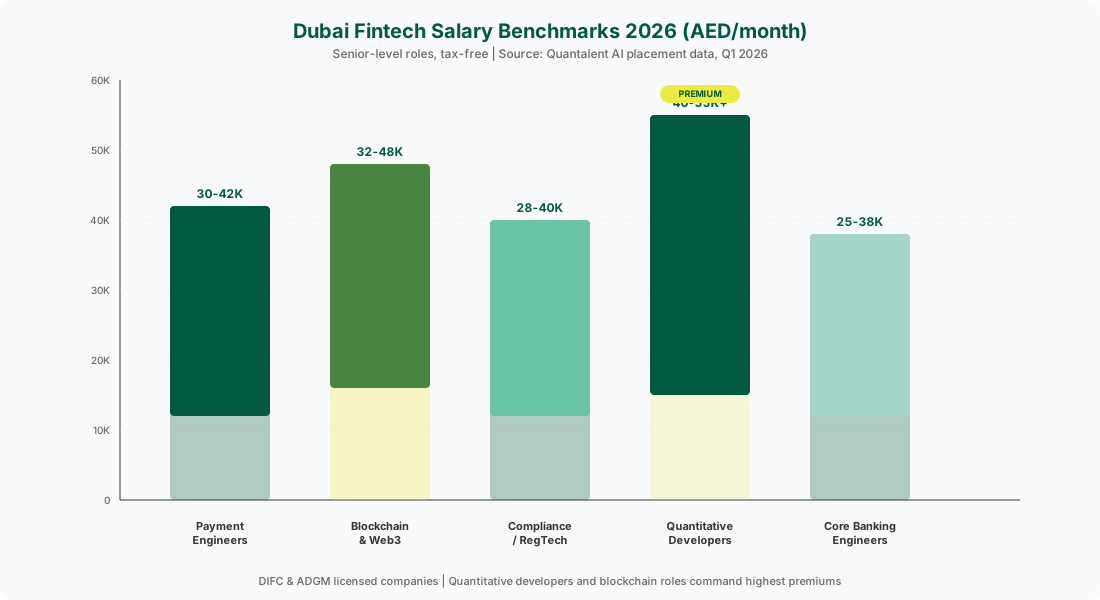
Payment Engineers. The largest category by volume. Companies building payment gateways, mobile wallets, and cross-border transfer platforms need engineers who understand PCI-DSS compliance, payment card schemes (Visa, Mastercard, local schemes like Mada), tokenisation, and settlement systems. Senior payment engineers earn AED 30,000-42,000/month in Dubai. The strongest candidates typically come from India's UPI ecosystem or Southeast Asian payment companies.
Blockchain and Web3 Developers. Dubai's regulatory clarity around crypto (VARA licensing) has attracted dozens of blockchain companies. Demand spans smart contract development (Solidity, Rust), DeFi protocol engineering, and crypto exchange infrastructure. Senior blockchain developers command AED 32,000-48,000/month — among the highest-paid specialisations in Dubai fintech. Sourcing these candidates requires looking beyond LinkedIn into crypto-specific communities, GitHub repos, and DeFi protocol contributor lists.
Compliance and RegTech Engineers. Every fintech in DIFC and ADGM needs engineers who can build KYC/AML systems, transaction monitoring platforms, and regulatory reporting tools. These roles require understanding of DFSA (DIFC) or FSRA (ADGM) requirements alongside technical skills. It's a niche that general recruiters struggle with because the candidate pool sits at the intersection of engineering and financial compliance. Senior compliance tech engineers earn AED 28,000-40,000/month.
Quantitative Developers. Trading firms, hedge funds, and algorithmic lending platforms in DIFC need quant devs who combine strong software engineering with mathematical modelling. Languages: Python, C++, R. Skills: time-series analysis, Monte Carlo simulation, real-time risk computation. These are the hardest fintech roles to fill in Dubai — the candidate pool is small and concentrated in London, New York, and Singapore. Expect AED 40,000-55,000+/month for senior quant developers.
Core Banking Engineers. Companies building or migrating core banking platforms (Temenos, Mambu, Thought Machine, or custom solutions) need engineers with deep domain knowledge in banking operations — account management, ledger systems, interest calculations, and multi-currency handling. These roles are less glamorous than crypto or AI but consistently in demand.
DIFC vs ADGM: Hiring Implications for Fintech Companies
The regulatory zone where your company is licensed affects your hiring strategy in ways that most recruitment agencies don't consider.
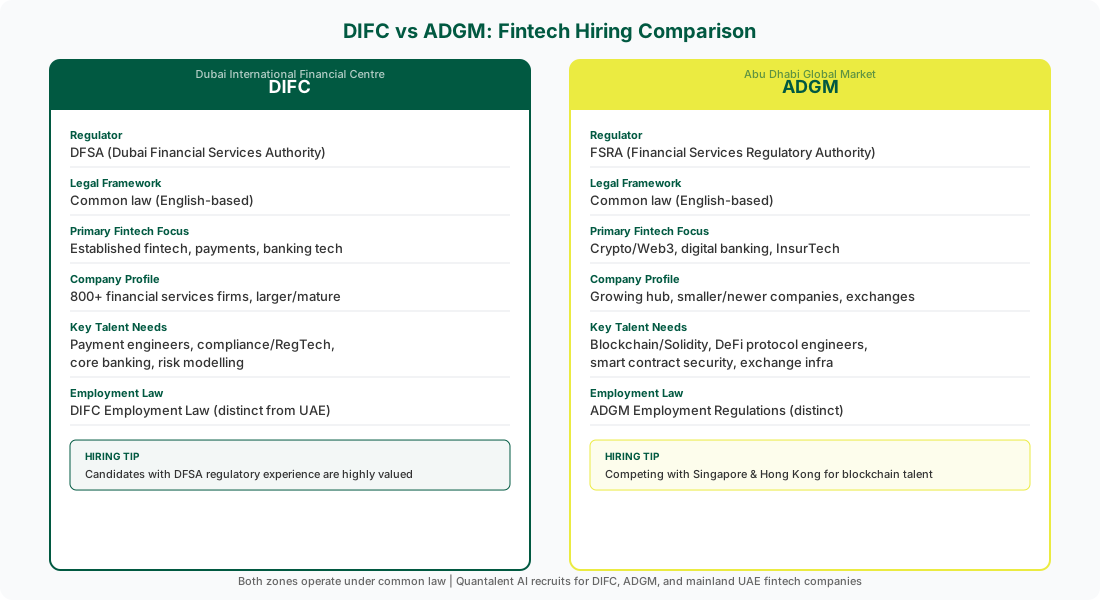
DIFC (Dubai International Financial Centre) operates under common law and is regulated by the DFSA. It's the larger of the two centres and hosts the majority of Dubai's established fintech companies. DIFC employment contracts follow DIFC Employment Law — which differs from mainland UAE labour law in areas like termination, gratuity, and non-compete clauses. Engineers being hired into DIFC roles need to understand these differences, especially those relocating from India or other markets with different employment norms.
ADGM (Abu Dhabi Global Market) has positioned itself as the more crypto-friendly regulator. Its Financial Services Regulatory Authority (FSRA) was among the first in the region to create a comprehensive crypto regulatory framework. ADGM has attracted several major exchanges and Web3 companies. The hiring implication: ADGM-based companies tend to need more blockchain-specific talent and are competing directly with Singapore and Hong Kong for the same candidates.
Mainland UAE fintech companies operate under Central Bank of UAE regulations. They often have larger teams and more traditional banking technology needs — core banking, mobile banking apps, and payment processing. Mainland companies typically offer more structured career paths, which appeals to candidates seeking stability over startup-style growth.
Understanding these distinctions matters because candidates have preferences. An engineer excited about DeFi protocol development will be more drawn to an ADGM-licensed company than a mainland bank. A compliance engineer with DFSA experience is more valuable to a DIFC company than one with only Central Bank exposure. We match not just skills but regulatory context.
Where Fintech Talent Comes From
Dubai's fintech talent pool is overwhelmingly international. Understanding the source markets helps set realistic hiring timelines and compensation expectations.
India is the largest source, particularly for payment engineers. According to the National Payments Corporation of India (NPCI), UPI processed over 14 billion transactions monthly in 2025 — making it one of the world's most advanced real-time payment networks. Indian fintech engineers from this ecosystem bring production-scale payment experience. Indian fintech engineers from companies like PhonePe, Razorpay, PayTM, and Jio Financial Services bring production-scale payment experience that's directly transferable to Dubai. Typical notice period: 60-90 days. For more on hiring from India, see our India-to-Dubai hiring guide.
UK and Europe are primary sources for compliance/RegTech talent and quant developers. London's fintech ecosystem (Revolut, Monzo, Wise) produces engineers with strong regulatory awareness. European candidates typically seek Dubai for the tax advantage and lifestyle — but expect competitive compensation.
Southeast Asia (Singapore, Indonesia, Vietnam) produces strong payment and mobile banking engineers. The region's mobile-first financial services ecosystem creates candidates with skills highly relevant to Dubai's market.
Local UAE talent is growing in junior fintech roles, driven by university programmes and government-backed coding academies. For senior and specialist roles, international sourcing remains essential.
How Quantalent AI Recruits for Fintech
General recruitment agencies send fintech companies the same full-stack developers they send everyone else. The candidates look good on paper — strong technical skills, relevant years of experience — but they fail the first compliance-related technical question.
Quantalent AI recruits fintech differently. Our AI sourcing evaluates candidates on fintech-specific signals: contributions to payment-related open-source projects, experience with financial regulatory frameworks, PCI-DSS or SOC 2 audit experience, and employment history at recognised fintech companies. This filtering happens before any human reviews a profile.
Our domain expert interviews for fintech roles are conducted by evaluators who have built financial systems — not generalist recruiters with a checklist. They assess whether a candidate truly understands settlement finality, idempotent transactions, or regulatory reporting requirements. This is the depth that matters for fintech hiring — and it's why our dual-validation approach delivers a 3:1 interview-to-hire ratio.
For a complete overview of our hiring process, see our 4-step recruitment workflow. For broader Dubai tech hiring context — including salary benchmarks across all engineering roles — explore our other resources.
"Quantalent transformed our recruitment by engaging passive talent. Their outreach and precise matching turned overlooked professionals into valuable, active contributors." — Saiteja Veera, CEO, Gamyam
Ready to Hire Fintech Engineers in Dubai?
Dubai's fintech sector is hiring faster than agencies can keep up. Whether you need a payment engineer for your DIFC startup, a blockchain developer for your ADGM exchange, or a compliance tech team for your digital bank, Quantalent AI delivers vetted fintech professionals in an average of 12 days.
Get started: Email us at contact@quantalent.ai or book a free consultation. Tell us the role and regulatory context, and we'll have your first shortlist ready within 5 business days.