RPO (Recruitment Process Outsourcing) is better for GCCs hiring 50+ people annually with predictable, ongoing needs across standardised roles. A recruitment agency is better for GCCs hiring fewer than 50 people per year, filling niche technology roles, or needing flexibility without long-term contracts. The cost crossover point is approximately 50 hires per year — below that, recruitment agencies offer better value; above it, RPO's per-hire economics improve. Many GCCs use both models simultaneously, assigning each to the role types it handles best.
What Is RPO and How Does It Work for GCCs in India?
Recruitment Process Outsourcing means transferring all or part of your recruitment function to an external provider. For GCCs in India, RPO providers typically embed 3-10 dedicated recruiters within your organisation who work exclusively on your hiring, using your employer brand and ATS.
According to the Everest Group's 2025 RPO in India Report, the Indian RPO market grew 22% year-over-year in 2025, driven largely by GCC demand. Major RPO providers serving Indian GCCs include Randstad Sourceright, Cielo, and PeopleScout — alongside Indian providers like CIEL HR and TeamLease.
RPO strengths for GCCs:
- Predictable cost structure — monthly management fee plus lower per-hire fees at scale
- Deep cultural integration — embedded recruiters learn your engineering culture, technical standards, and team dynamics
- Process ownership — the RPO provider manages the entire pipeline from sourcing to onboarding
- Employer brand consistency — all candidate touchpoints use your brand, not the agency's
- Data and analytics — comprehensive reporting on pipeline metrics, time-to-fill, and source effectiveness
RPO limitations for GCCs:
- Setup time is 8-16 weeks before the first hire, according to the RPOA's 2025 Implementation Benchmark
- Minimum commitment of 12-24 months with annual hire volumes of 50+ to justify the management fee
- RPO recruiters are generalists — they handle volume but lack deep technical assessment capability for niche roles like AI/ML, cybersecurity, or cloud architecture
- Inflexibility when hiring needs fluctuate — scaling RPO teams up or down takes 4-8 weeks
- Technology lag — most RPO providers use traditional sourcing (LinkedIn Recruiter + job boards) without AI-powered multi-platform scanning
What Does a Recruitment Agency Offer GCCs That RPO Doesn't?
Recruitment agencies operate on a per-hire basis — you pay a fee (typically 8-15% of CTC in India) for each successful placement, with no ongoing management fee or minimum hire commitment.
According to the Recruitment & Employment Confederation's 2025 India Market Report, India has approximately 2,500 active tech recruitment agencies, of which fewer than 200 specialise in GCC hiring.
Recruitment agency strengths for GCCs:
- Immediate start — begin receiving candidates within 1-2 weeks of engagement
- No minimum commitment — hire 1 role or 100, scale up or down instantly
- Specialist expertise — niche agencies have deep domain knowledge in specific technology areas
- Broader market access — agencies work across multiple clients, giving them wider candidate networks
- Flexibility — engage for a single hard-to-fill role without committing to an annual contract
Recruitment agency limitations for GCCs:
- Higher per-hire cost at volume — 8-15% of CTC adds up when hiring 50+ people annually
- Less cultural integration — external agencies have limited visibility into your engineering culture
- Quality varies dramatically — the average interview-to-hire ratio across Indian agencies is 8:1 per NASSCOM's 2025 benchmark, meaning 7 out of 8 candidates presented don't get hired
- Competing priorities — your roles compete with every other client the agency serves
- Transactional relationship — most agencies optimise for speed of placement, not long-term candidate fit
How Do RPO and Recruitment Agencies Compare on Key Metrics?
| Factor | RPO | Recruitment Agency | AI-Powered Agency (Quantalent) |
|---|---|---|---|
| Cost per hire (Sr Engineer) | INR 1-3 lakhs | INR 3.2-6 lakhs | Competitive with volume discounts |
| Minimum commitment | 12-24 months, 50+ hires | None | None |
| Setup time | 8-16 weeks | 1-2 weeks | 1-2 weeks |
| Interview-to-hire ratio | 5:1 average | 8:1 average | 3:1 |
| Niche role capability | Limited | Varies by agency | Strong (domain expert validation) |
| Sourcing platforms | 2-3 (LinkedIn, job boards) | 2-5 | 25+ |
| Scalability | Scales in 4-8 weeks | Instant | Instant (AI parallel processing) |
| Cultural integration | High (embedded team) | Low-Medium | Medium (dedicated pods) |
| Employer brand control | Full (uses your brand) | Partial | Partial |
| Contract flexibility | Rigid annual contracts | Per-hire engagement | Per-hire or pod arrangements |
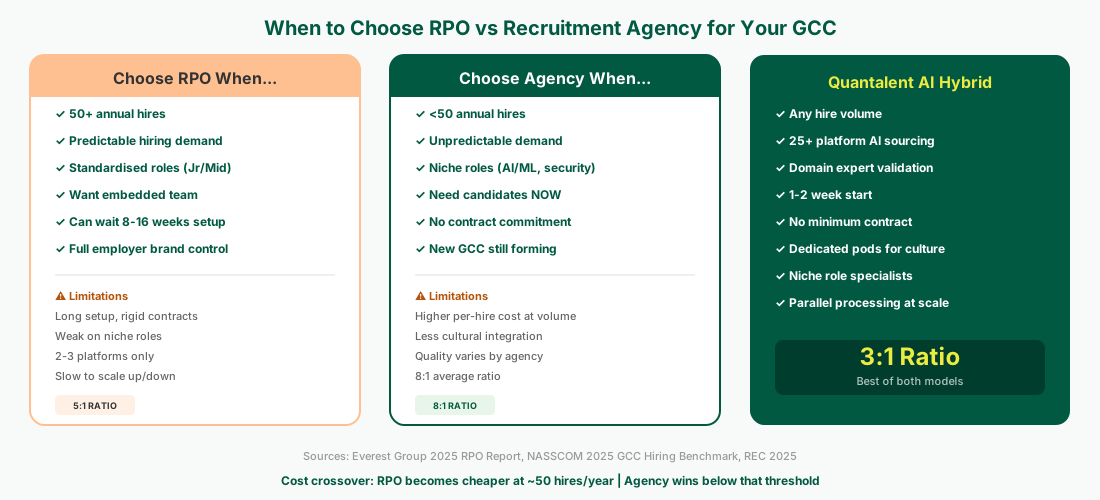
When Should a GCC Choose RPO Over a Recruitment Agency?
Choose RPO when your GCC:
- Hires 50+ people annually with predictable demand
- Needs consistent employer branding across all candidate touchpoints
- Wants a dedicated team that learns your culture deeply over 12+ months
- Primarily hires standardised roles (junior-to-mid engineers, QA, project managers)
- Has the budget for 8-16 weeks of setup before seeing first hires
- Values process ownership and comprehensive pipeline analytics
Choose a recruitment agency when your GCC:
- Hires fewer than 50 people per year or has unpredictable demand
- Needs to fill roles immediately (within 2-4 weeks)
- Is hiring niche technology specialists (AI/ML, cybersecurity, cloud architects)
- Wants flexibility to scale engagement up or down without contract renegotiation
- Is a new GCC still establishing its hiring processes and employer brand
- Needs access to passive candidates beyond LinkedIn and job boards
How Does Quantalent AI Combine the Best of Both Models?
Quantalent AI offers a hybrid approach that addresses the limitations of both pure RPO and traditional recruitment agencies. For GCCs with ongoing hiring needs, our dedicated recruitment pod model provides RPO-level cultural integration — pod members learn your engineering culture, technical standards, and team dynamics — without requiring 12-month minimum contracts or 8-week setup periods.
The AI-powered sourcing layer provides what neither RPO nor traditional agencies offer: systematic scanning of 25+ platforms including GitHub, Stack Overflow, specialist Slack communities, and tier-2 city talent pools. This reaches the 73% of senior engineers who are passive candidates — invisible to the LinkedIn Recruiter + job board approach that both RPO providers and most agencies rely on.
Domain expert validation adds specialist technical assessment that RPO generalist recruiters cannot provide. Each candidate is evaluated by a practitioner in their specific technology area — backend candidates by backend architects, AI/ML candidates by ML engineers. This produces the 3:1 interview-to-hire ratio that outperforms both RPO (5:1) and general agency (8:1) averages.
For a broader overview of GCC recruitment across India, see our recruitment agency for GCC India page, which covers all five major hiring cities.
Decision Framework: Which Model for Your GCC?
| Your Situation | Recommended Model | Why |
|---|---|---|
| New GCC, first 20 hires | Recruitment agency | Speed matters most; no volume for RPO economics |
| Established GCC, 50+ hires/year | RPO + specialist agency | RPO for volume roles, agency for niche talent |
| Scaling rapidly (20→100 in 6 months) | AI-powered agency with pods | Combines speed, scale, and quality without RPO setup time |
| Hiring only niche roles (AI/ML, security) | Specialist recruitment agency | Domain expertise matters more than process ownership |
| Stable GCC, 30-50 hires/year | Recruitment agency with volume discount | Below RPO threshold but enough for fee negotiation |
The right answer often isn't one model or the other — it's the right combination for your specific hiring volume, role complexity, and timeline.
Need help deciding? Email contact@quantalent.ai or book a free consultation. We'll analyse your GCC's hiring pattern and recommend the optimal recruitment model — whether that's Quantalent AI alone, RPO alone, or a blended approach.