Quantalent AI is a Bangalore-based GCC hiring partner that combines AI-powered sourcing across 25+ platforms with domain expert validation to deliver qualified tech candidates at capability center scale. With our primary office on Bannerghatta Road and deep local networks across Bengaluru's tech ecosystem, we help GCCs hire engineers with a 3:1 interview-to-hire ratio and 12-day average time-to-shortlist — whether you're filling 5 specialist roles or scaling a 200-person engineering floor.
Why Is Bangalore the Most Competitive GCC Hiring Market in India?
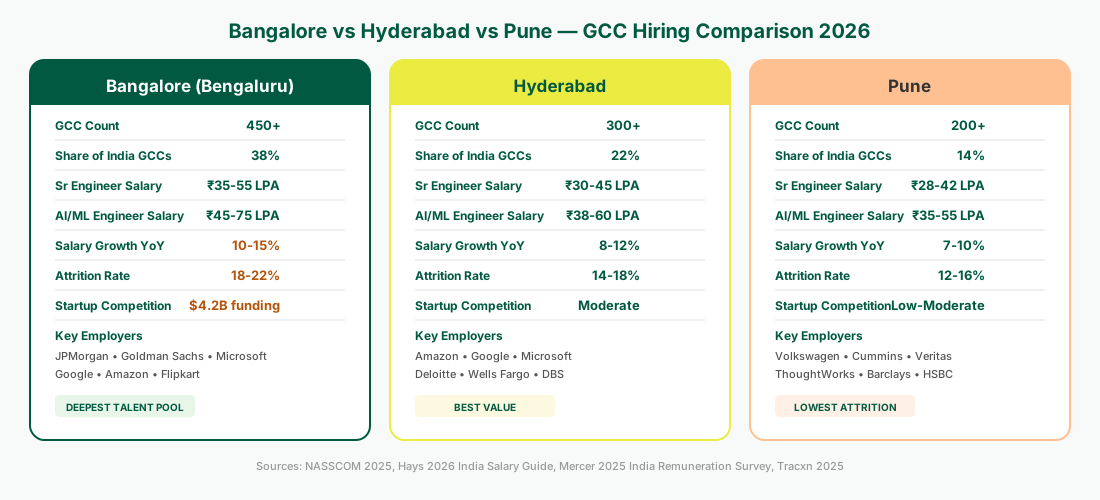
Bangalore accounts for 38% of all GCC employees in India, according to NASSCOM's 2025 GCC Annual Report. The city hosts over 450 global capability centers — including the largest technology operations of JPMorgan (50,000+ employees), Goldman Sachs (12,000+), and Microsoft (20,000+). This concentration creates India's most intense competition for tech talent.
Three factors make Bangalore uniquely difficult for GCC recruitment in 2026:
Startup competition is fiercer here than anywhere in India. Bangalore-based startups raised USD 4.2 billion in 2025, according to the Tracxn India Tech Startup Report. Companies like Razorpay, Zerodha, and Flipkart offer equity packages, product ownership, and rapid promotions that attract senior engineers away from GCC roles. According to the Everest Group's 2025 GCC Talent Report, 71% of Bangalore GCC leaders cite startup competition as their primary hiring challenge — compared to 45% in Hyderabad and 38% in Pune.
Salary inflation outpaces other Indian cities. Senior software engineers in Bangalore command INR 35-55 LPA — 15-20% higher than equivalent roles in Hyderabad or Pune, according to the Hays 2026 India Salary Guide. AI/ML specialists command INR 45-75 LPA, with top-tier researchers exceeding INR 1 crore. Annual salary growth of 10-15% for in-demand skills means compensation packages negotiated 6 months ago are already below market.
Attrition remains India's highest. Bangalore's tech attrition rate averaged 18-22% in 2025 according to Mercer's India Remuneration Survey — meaning GCCs must not only hire but continuously backfill. The 90-day notice period standard across Indian IT companies adds pipeline lag, and offer dropout rates of 15-25% mean GCCs must over-source by 20-30% to hit hiring targets.
How Quantalent AI Solves Bangalore's GCC Hiring Challenges
Being headquartered in Bangalore gives Quantalent AI advantages that remote or Delhi-based agencies cannot match. Our team lives in this market — we understand which companies are doing layoffs before it hits the news, which startups are running out of runway, and which engineering teams are frustrated with their tech stack.
Local AI sourcing with national reach. Quantalent AI's engine scans 25+ platforms — LinkedIn, GitHub, Stack Overflow, Naukri, specialist Slack communities, and Bangalore-specific networks like HasGeek and BangaloreJS. For a GCC hiring 15 backend engineers, the AI runs parallel searches across all platforms simultaneously, producing shortlists within 12 days. We also tap into Hyderabad, Pune, and Chennai talent pools for candidates willing to relocate — expanding the candidate universe beyond Bangalore's saturated market.
Domain expert validation by technology cluster. Each candidate on the AI shortlist undergoes evaluation by a domain expert who has built production systems in that specific technology area. For a BFSI GCC hiring Java/microservices engineers, the assessor is a senior backend architect. For a SaaS GCC hiring AI/ML engineers, the assessor is an ML practitioner. This dual-validation approach maintains the 3:1 interview-to-hire ratio even when filling 30+ roles simultaneously.
Dedicated recruitment pods for ongoing mandates. For GCCs with continuous hiring needs, Quantalent AI assigns dedicated pods — recruitment specialists mapped to specific technology clusters within your organisation. Pod members build deep understanding of your engineering culture, technical standards, and team dynamics. Over time, pod hiring quality improves as members learn which candidate profiles succeed in your specific environment.
"Quantalent's recruitment process accelerated our hiring, delivering a curated shortlist of skilled professionals swiftly while ensuring a perfect cultural fit." — Giridhar Soundararajan, CEO, Barrel Motors
Which Roles Do Bangalore GCCs Hire Most?
According to NASSCOM's 2025 data, Bangalore GCCs hire across four primary technology clusters. Each cluster has distinct talent availability, salary ranges, and sourcing challenges.
Backend and platform engineering — the highest-volume hiring category. Roles include Java/Spring engineers, Python/Django developers, Go engineers, and microservices architects. Senior backend engineers command INR 35-50 LPA. Talent pool is deep but heavily competed for — average of 4.2 open positions per qualified candidate according to LinkedIn India's 2025 Talent Insights.
AI, ML, and data engineering — the fastest-growing category. Roles include ML engineers, data scientists, data engineers (Spark/Kafka/Airflow), and MLOps specialists. Senior AI/ML engineers command INR 45-75 LPA. Talent pool is shallow — India produces approximately 15,000 AI/ML specialists annually against demand for 50,000+ according to the Analytics India Magazine 2025 Skills Report. Quantalent AI sources from research lab alumni networks, Kaggle contributor communities, and conference speaker circuits to access candidates that job boards miss.
Cloud infrastructure and DevOps — critical for GCCs building India-based platforms. Roles include AWS/Azure/GCP architects, Kubernetes engineers, SRE specialists, and infrastructure automation engineers. Senior cloud architects command INR 40-60 LPA. Multi-cloud expertise (AWS + Azure or AWS + GCP) commands a 15-25% premium.
Engineering leadership — the hardest category to fill. Roles include Engineering Managers, Directors of Engineering, VPs, and CTOs. Senior engineering managers command INR 55-90 LPA. These roles require both technical depth and people management experience — a combination that fewer than 8% of Bangalore's senior engineers possess according to the Hays 2026 India Technology Report. Quantalent AI's executive search capability uses AI to identify candidates with the right mix of technical and leadership signals.
What Does Bangalore GCC Compensation Look Like in 2026?
Competitive compensation is essential for Bangalore GCC hiring. According to the Hays 2026 India Salary Guide and Mercer's 2025 India Remuneration Survey, here are current market rates for GCC engineering roles in Bangalore:
| Role | Junior (0-3 yrs) | Mid (3-7 yrs) | Senior (7-12 yrs) | Lead/Architect (12+ yrs) |
|---|---|---|---|---|
| Backend Engineer | INR 8-15 LPA | INR 18-30 LPA | INR 35-50 LPA | INR 50-70 LPA |
| Frontend Engineer | INR 7-14 LPA | INR 16-28 LPA | INR 30-45 LPA | INR 45-65 LPA |
| AI/ML Engineer | INR 12-20 LPA | INR 25-40 LPA | INR 45-75 LPA | INR 70-100+ LPA |
| Data Engineer | INR 8-16 LPA | INR 20-32 LPA | INR 35-55 LPA | INR 50-75 LPA |
| Cloud/DevOps | INR 8-15 LPA | INR 18-30 LPA | INR 40-60 LPA | INR 55-80 LPA |
| Eng Manager | — | — | INR 55-80 LPA | INR 80-120 LPA |
GCCs competing with funded startups must also consider non-salary components: annual bonuses (15-25% of base), stock/ESOP equivalents (restricted stock units for listed parent companies), learning budgets (INR 1-3 lakhs/year), and international rotation opportunities. For a broader view of the GCC talent landscape across all six Gulf countries and India, see our GCC tech talent landscape 2026 guide.
Ready to Scale Your Bangalore GCC Team?
Whether you're opening a new capability center in Bangalore or scaling an existing one, Quantalent AI delivers the speed and quality that this market demands. Our Bangalore headquarters means we're embedded in the same talent ecosystem your GCC competes in — and our AI sources from 25+ platforms while domain experts validate every candidate.
Get started: Email contact@quantalent.ai or book a free consultation. We'll map your Bangalore hiring plan by technology cluster, seniority level, and timeline — and show you how dual-validation maintains quality even in India's most competitive market.