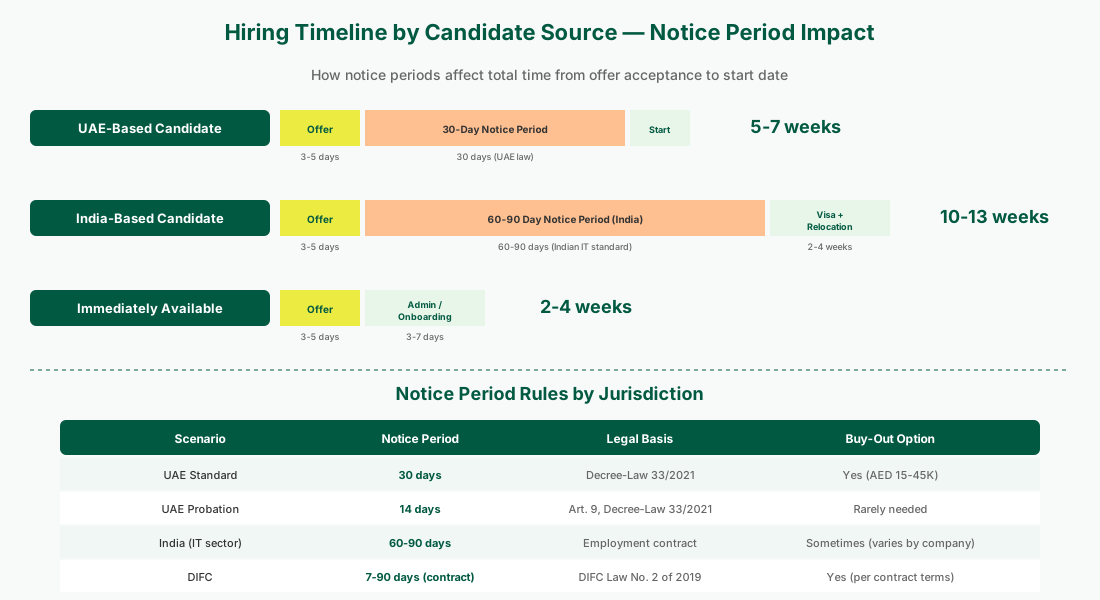
UAE employment law (Federal Decree-Law No. 33 of 2021) sets the standard notice period at 30 calendar days for both employers and employees. Employment contracts can extend this to a maximum of 90 days. During probation (up to 6 months), the notice period drops to 14 days. For tech employers in Dubai, understanding these timelines is critical for planning realistic hiring schedules — especially when sourcing candidates from India, where 60-90 day notice periods are standard.
What Are the Notice Period Rules Under UAE Employment Law?
UAE Federal Decree-Law No. 33 of 2021, which replaced the previous 1980 Labour Law, standardised notice period rules across all employment contracts. The law eliminated the distinction between limited and unlimited contracts, simplifying the framework for employers and employees.
Standard notice period: 30 calendar days, applicable to both resignation and termination. The contract can specify a longer period up to 90 days, but cannot specify less than 30 days. Both parties must honour the notice period — the employee continues working, and the employer continues paying full salary.
During probation: Either party can terminate with 14 days' written notice. According to MOHRE's 2025 Labour Market Report, the average probation period in Dubai tech companies is 3 months, though the law permits up to 6 months.
Immediate termination (without notice): Permitted in specific circumstances defined by Article 44 of the law — including gross misconduct, disclosure of confidential information, or reporting to work under the influence of alcohol or drugs. Employers who terminate without notice outside these grounds must pay the employee's salary for the full notice period.
| Scenario | Notice Period | Legal Basis |
|---|---|---|
| Standard resignation/termination | 30 days (contract may specify up to 90) | Article 43, Decree-Law 33/2021 |
| During probation | 14 days | Article 9, Decree-Law 33/2021 |
| Gross misconduct | Immediate (no notice) | Article 44, Decree-Law 33/2021 |
| DIFC employment | 7-90 days per contract (default 30) | DIFC Law No. 2 of 2019 |
How Does Probation Work for Tech Jobs in the UAE?
Probation periods in UAE tech companies serve as a mutual evaluation window where both employer and employee can exit the relationship with minimal friction. Understanding probation rules helps HR teams structure onboarding expectations and set clear performance milestones.
Maximum duration: 6 months under UAE Federal Law. Probation cannot be extended or renewed — once the specified period ends, the employee automatically transitions to confirmed status. According to the Robert Half 2026 Middle East Employment Survey, 78% of Dubai tech companies set probation at 3 months rather than the maximum 6.
Termination during probation: Either party can terminate with 14 days' written notice. The employer has no obligation to pay end-of-service gratuity for employees terminated during probation. The employee has no obligation to reimburse recruitment or visa costs unless specifically stated in the contract (and even then, such clauses face enforceability challenges under UAE law).
Post-probation protections: After probation ends, the standard 30-day notice period applies. End-of-service gratuity begins accruing from day one of employment (not from the end of probation), calculated at 21 days of basic salary per year for the first 5 years and 30 days per year thereafter.
Probation and visa status: If an international tech worker's employment ends during probation, they receive a 30-day grace period to find new employment or leave the UAE. Workers on Golden Visas retain their residency regardless of employment status.
How Do Notice Periods Affect Time-to-Hire in Dubai?
Notice periods are the single largest variable affecting total time-to-hire in Dubai's tech market. The gap between identifying the right candidate and their actual start date depends heavily on where the candidate is currently employed and what their contract stipulates.
Hiring a candidate currently in Dubai (UAE notice period): Total time from offer to start: 5-7 weeks. Breakdown: offer negotiation (3-5 days), 30-day notice period, and handover/transition (3-5 days). Companies that benchmark salaries correctly and move quickly on offers gain a significant advantage — according to the Hays 2026 GCC Salary Guide, 42% of tech candidates in Dubai receive counter-offers when they resign.
Hiring a candidate from India: Total time from offer to start: 10-13 weeks. Indian IT companies enforce 60-90 day notice periods, and visa processing adds 2-4 weeks. The India-to-Dubai relocation timeline requires careful coordination of document attestation, notice period, and visa processing to avoid delays.
Hiring a candidate currently unemployed or on a Golden Visa: Total time from offer to start: 2-4 weeks. No notice period to serve — only visa processing (if needed) or administrative onboarding. Golden Visa holders can start immediately since they already have valid UAE residency.
The recruitment phase itself — sourcing, screening, and interviewing — adds 15-45 days depending on the approach. According to LinkedIn's 2025 Talent Trends Middle East report, the average time-to-hire for tech roles in Dubai is 45-60 days. Quantalent AI compresses the sourcing and screening phase to an average of 12 days, delivering interview-ready candidates while reducing total time-to-hire by 30-40%.
What Are Common Notice Period Negotiation Strategies?
Effective notice period management can reduce time-to-hire by 2-4 weeks. HR teams in Dubai use several strategies to accelerate candidate availability without violating UAE employment law.
Garden leave agreements. The current employer releases the employee from working duties during the notice period while still paying their salary. The employee cannot start with the new employer during garden leave (they remain employed by the current company), but they can complete visa documentation and relocation logistics. Garden leave is more common in financial services and fintech roles due to client confidentiality concerns.
Notice period buy-outs. The incoming employer offers to compensate the candidate for the salary they would forfeit by leaving early. According to Mercer's 2025 UAE Total Remuneration Survey, 31% of tech companies in Dubai have used buy-outs to secure high-priority hires. Typical buy-out costs for senior tech roles: AED 25,000-45,000 — a fraction of the AED 630,000+ total cost of leaving the position unfilled.
Parallel processing. Starting visa paperwork and relocation logistics during the notice period rather than after. Entry permit applications, document attestation, and housing arrangements can all proceed while the candidate serves notice. Quantalent AI coordinates this parallel timeline for every placement, ensuring candidates are ready to work within days of completing their notice period.
Early release negotiation. Many employers will agree to an early release (2-3 weeks instead of 30 days) if the departing employee completes a proper handover. Approaching the current employer professionally — with a written handover plan — increases the likelihood of early release. Aggressive or confrontational exits rarely result in shortened notice periods.
How Does End-of-Service Gratuity Work in the UAE?
End-of-service gratuity is a mandatory payment under UAE law that affects both hiring costs and retention economics. Understanding gratuity calculations helps employers budget accurately and structure competitive compensation packages.
Calculation formula. UAE Federal Law mandates gratuity based on basic salary (excluding housing, transport, and other allowances): 21 days of basic salary per year for the first 5 years of service, and 30 days of basic salary per year for each subsequent year. The total gratuity cannot exceed 2 years' worth of basic salary regardless of tenure.
Example for a senior engineer earning AED 25,000 basic salary: After 3 years of service, gratuity = (25,000 ÷ 30) × 21 × 3 = AED 52,500. After 7 years: first 5 years = AED 87,500, years 6-7 = (25,000 ÷ 30) × 30 × 2 = AED 50,000, total = AED 137,500.
Gratuity and resignation. Under the 2021 law reform, employees who resign receive full gratuity entitlement regardless of how long they served (previously, employees who resigned before 5 years received reduced gratuity). According to the UAE Ministry of Finance's 2025 Economic Report, the average end-of-service gratuity payment in the technology sector was AED 45,000.
DIFC exception. DIFC operates a Qualifying Scheme (DEWS — DIFC Employee Workplace Savings) that replaced gratuity with a funded pension-like scheme. Employers contribute 5.83% of basic salary monthly for employees with less than 5 years of service, and 8.33% for those with 5+ years. Contributions are invested and the employee receives the accumulated value upon departure.
Still Have Questions About UAE Employment Timelines?
Navigating notice periods, probation rules, and hiring timelines requires planning that starts at the recruitment phase. Quantalent AI's 12-day average time-to-close means your shortlist is ready before competitors even finish sourcing — giving you a head start on the notice period clock.
Get started: Email contact@quantalent.ai or book a free consultation. We'll map out a realistic hiring timeline for your specific roles and candidate sources.