UAE employment visas for tech workers follow a structured process managed by MOHRE (Ministry of Human Resources and Emiratisation) or the relevant free zone authority. Standard work visas take 2-4 weeks and cost AED 5,000-7,500, while Golden Visas offer 10-year residency for qualified tech professionals earning AED 30,000+ monthly. Quantalent AI handles end-to-end visa coordination for every placement, ensuring tech hires relocate without delays.
What Types of UAE Visas Are Available for Tech Workers?
The UAE offers three main visa categories relevant to tech professionals relocating to Dubai in 2026. Each serves a different employment scenario and provides distinct benefits for both employers and employees.
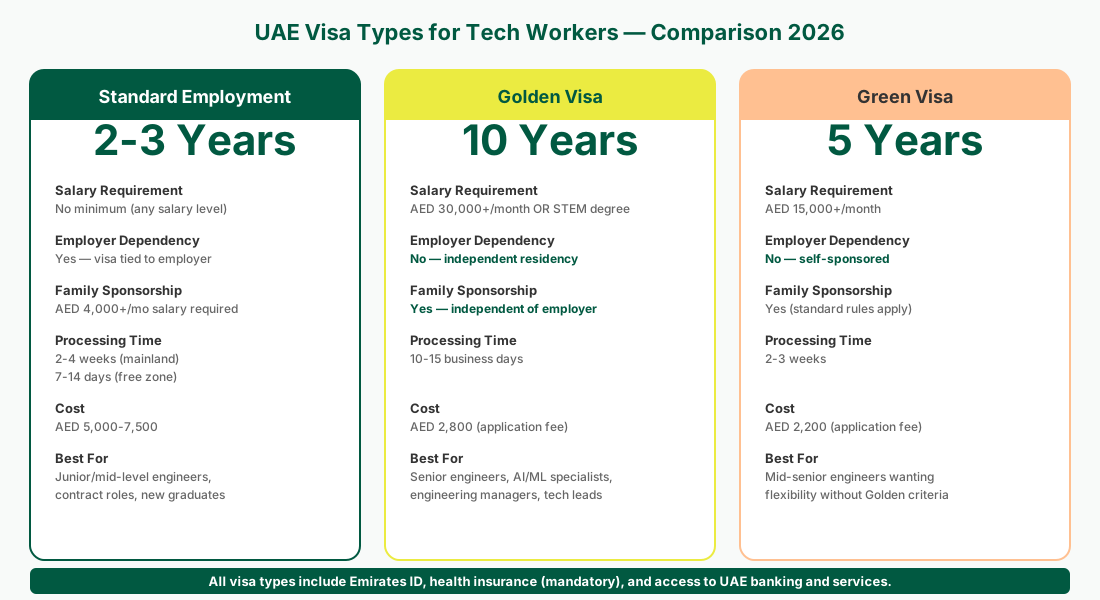
Standard Employment Visa (2-3 years). Issued through MOHRE for mainland companies or through the free zone authority for free zone entities. The employer sponsors the visa, covers all costs, and the employee's residency is tied to continued employment. According to MOHRE's 2025 annual report, over 340,000 new employment visas were issued in the technology sector across the UAE.
Golden Visa (10 years). Available to tech workers meeting salary, education, or specialization criteria. The Golden Visa eliminates employer dependency — if the employee leaves their job, they retain residency while seeking new employment. According to the UAE government's ICA data, Golden Visa issuance grew 65% year-over-year in 2025, with technology professionals representing the fastest-growing category.
Green Visa (5 years). Introduced in 2022 for skilled employees earning AED 15,000+ monthly. Offers self-sponsorship without employer dependency, though it requires higher salary thresholds than standard visas. Particularly useful for senior engineers and tech leads who want flexibility without meeting Golden Visa criteria.
How Does the UAE Golden Visa Work for Tech Professionals?
The UAE Golden Visa grants 10-year renewable residency to qualified tech professionals without requiring continuous employer sponsorship. Engineers, data scientists, AI specialists, and cybersecurity experts qualify through one of three pathways established by UAE Cabinet Resolution No. 56 of 2023.
Salary pathway: Tech workers earning AED 30,000 or more per month (AED 360,000 annually) qualify automatically. According to the Hays 2026 GCC Salary Guide, senior software engineers, engineering managers, and AI/ML specialists in Dubai typically earn above this threshold.
Education pathway: Graduates holding a bachelor's degree or higher in computer science, engineering, AI, data science, or cybersecurity from a university ranked in the top 500 globally (QS or Times Higher Education rankings) qualify regardless of salary. Indian tech professionals from IITs, NITs, BITS Pilani, and IIITs generally qualify under this criterion.
Specialized talent pathway: Workers classified as specialists in priority sectors — artificial intelligence, blockchain, cybersecurity, cloud computing, and semiconductor technology — can apply through nomination by a UAE federal or local government entity.
Golden Visa holders can sponsor family members independently, own property, and maintain UAE residency even during extended travel abroad (up to 6 months). The application fee is AED 2,800, processed through the ICA portal, with approval typically taking 10-15 business days.
How Much Does It Cost to Relocate a Tech Worker to Dubai?
Total relocation cost for an international tech hire ranges from AED 16,000-35,000 depending on the worker's origin country, family size, and the employer's relocation policy. According to Mercer's 2025 International Mobility Survey, Dubai ranks as the 4th most common tech relocation destination globally.
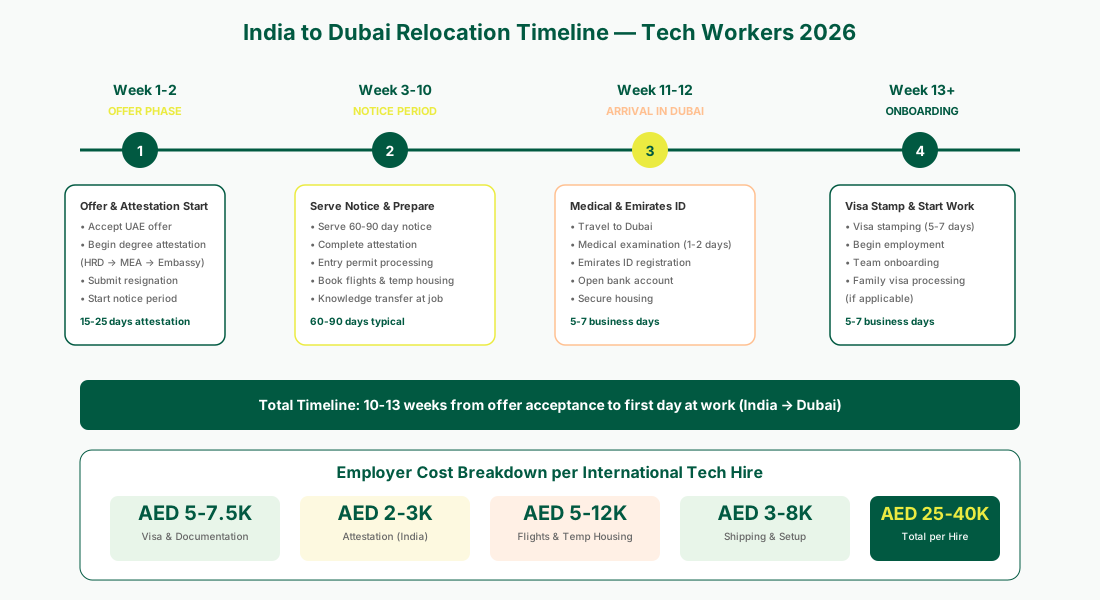
Visa and documentation costs: AED 5,000-7,500 for the employment visa, medical examination, Emirates ID, and insurance. For Indian workers, add AED 2,000-3,000 for degree attestation through MEA and UAE Embassy.
Relocation logistics: One-way flights from India average AED 1,500-3,000 per person. Shipping personal belongings costs AED 3,000-8,000 for a standard container from Mumbai or Bangalore. Temporary accommodation for the first month runs AED 5,000-12,000 depending on location and apartment size.
Housing deposits and setup: Dubai landlords require a security deposit of 5% of annual rent for unfurnished apartments, payable upfront. A two-bedroom apartment in areas popular with tech professionals — JLT, Dubai Marina, Business Bay, Downtown — costs AED 80,000-140,000 annually. According to the Dubai Land Department's 2025 Rental Index, tech hubs like DIFC and Dubai Internet City command 15-25% rental premiums.
Total employer investment per hire: When combining visa costs, relocation support, and the first month's salary advance, employers should budget AED 25,000-40,000 per international tech hire. Compared to the AED 630,000+ cost of a failed hire, proper relocation investment delivers clear ROI.
What Is the Step-by-Step UAE Work Visa Process?
The UAE employment visa process follows a standardized sequence managed by MOHRE for mainland companies or the relevant free zone authority for free zone entities. Understanding each step helps HR teams plan realistic onboarding timelines for international tech hires.
Entry permit (3-5 business days)
The employer submits an entry permit application through the MOHRE portal or free zone system. Required documents include the employee's passport copy, passport photo, offer letter, and attested educational certificates. Approval generates an entry permit valid for 60 days.
Medical fitness test (1-2 business days)
Upon arriving in the UAE, the employee completes a medical examination at an authorized health centre. The test includes blood work (HIV, Hepatitis B/C, tuberculosis screening) and a chest X-ray. Results are typically available within 24-48 hours.
Emirates ID registration (3-5 business days)
The employee registers for an Emirates ID card at an ICA-authorized typing centre. Biometric data (fingerprints, photograph) is captured during registration. The physical ID card arrives by mail within 7-10 days, though the registration number is sufficient for most immediate needs.
Visa stamping (5-7 business days)
MOHRE or the free zone authority stamps the employment visa in the employee's passport. The visa is valid for the duration of the employment contract, typically 2-3 years, and is renewable.
Total timeline: 14-21 business days from entry permit application to completed visa stamping. Companies with established MOHRE accounts and pre-approved quotas can complete the process in 10-14 days. Quantalent AI's recruitment process includes visa coordination to ensure candidates begin work within 2-3 weeks of arrival.
How Do Indian Tech Workers Relocate to Dubai?
India is the largest source of tech talent for Dubai companies, with Indian nationals holding an estimated 40-45% of all tech roles in the UAE according to the Ministry of Overseas Indian Affairs' 2025 data. The India-to-Dubai relocation path has specific requirements that HR teams must plan for.
Notice period management. Indian tech companies typically enforce 60-90 day notice periods, with some enforcing strict 90-day policies. According to NASSCOM's 2025 Industry Report, 67% of Indian IT companies require a minimum 60-day notice. Employers in Dubai should factor this into their hiring timeline — a candidate accepted today may not arrive for 10-13 weeks.
Document attestation from India. Educational certificates require attestation through three authorities before UAE visa processing: the HRD department of the state where the university is located, the MEA (Ministry of External Affairs) in New Delhi, and the UAE Embassy in India. The full attestation chain takes 15-25 business days. Start this process during the notice period to avoid delays after arrival.
CTC-to-package conversion. Indian engineers evaluate offers differently — they compare total CTC (Cost to Company) including employer PF contribution, gratuity, variable pay, and stock options. A detailed guide on converting Indian CTC to UAE packages helps employers make competitive offers that Indian candidates can accurately compare.
Banking and financial setup. New arrivals need a UAE bank account (requires Emirates ID), which takes 3-5 business days. During the first month, employees typically need salary advances or corporate housing to bridge the gap before their first pay cycle.
Quantalent AI specializes in hiring Indian developers for Dubai roles, managing the full timeline from offer acceptance through onboarding — including notice period negotiation, document attestation guidance, and relocation coordination.
How Does UAE Free Zone Employment Differ From Mainland?
Dubai's free zones — DIFC, DAFZA, DTEC, DMCC, and JAFZA — operate under independent regulatory frameworks that differ from mainland UAE employment law. For tech companies, the choice between free zone and mainland employment affects visa processing, contract terms, and employee rights.
DIFC (Dubai International Financial Centre) uses its own employment law modelled on English common law. DIFC contracts specify notice periods, non-compete clauses, and termination terms independently from UAE Labour Law. According to DIFC Authority data, over 500 fintech and technology companies operate from DIFC as of 2025.
DTEC (Dubai Technology Entrepreneur Campus) in Dubai Silicon Oasis targets tech startups specifically. DTEC offers coworking-to-office scaling, visa quotas starting from 1 employee, and tech startup community benefits. Visa processing through DTEC averages 7-10 business days.
Mainland companies follow UAE Federal Labour Law (Federal Decree-Law No. 33 of 2021), which provides standard protections: 30-day probation notice, end-of-service gratuity (21 days per year for the first 5 years, 30 days per year thereafter), and mandatory health insurance. Mainland entities can work directly with any UAE client without restrictions.
For tech companies choosing between free zone and mainland, the practical difference is often minimal. Free zones offer faster setup, 100% foreign ownership, and simpler visa processing. Mainland offers broader commercial flexibility and no restrictions on client engagement.
Still Have Questions About UAE Visas for Tech Workers?
Navigating UAE visa regulations while hiring international tech talent requires coordination between recruitment, legal, and operations teams. Quantalent AI handles visa and relocation logistics as part of every Dubai placement — from document attestation guidance to onboarding coordination.
Get started: Email contact@quantalent.ai or book a free consultation. We'll walk through the visa process for your specific hiring scenario and timeline.