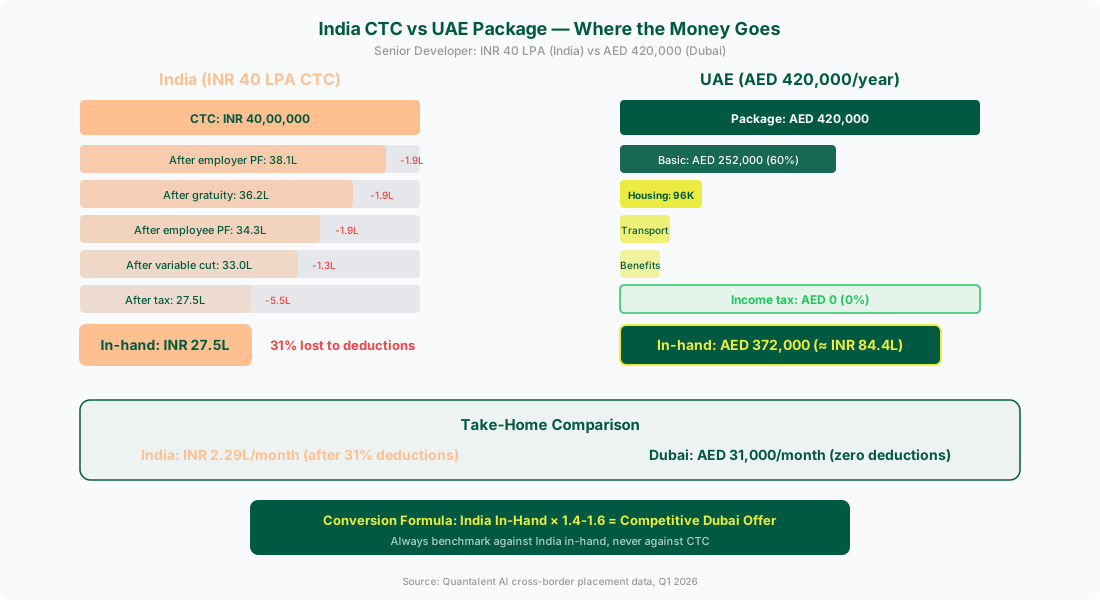
Indian CTC (Cost to Company) includes basic salary, HRA, provident fund, gratuity, and tax deductions — a developer earning INR 40 LPA CTC takes home only INR 28-30 LPA. UAE compensation is simpler and entirely tax-free: basic salary plus housing allowance plus benefits, with gross equalling net. To convert an India CTC to a competitive Dubai offer, calculate the candidate's in-hand salary and add 40-60%. Quantalent AI handles this conversion daily — our dual-office model (Dubai + Bengaluru) means we understand both compensation systems deeply and help employers craft offers that close candidates.
How Does India's CTC Salary Structure Work?
According to the Mercer 2025 Total Remuneration Survey for India, Indian compensation is notoriously complex. A "40 LPA CTC" does not mean the developer takes home INR 40 lakh per year. Here's what actually happens to that money.
Example: Senior Developer at INR 40 LPA CTC
| Component | Annual (INR) | % of CTC | Notes |
|---|---|---|---|
| Basic salary | 16,00,000 | 40% | Foundation for PF, gratuity calculations |
| HRA (House Rent Allowance) | 8,00,000 | 20% | Partially tax-exempt if rent is paid |
| Special allowance | 6,40,000 | 16% | Fully taxable |
| Employer PF contribution | 1,92,000 | 4.8% | 12% of basic, locked until retirement |
| Gratuity | 1,92,000 | 4.8% | Only payable after 5 years of service |
| Medical insurance | 25,000 | 0.6% | Group policy, employer-paid |
| Meal/transport allowances | 1,20,000 | 3% | Partially tax-exempt |
| Variable pay/bonus | 4,31,000 | 10.8% | Performance-linked, not guaranteed |
| Total CTC | 40,00,000 | 100% |
What the developer actually takes home
| Deduction | Amount (INR) |
|---|---|
| CTC | 40,00,000 |
| Minus: Employer PF (not in salary) | -1,92,000 |
| Minus: Gratuity (accrued, not paid) | -1,92,000 |
| Minus: Employee PF (12% of basic) | -1,92,000 |
| Minus: Income tax (~30% bracket) | -5,50,000 |
| Minus: Variable pay (assume 70% payout) | -1,29,000 |
| Annual in-hand | ~27,45,000 |
| Monthly in-hand | ~2,29,000 |
Key insight: A developer with INR 40 LPA CTC takes home approximately INR 27.5 LPA — only 69% of the headline number. When making a Dubai offer, you must benchmark against the in-hand salary, not the CTC.
UAE Compensation Breakdown: Simpler and Tax-Free
UAE compensation is refreshingly straightforward compared to India. There are fewer components, no income tax deductions, and no mandatory provident fund contributions.
Example: Senior Developer at AED 420,000/year
| Component | Annual (AED) | Monthly (AED) | Notes |
|---|---|---|---|
| Basic salary | 252,000 | 21,000 | 60% of package, basis for gratuity |
| Housing allowance | 96,000 | 8,000 | Cash or company accommodation |
| Transport allowance | 24,000 | 2,000 | Cash |
| Annual flight tickets | 5,000 | — | Return ticket to home country |
| Medical insurance | 8,000 | — | Employer-paid (mandatory) |
| End-of-service gratuity | 21,000 | — | Accrued: 21 days basic/year |
| Total package | 406,000 | ~31,000 | Plus gratuity accrual |
What the developer actually takes home
| Item | Amount (AED) |
|---|---|
| Monthly basic + housing + transport | 31,000 |
| Income tax | 0 |
| Pension/PF deduction | 0 |
| Monthly in-hand | 31,000 |
| Annual in-hand | 372,000 |
Key insight: AED 372,000 in-hand in Dubai (tax-free) is the actual comparison point against INR 27,45,000 in-hand in India. At current exchange rates (1 AED ≈ 22.7 INR), that's approximately INR 84.4 LPA in-hand — a 3x increase in take-home pay.
How to Convert an Indian CTC to a Dubai Salary Offer
Here's the framework we use at Quantalent AI for every India-to-Dubai placement:
Step 1: Calculate India in-hand salary
India in-hand = CTC × 0.65–0.72 (depending on CTC level and tax bracket)
Step 2: Apply the Dubai multiplier
Dubai offer = India in-hand × 1.4–1.6 (40-60% premium)
Step 3: Validate against Dubai market benchmarks
Cross-check the calculated offer against current Dubai salary data to ensure it's competitive within the Dubai market, not just relative to the candidate's India salary. For GCC roles beyond Dubai, our GCC tech talent landscape 2026 guide includes salary benchmarks across Saudi Arabia, Qatar, Bahrain, Oman, and Kuwait.
Conversion examples
| India CTC (INR) | India In-Hand (INR) | Dubai Offer Range (AED) | Dubai Monthly (AED) |
|---|---|---|---|
| 15 LPA | ~11 LPA | 180,000-210,000 | 15,000-17,500 |
| 25 LPA | ~18 LPA | 264,000-330,000 | 22,000-27,500 |
| 40 LPA | ~28 LPA | 384,000-480,000 | 32,000-40,000 |
| 60 LPA | ~40 LPA | 504,000-600,000 | 42,000-50,000 |
| 80 LPA | ~52 LPA | 600,000-720,000 | 50,000-60,000 |
| 100+ LPA | ~65+ LPA | 720,000+ | 60,000+ |
Note: Candidates above INR 60 LPA often accept smaller premiums (20-30%) if the role offers career advancement or equity.
5 Mistakes Employers Make with Cross-Border Offers
1. Comparing CTC to CTC
The most common mistake. An employer sees "INR 40 LPA" and offers "AED 250,000" thinking it's a significant increase. But AED 250,000 (INR 56.7 LPA) divided by 12 months is AED 20,800/month — barely more than the candidate's India in-hand of INR 2.29 lakh/month (AED 10,100) after accounting for Dubai's 2-3x higher housing costs. The candidate rejects the offer.
2. Ignoring housing cost differential
Rent in Dubai Marina or JLT (popular areas for tech professionals) is AED 70,000-120,000/year for a 1-bedroom apartment. In Bengaluru's tech corridors (Whitefield, Sarjapur), equivalent housing costs INR 3-5 lakh/year (AED 13,000-22,000). If your offer doesn't include a housing allowance of at least AED 5,000-8,000/month, the candidate's disposable income may actually decrease despite a higher headline salary.
3. Not accounting for India's notice period economics
An Indian developer serving a 90-day notice period forgoes 3 months of potential joining bonuses, loses vested stock options at many companies, and risks counter-offers. Your Dubai offer needs to compensate for this switching cost. Consider a one-time joining bonus of AED 10,000-25,000 for senior hires.
4. Offering in total package instead of base + housing
Candidates evaluate offers based on monthly in-hand, not annual total package. An offer letter stating "AED 420,000 total package" is less compelling than "AED 25,000 basic + AED 8,000 housing + AED 2,000 transport" — even though they're the same number. Break it down.
5. Not explaining the tax-free advantage
Indian candidates are used to seeing 30% of their salary disappear in taxes. Many don't fully appreciate that AED 30,000/month in Dubai equals AED 30,000 in the bank. Explicitly explain: "Your monthly take-home in Dubai will be AED 30,000 — no income tax deductions. This is equivalent to approximately INR 6.8 lakh/month in-hand."
How to Negotiate Cross-Border Offers Between India and Dubai
Lead with the tax-free advantage. Calculate and show the candidate their exact take-home comparison. A visual side-by-side showing India in-hand vs Dubai in-hand is more persuasive than any salary number in isolation.
Offer a housing allowance, not company housing. Tech professionals strongly prefer the flexibility of choosing their own accommodation. Cash housing allowance is perceived as higher value.
Include a relocation package. Cover flights, temporary housing for the first month, and a settling-in allowance of AED 5,000-10,000. This removes a major friction point from the candidate's decision.
Provide a joining bonus for senior hires. A one-time AED 15,000-25,000 joining bonus compensates for the notice period serving cost and makes your offer stand out from competitors.
Move fast. According to NASSCOM's 2025 Tech Industry Report, Indian tech professionals receive an average of 2.3 competing offers simultaneously. The first company to make a compelling offer wins 70% of the time.
How Quantalent AI Handles Cross-Border Compensation
Because we operate from both Dubai and Bengaluru, we understand both compensation systems intimately. Here's what we do for every India-to-Dubai placement:
- Verify India compensation — We confirm the candidate's actual CTC structure and in-hand salary, not just the headline number
- Calculate the right Dubai offer — Using our conversion framework and current market data
- Set expectations early — We discuss salary range with candidates before your interview stage, eliminating surprise mismatches
- Advise on structure — We recommend how to split basic, housing, and transport for optimal candidate perception
- Handle negotiation — We mediate between your budget and the candidate's expectations, finding the structure that works for both
"Quantalent's recruitment process accelerated our hiring, delivering a curated shortlist of skilled professionals swiftly while ensuring a perfect cultural fit." — Giridhar Soundararajan, CEO, Barrel Motors
Need Help Structuring Cross-Border Offers?
Getting compensation right is the difference between closing your top candidate and losing them to a competitor. Quantalent AI provides free salary benchmarking and offer structuring advice for India-to-Dubai tech hires.
Get started: Email contact@quantalent.ai or book a consultation. We'll share our conversion data and help you build offers that close candidates — at a budget that works for your company.