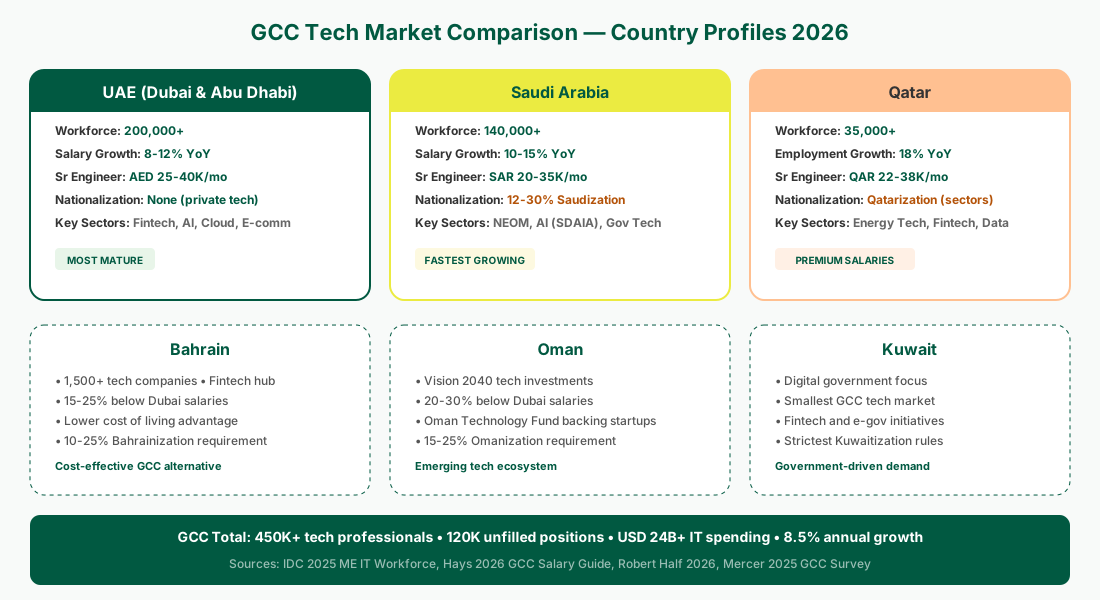
The GCC tech talent market in 2026 employs approximately 450,000 technology professionals across six countries, with an estimated 120,000 unfilled positions and total IT spending exceeding USD 24 billion. According to IDC's 2025 Middle East IT Workforce report, demand for tech talent is growing at 15-20% annually while the talent supply grows at only 7-9% — creating a structural shortage that defines hiring strategy across the entire Gulf region. Quantalent AI operates across the GCC, placing tech professionals in Dubai, Riyadh, Doha, and the wider Middle East through AI-powered sourcing combined with domain expert validation.
What Does the Tech Talent Market Look Like Across the GCC?
Each GCC country has a distinct tech ecosystem shaped by its economic diversification strategy, regulatory environment, and workforce demographics. Understanding these differences is essential for companies planning regional hiring.
UAE: The Regional Tech Hub
The UAE — primarily Dubai and Abu Dhabi — hosts the largest and most mature tech ecosystem in the GCC. According to DMCC's 2025 Free Zone Report, 4,500+ technology companies operate across the emirates' free zones.
Market profile: 200,000+ tech professionals, 50+ nationalities, annual salary growth of 8-12%. Dubai's tech sector benefits from zero income tax, world-class infrastructure, and a cosmopolitan lifestyle that attracts international talent. Abu Dhabi's Hub71 and ADGM (Abu Dhabi Global Market) have emerged as fintech and AI centres.
Key challenge: Intense competition for talent. With 2.5 open positions per qualified candidate, companies that don't move fast on offers lose candidates to competitors. According to the Hays 2026 GCC Salary Guide, 42% of tech professionals in the UAE receive counter-offers when they resign.
Hiring strategy: Combine local sourcing with India pipeline for volume. Use AI-powered recruitment to compress sourcing time from weeks to days.
Saudi Arabia: The Fastest-Growing Market
Saudi Arabia's Vision 2030 has transformed the Kingdom into the GCC's fastest-growing tech market. According to the Saudi Ministry of Communications and IT, the digital economy grew 35% year-over-year in 2025, with Riyadh positioning itself as a regional technology capital.
Market profile: 140,000+ tech professionals, salary growth of 10-15% annually. NEOM, the Red Sea project, and government-backed tech initiatives are creating massive demand for AI engineers, cloud architects, and cybersecurity specialists. The Saudi Data and AI Authority (SDAIA) alone has driven thousands of AI-related job openings.
Key challenge: Saudization (Nitaqat system). The Saudi government mandates minimum percentages of Saudi nationals in private-sector companies. Tech companies in the "Green" and "Premium Green" bands must maintain 12-30% Saudi employment depending on company size. According to HRDF (Human Resources Development Fund) 2025 data, only 8% of Saudi nationals work in technology roles — creating a significant gap between quota requirements and available Saudi tech talent.
Hiring strategy: Hire Saudi nationals for roles where they're available (project management, business analysis, QA), source internationally for deep technical roles with Nitaqat exemptions, and invest in Saudi graduate training programmes. Quantalent AI assists with both international sourcing and identifying Saudi tech talent for quota compliance.
Qatar: Premium Compensation, Smaller Scale
Qatar's tech market is smaller but offers premium compensation, particularly for roles connected to the energy sector, financial services, and the Qatar National Vision 2030 programme.
Market profile: 35,000+ tech professionals, highest absolute salaries for oil and gas technology roles. Qatar Foundation's technology initiatives and the Qatar Financial Centre (QFC) drive demand for fintech and data engineering talent. According to the Qatar Planning and Statistics Authority's 2025 Labour Force Survey, tech sector employment grew 18% year-over-year.
Key challenge: Small candidate pool. Qatar's total population (2.9 million) limits the local talent supply, making international recruitment essential for nearly all tech hiring. Qatarization requirements (similar to Saudization) apply to certain sectors.
Hiring strategy: Source almost entirely internationally. Focus on candidates willing to relocate for premium packages. India, Pakistan, and Egypt are primary source countries.
Bahrain, Oman, and Kuwait: Emerging Markets
Bahrain positions itself as a fintech-friendly alternative to the UAE, with the Central Bank of Bahrain supporting digital banking innovation. Lower cost of living and competitive tech salaries (15-25% below Dubai) attract companies seeking cost-effective GCC presence. The Bahrain Economic Development Board reports 1,500+ tech companies operating from the island.
Oman is investing in technology through its Oman Vision 2040 plan, with the Oman Technology Fund backing startups and digital transformation projects. Tech salaries are 20-30% below UAE levels, but growing. Omanization requirements mandate minimum percentages of Omani nationals.
Kuwait has the smallest tech ecosystem among GCC states but is investing in digital government services and fintech. Kuwaitization requirements are the strictest in the GCC, with high quotas for private-sector companies.
What Are Tech Salary Benchmarks Across the GCC?
Salary benchmarks vary significantly by GCC country, role, and seniority. The following data combines Hays 2026 GCC Salary Guide, Robert Half 2026 Middle East Salary Guide, and Mercer's 2025 GCC Total Remuneration Survey data with Quantalent AI's placement records.
Software Engineering Salaries by Country (Monthly, Local Currency)
| Role | UAE (AED) | Saudi (SAR) | Qatar (QAR) | Bahrain (BHD) |
|---|---|---|---|---|
| Junior Developer | 8,000-12,000 | 7,000-11,000 | 8,000-13,000 | 350-500 |
| Mid-Level Engineer | 15,000-25,000 | 13,000-22,000 | 15,000-25,000 | 550-850 |
| Senior Engineer | 25,000-40,000 | 20,000-35,000 | 22,000-38,000 | 800-1,300 |
| Engineering Manager | 35,000-55,000 | 28,000-45,000 | 32,000-50,000 | 1,100-1,800 |
| CTO / VP Eng | 50,000-80,000+ | 40,000-70,000+ | 45,000-75,000+ | 1,500-2,500+ |
Specialist Role Premiums (GCC-Wide)
Specialist roles command significant premiums above general software engineering rates. According to IDC's 2025 GCC IT Skills Gap Analysis, specialist premiums range from 15-40% above baseline engineering salaries.
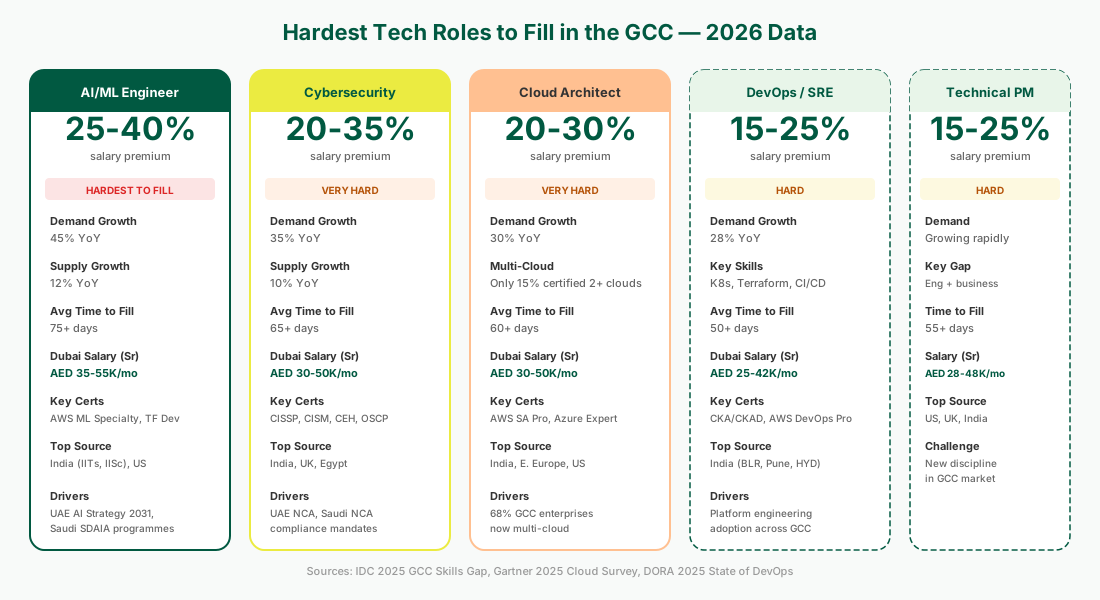
AI/ML Engineers: 25-40% premium. The UAE's AI Strategy 2031 and Saudi Arabia's SDAIA investments have driven demand far beyond supply. Senior AI engineers in Dubai command AED 35,000-55,000/month. Companies compete with global remote employers offering US-level compensation.
Cybersecurity Professionals: 20-35% premium. UAE's National Cybersecurity Authority and Saudi Arabia's National Cybersecurity Authority (NCA) have mandated compliance frameworks that require dedicated security teams. Cybersecurity hiring in Dubai often requires candidates with CISSP, CISM, or CEH certifications plus hands-on penetration testing or incident response experience.
Cloud Architects (AWS/Azure/GCP): 20-30% premium. Multi-cloud expertise commands the highest premiums. According to Gartner's 2025 Cloud Infrastructure Survey, 68% of GCC enterprises now use multiple cloud providers, creating demand for architects who can design across AWS, Azure, and GCP.
DevOps/SRE Engineers: 15-25% premium. Kubernetes expertise, infrastructure-as-code (Terraform, Pulumi), and CI/CD pipeline design are the most sought-after DevOps skills in the GCC. According to the DORA 2025 State of DevOps Report, GCC companies that adopted platform engineering practices reduced deployment failures by 40%.
Technical Product Managers: 15-25% premium. Product managers with engineering backgrounds who can bridge technical and business teams are exceptionally scarce in the GCC. Most technical PMs in the region are hired internationally from US, UK, or Indian tech companies.
Should You Hire Locally or Build an Offshore Team?
The offshore versus local debate is central to GCC tech hiring strategy. The right answer depends on your product's regulatory requirements, team collaboration needs, and budget constraints.
When to Hire Locally in the GCC
Data sovereignty requirements. UAE's PDPL (Personal Data Protection Law) and Saudi Arabia's PDPL impose restrictions on where certain data can be processed. Financial services, healthcare, and government technology projects often require local engineering teams with security clearances.
Customer-facing engineering. Engineers who interact directly with regional clients, adapt products for Arabic-language markets, or need deep understanding of local business practices should be based in-country.
Technical leadership. Engineering managers, architects, and team leads benefit from co-location with stakeholders. According to the McKinsey 2025 Hybrid Work Productivity study, technical leadership roles lose 20-30% coordination efficiency in fully remote setups.
When to Build Offshore (Typically India)
Execution at scale. Building a 10-20 person development team locally in the GCC takes 6-12 months given notice periods, visa processing, and limited candidate pools. An offshore team in India can be assembled in 4-8 weeks at 40-60% lower cost. According to NASSCOM's 2025 Industry Report, India produces 1.5 million new engineering graduates annually — providing scale that no GCC country can match locally.
Niche technical skills. When the GCC candidate pool has fewer than 50 qualified candidates for a specific technology (Rust, Elixir, blockchain L2 protocols, quantum computing), offshore sourcing is the only realistic option.
Cost optimisation. A senior engineer in Bangalore costs INR 40-60 LPA (AED 180,000-270,000 equivalent) versus AED 370,000-560,000 in Dubai for comparable skills. The CTC comparison guide details the cost differential accounting for all compensation components.
The Hybrid Model: Best of Both Worlds
Most successful GCC tech companies operate a hybrid model: local architects and team leads for strategic direction and stakeholder management, with offshore teams in India for development execution. According to the Everest Group's 2025 GCC-India Corridor Report, 72% of GCC enterprises with 100+ tech employees use some form of hybrid onshore-offshore model.
Recommended structure:
- Onshore (GCC): CTO/VP Engineering, senior architects, engineering managers, security engineers, DevOps leads, product managers
- Offshore (India): Mid-level developers, QA engineers, data engineers, junior-to-mid DevOps engineers, support and maintenance teams
- Flexible: Senior engineers who can work effectively in either location
Quantalent AI supports both models — sourcing local talent for Dubai offices and Indian engineers for GCC companies through the same AI-powered platform.
How to Hire for the Hardest Tech Roles in the GCC
Five role categories consistently challenge GCC employers with time-to-fill exceeding 60 days and frequent offer rejections.
AI/ML Engineers
Why it's hard: According to IDC's 2025 GCC Skills Gap Analysis, AI/ML demand grew 45% year-over-year while supply grew only 12%. The UAE's AI Strategy 2031 and Saudi Arabia's SDAIA programmes are creating thousands of positions simultaneously. Candidates with production ML experience (not just academic research) are especially scarce.
How to hire them: Source globally — AI talent operates in a borderless market. Offer Golden Visa sponsorship (most senior AI engineers qualify via the AED 30,000+ salary pathway). Provide compelling technical challenges and access to large-scale data — AI engineers choose roles based on the problem, not just the package. Quantalent AI's AI/ML specialist recruitment leverages deep sourcing in India's AI research hubs (IITs, IISc, IIIT Hyderabad) where pipeline quality is highest.
Cybersecurity Professionals
Why it's hard: Regulatory mandates from UAE NCA, Saudi NCA, and Qatar's National Cybersecurity Agency (NCSA) require dedicated security teams. According to Gartner's 2025 Security and Risk Management Survey, 55% of GCC enterprises report cybersecurity talent shortages as a top-three risk factor. Certified professionals (CISSP, CISM) are in especially short supply.
How to hire them: Offer premium packages (20-35% above engineering baseline), emphasise regulatory importance and career impact, and consider candidates from adjacent fields (network engineering, systems administration) who can be upskilled. Contract cybersecurity specialists through staffing agencies for project-based compliance work.
Cloud Architects
Why it's hard: Multi-cloud expertise (AWS + Azure + GCP) is the new standard, but most engineers specialise in one platform. According to Gartner's 2025 Cloud Infrastructure Survey, only 15% of cloud engineers in the GCC hold certifications across two or more providers.
How to hire them: Prioritise AWS-certified architects (largest market share in GCC) who have working knowledge of at least one additional cloud. Sponsor multi-cloud certification for promising candidates post-hire. Senior cloud architects often hold existing Golden Visas, reducing visa processing time.
DevOps/SRE Engineers
Why it's hard: The shift from traditional operations to DevOps and platform engineering has created demand for a skill set that combines infrastructure expertise with software engineering practices. According to the DORA 2025 State of DevOps Report, companies with mature DevOps practices deploy 208x more frequently than low performers — creating a direct business case for DevOps investment.
How to hire them: Look for candidates with hands-on Kubernetes experience, Terraform/infrastructure-as-code proficiency, and CI/CD pipeline design skills. India's DevOps talent pool is the deepest in the region — source from Bangalore, Pune, and Hyderabad where DevOps culture is mature.
Technical Product Managers
Why it's hard: Product management is a relatively new discipline in the GCC. Most regional PMs come from business or marketing backgrounds, not engineering. Companies seeking technical PMs who can read code, understand system architecture, and translate between engineering and business struggle to find candidates locally.
How to hire them: Source from US, UK, or Indian tech companies where product management is a mature discipline. Accept that technical PMs in the GCC command premium salaries due to scarcity. Consider promoting strong senior engineers into PM roles with structured training.
What Nationalization Policies Affect Tech Hiring in the GCC?
Every GCC country except the UAE (which has no quota for private tech companies) mandates minimum percentages of national employees. These policies directly impact hiring plans, timelines, and costs.
Saudi Arabia (Nitaqat/Saudization). Companies are categorised into bands based on their Saudization percentage — Platinum, Green, Yellow, Red. Tech companies must maintain 12-30% Saudi employment depending on size. According to HRDF 2025 data, non-compliant companies face work permit restrictions and fines. Saudi nationals in tech roles command 20-40% salary premiums over expatriates at equivalent levels due to demand from quota requirements.
Qatar (Qatarization). Applies primarily to government and semi-government entities, with increasing pressure on private-sector companies. Financial services and energy companies face the strictest quotas. Tech companies with government contracts must demonstrate Qatarization compliance.
Bahrain (Bahrainization). The Labour Market Regulatory Authority (LMRA) sets sector-specific quotas. Technology companies face moderate requirements (10-25%) with government-subsidised training programmes for Bahraini nationals entering tech careers.
Oman (Omanization). The Oman Ministry of Labour mandates sector-specific quotas with penalties for non-compliance. Technology is classified as a priority sector for Omanization, with requirements of 15-25% depending on company size.
UAE. No Emiratization quota exists for private-sector technology companies, though the government encourages Emirati employment through Nafis programme incentives. According to the Nafis 2025 Annual Report, Emirati participation in private-sector technology roles grew 28% year-over-year — driven by training subsidies and salary top-ups rather than mandates.
Practical impact on hiring strategy: Factor in nationalisation requirements from the start. Budget for national-hire salary premiums, identify roles where nationals can contribute effectively (project management, QA, technical writing, customer-facing engineering), and invest in graduate programmes to build a national tech talent pipeline.
How to Plan a GCC-Wide Tech Hiring Strategy
Companies operating across multiple GCC countries need a coordinated approach that accounts for regulatory differences, salary variations, and sourcing challenges in each market.
Centralise sourcing, localise compliance. Use a single recruitment partner with GCC-wide reach rather than engaging separate agencies in each country. Quantalent AI operates across the UAE, Saudi Arabia, Qatar, and the wider GCC — providing consistent candidate quality and sourcing methodology while adapting to local regulatory requirements.
Build salary bands by country and role. Avoid the mistake of applying Dubai salary bands across the GCC. Saudi Arabia and Bahrain salaries are 10-25% lower for comparable roles. Qatar matches or exceeds Dubai for energy-adjacent technology roles. Create country-specific salary bands benchmarked against current local data, not regional averages.
Stagger hiring across countries. Processing timelines differ: UAE free zone visas take 7-14 days, Saudi work permits take 4-8 weeks, and Qatar work permits take 3-6 weeks. Factor these differences into project staffing plans.
Invest in internal mobility. Engineers who join in Dubai may be willing to transfer to Riyadh or Doha for career advancement. Internal mobility across GCC offices is faster and cheaper than external recruitment — the engineer already has regional context and company knowledge.
Your GCC Hiring Readiness Checklist
- Market intelligence: Benchmark salaries by country using current (2025-2026) data, not older surveys
- Nationalisation compliance: Map quota requirements for each GCC country where you operate
- Sourcing strategy: Define onshore vs offshore split by role type and seniority
- Specialist pipeline: Identify hardest-to-fill roles and start sourcing 8-12 weeks ahead
- Visa planning: Map visa types and processing timelines by country
- Compensation structure: Create country-specific packages accounting for cost-of-living differences
- Recruitment partner: Engage a partner with cross-GCC capabilities and AI-powered sourcing
Ready to Hire Across the GCC?
Whether you're scaling in Dubai, launching in Riyadh, or building a pan-GCC technology team, Quantalent AI provides a single recruitment partner for the entire region. Our AI-powered sourcing scans 25+ platforms while domain experts validate every candidate — delivering a 3:1 interview-to-hire ratio across markets.
Get started: Email contact@quantalent.ai or book a free consultation. We'll map your GCC hiring strategy by country, role, and timeline.