GCC India talent retention starts before the hire. Capability centers in Bangalore, Hyderabad, Pune, and Chennai are losing senior engineers to startups at attrition rates above 22 percent, while employer branding gaps leave 45 percent of mid-level engineers unable to name three GCCs they would work for. Quantalent AI helps GCC leaders design EVPs that compete with startup equity, build India-specific employer brand channels, and reduce regrettable attrition by hiring the right candidates in the first place.
Why Is Retention Harder at India GCCs Than Other Employers?
Retention at India GCCs is structurally harder than at product startups or traditional IT services for three specific reasons. Attrition data from Aon's 2025 India Salary Increase Survey shows voluntary attrition averaging 16 to 22 percent across GCCs, with AI/ML and senior engineering roles spiking to 25 to 30 percent. The same survey puts product startup attrition at 18 to 24 percent and IT services at 14 to 18 percent, so GCCs are not uniformly the worst, but they lose senior talent faster than either comparison group.
The root cause is rarely compensation alone. NASSCOM's 2025 GCC India Report found that 42 percent of senior engineers leaving GCCs cited limited career progression as their top reason, 28 percent cited lack of ownership over product outcomes, and only 19 percent cited base salary gaps. The career-ceiling problem is specific to the GCC model: engineers report to a headquarters function that sets the strategy, leaving India teams to execute rather than decide. Engineers with 6 to 10 years of experience view this as a growth ceiling, even when compensation is competitive.
The brand invisibility problem compounds everything else. Most GCCs operate under a parent brand that has strong consumer recognition in Europe or North America but near-zero employer brand in India. A European insurer's Bangalore GCC competes for the same engineers as Flipkart, Razorpay, and Google.
When an engineer reads two offer letters, the startup offer wins on recognition even when the GCC offer wins on total value. The retention fix has to address all three layers, and employer branding is where it starts.
What Should an India GCC EVP Include in 2026?
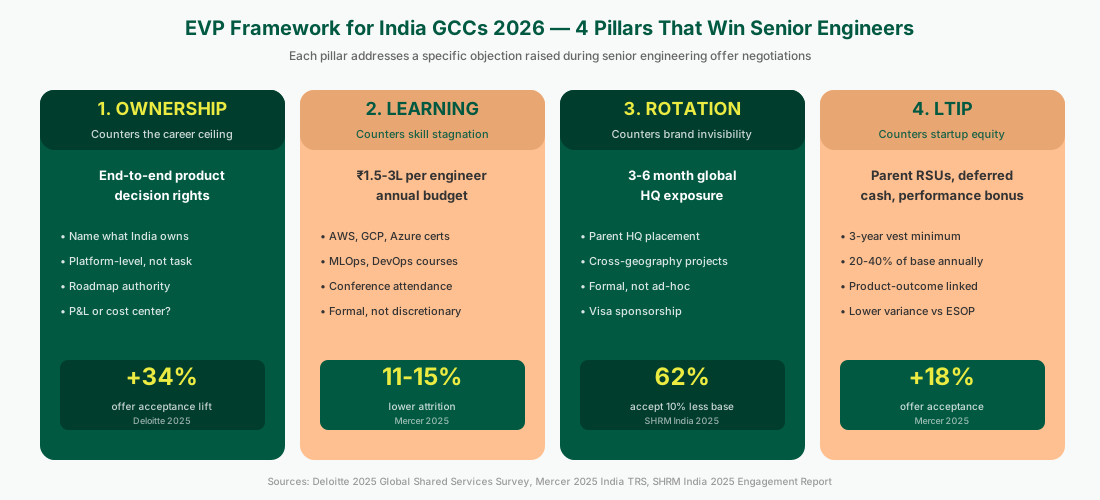
An Employee Value Proposition (EVP) for an India GCC in 2026 needs four pillars that specifically counter the objections senior engineers raise when evaluating offers: career ceiling, brand invisibility, ownership gaps, and equity mismatch. Generic corporate EVPs that lead with "global company, stable career" underperform because they fail to name the specific thing engineers are weighing against.
Pillar 1: Ownership and decision rights. Name what the India team owns end-to-end. "India GCC owns the Payments platform globally" is a substantive claim an engineer can verify. Vague statements like "strategic role in global operations" fail the test. Deloitte's 2025 Global Shared Services Survey found that GCCs articulating specific ownership see 34 percent higher offer acceptance among engineers with 5+ years of experience.
Pillar 2: Learning and certification budgets. Engineers at top India GCCs now expect 1.5 to 3 lakh rupees per year in individual learning budgets covering AWS, GCP, Azure certifications, MLOps courses, and conference attendance. According to Mercer's 2025 India Total Remuneration Survey, GCCs offering formal learning budgets above 1.5 lakh per engineer see 11 to 15 percent lower voluntary attrition than GCCs offering training on a discretionary basis.
Pillar 3: International rotation and global exposure. A 3 to 6 month rotation at the parent company's headquarters or another global hub is worth 15 to 25 percent premium in perceived compensation for engineers under 35. SHRM India's 2025 Engagement Report found that 62 percent of senior engineers would accept a 10 percent lower base offer if the role included a formal international rotation program.
Pillar 4: Deferred long-term incentives. Base compensation alone cannot compete with startup equity. GCCs winning the talent war offer Long-Term Incentive Plans (LTIPs) in the form of restricted stock units of the parent company, deferred cash bonuses with 3-year vesting, or performance-linked bonuses tied to product outcomes. Mercer's 2025 data shows LTIP-inclusive offers win 18 percent more frequently than base-only offers at comparable total value.
Which Employer Branding Channels Drive Inbound GCC Applications?
Employer branding channels fall into three tiers based on application conversion data from LinkedIn's 2025 India Talent Trends report. Tier 1 channels (engineering content, hackathons, open-source contributions) drive 3x more candidate engagement than Tier 2 (LinkedIn Life pages, employer branding videos) or Tier 3 (job board postings, agency listings). GCCs allocating budget disproportionately to Tier 1 see the fastest returns on branding spend.
Engineering blog content on the GCC's own domain or on Medium is the highest-ROI channel. Posts that walk through actual technical challenges, architecture decisions, or incident postmortems generate 5 to 10x more candidate engagement than corporate PR content. The test is simple: would an engineer share this post in a team Slack? If not, it will not generate applications.
Target 1 to 2 deeply technical posts per month written by actual engineers, not the marketing team.
Hackathon sponsorships and tech meetup hosting sit at the intersection of branding and sourcing. A GCC hosting a monthly MLOps meetup in Bangalore builds name recognition among exactly the engineers they want to hire. According to the Everest Group's 2025 GCC Talent Report, GCCs that host recurring technical meetups see 40 percent of their senior AI/ML hires come from meetup attendees within 18 months. The cost is 2 to 5 lakh rupees per meetup, a fraction of the equivalent agency fee for one senior hire.
Campus ambassador programs at IITs, IIITs, and tier-1 engineering colleges solve the early-career pipeline problem. Rather than recruiting only in the October placement window, GCCs with year-round campus presence build relationships with students across three or four years of their degree. Programs that include hackathon judging, capstone project mentorship, and internship-to-full-time conversion see 60 percent lower cost per hire for entry-level engineers compared to placement-day hiring. For a city-by-city view of where GCC campus programs deliver the strongest pipelines, see our GCC hiring partner guidance for Bangalore.
How Do GCCs Compete With Startup ESOPs in India?
Startup ESOPs at Series C and later create a compensation gap that base salary alone cannot close. A senior engineer joining a Series C Indian SaaS startup in 2026 typically receives 0.1 to 0.3 percent equity, which at a 500 to 800 million dollar valuation translates to 50 lakh to 2 crore rupees in paper value over a 4-year vest. GCCs benchmarking only against peer GCCs miss this comparison set entirely.
GCCs winning senior engineering offers in 2026 are structuring compensation differently. The winning pattern combines a 10 to 15 percent premium on base salary versus startup offers, parent-company RSUs or deferred cash as LTIP, and performance-linked annual bonuses of 20 to 40 percent of base. PwC's 2025 India Workforce Study found that GCCs using this three-part structure win offers against Series C startups 54 percent of the time, compared to 31 percent for base-only GCC offers. For a detailed view of where Bangalore GCC compensation stands today, see our Bangalore GCC software engineer salary benchmarks for 2026.
The other lever is stability framing. Startup equity is optionality with downside risk: a 2023 cohort of Indian SaaS employees saw roughly 35 percent of their ESOP paper value evaporate when valuations reset in 2024 and 2025. GCC LTIP at a listed parent carries lower variance and higher liquidity at vest. Engineers under 35 still prefer startup upside, but engineers with family responsibilities between 32 and 45 increasingly choose the lower-variance path when the total comp gap is within 20 percent.
What Non-Financial Retention Levers Work Best at GCCs?
Non-financial retention levers matter more after year two, when base comp normalization reduces the weight of financial incentives. Gallup's 2024 State of the Global Workplace report found that India knowledge workers cite three non-financial factors as the top retention drivers after 24 months: clarity of role growth path, quality of direct manager, and access to learning opportunities.
Internal mobility programs are the single highest-impact non-financial lever for GCCs specifically. A formal internal transfer policy that allows engineers to move across product areas, functions, or geographies every 24 to 30 months cuts senior attrition by 30 to 40 percent according to SHRM India's 2025 Engagement Report. GCCs that lack internal mobility lose engineers to external roles at the exact career stage (5 to 8 years) when mobility becomes the deciding factor.
Hybrid work flexibility has stabilized at 2 to 3 office days per week as the GCC norm in 2026, down from the 4 to 5 day push that several GCCs attempted in 2024. Attempts to enforce 5-day office mandates triggered 15 to 25 percent attrition spikes at multiple large GCCs in 2024 according to LinkedIn's 2025 India Talent Trends. The retention benefit of flexibility compounds with manager quality: engineers with strong managers and flexible schedules report 4x higher intent-to-stay scores than engineers with rigid schedules regardless of manager quality.
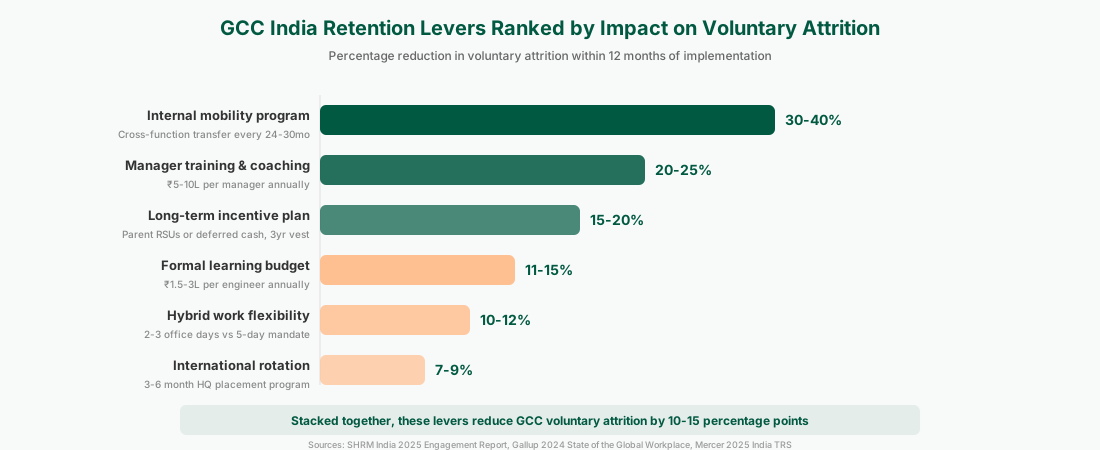
Manager training is the most underrated lever. Gallup's 2024 workplace report identified direct manager quality as responsible for 70 percent of variance in team engagement scores. GCCs that invest 5 to 10 lakh rupees per manager annually in leadership coaching, feedback training, and performance-management frameworks see measurably lower team-level attrition within 12 months. The tactical move is to run a quarterly manager effectiveness survey and intervene on the bottom quartile before attrition follows.
Why Quality Hiring Is the Most Underrated GCC Retention Strategy
The best retention strategy is hiring the right candidate in the first place. An engineer who is a genuine fit for the role, team, and mission stays for 3 to 5 years by default. An engineer hired against type leaves within 12 to 18 months regardless of compensation, learning budget, or manager quality. The math on mis-hires is brutal: replacing a senior engineer at an India GCC costs 150 to 200 percent of annual compensation when accounting for recruiting fees, ramp time, and productivity loss.
Most mis-hires trace to hiring process gaps, not candidate deception. The most common failures include cultural misalignment between the India team and headquarters expectations, technical depth that looks strong on paper but collapses under real problem-solving, and unclear role scope where the candidate accepts a role that turns out to be different from what was pitched. A rigorous pre-hire evaluation process catches these gaps before the offer stage, not after the engineer joins.
Quantalent AI addresses the quality-hiring angle through a dual-validation approach that combines AI sourcing across 25+ platforms with human domain expert interviews before a candidate reaches the client. The outcome metric is the 3:1 interview-to-hire ratio and 98 percent profile-to-interview conversion, which reflect candidates who match the role precisely rather than candidates who match it approximately. GCCs using pre-vetted shortlists report 20 to 30 percent lower 12-month attrition compared to GCCs hiring from generic agency pipelines, because the initial fit is materially better. For a deeper view of current GCC hiring dynamics, see our 2026 GCC hiring trends report.
How Quantalent AI Helps GCCs Hire and Retain Better
Quantalent AI supports India GCCs across the hire-and-retain lifecycle in three specific ways. Sourcing across 25+ platforms identifies passive candidates in specialist communities (research labs, open-source projects, MLOps meetups) that generic agency sourcing misses. Dual-validation reduces mis-hire rates by catching cultural and technical mismatches before the client interview stage. Compensation benchmarking against both peer GCCs and startup alternatives produces offer structures that win the specific comparisons candidates are running.
Quantalent AI's average 12-day time-to-close matters for retention because extended hiring timelines correlate with offer dropouts and post-joining regret. Candidates who wait 60 days for a decision often restart their search in parallel, and those who accept after long delays report lower commitment scores in 90-day surveys. Shorter, rigorous processes produce engineers who show up on day one committed to the role.
Key Takeaways
- GCC voluntary attrition averages 16 to 22 percent in India in 2026, with AI/ML and senior engineering roles at 25 to 30 percent per Aon's 2025 India Salary Increase Survey
- A strong India GCC EVP rests on four pillars: ownership clarity, learning budgets above 1.5 lakh per engineer, international rotation, and LTIP components beyond base compensation
- Engineering blog content, hackathon sponsorships, and campus ambassador programs outperform corporate employer branding channels by 3 to 5x on candidate engagement
- GCCs win senior engineering offers against Series C startups 54 percent of the time when combining 10 to 15 percent base premium, LTIP, and performance bonuses, versus 31 percent for base-only structures
- Hiring quality is the most underrated retention lever: pre-vetted candidates show 20 to 30 percent lower 12-month attrition than candidates hired from generic agency pipelines
Email contact@quantalent.ai or book a free consultation to design a retention-first hiring plan for your GCC in Bangalore, Hyderabad, Pune, Chennai, or tier-2 cities. Quantalent AI builds the sourcing, vetting, and compensation-benchmarking infrastructure that reduces attrition before the engineer joins.