Bangalore wins on talent breadth and niche specialisation access, Hyderabad wins on cost-to-quality ratio and cloud talent depth, Pune wins on automotive/SaaS domain strength and lowest metro attrition, and Chennai wins on BFSI expertise and workforce stability. Quantalent AI recruits across all four cities simultaneously, helping GCC leaders make data-driven location decisions based on their specific role mix, industry focus, and scale timeline — not generic city rankings.
How Does Talent Density Compare Across India's Four Major GCC Cities?
Talent density matters less than talent accessibility — the number of qualified engineers you can actually engage per sourcing effort. For city-level talent pool sizes and salary benchmarks, see our best cities for GCC in India guide. The comparison below focuses on hiring efficiency metrics that basic city profiles miss.
| Hiring Efficiency Metric | Bangalore | Hyderabad | Pune | Chennai |
|---|---|---|---|---|
| Recruiter InMails/Month (avg engineer) | 4.2 | 3.1 | 2.1 | 1.8 |
| Candidate Response Rate | 18-22% | 24-28% | 28-35% | 30-35% |
| Time-to-Fill (mid-level, days) | 28-35 | 25-32 | 30-38 | 32-40 |
| Offer Acceptance Rate | 62-68% | 72-78% | 75-82% | 78-85% |
| Counter-Offer Success Rate | 40% | 28% | 22% | 18% |
Bangalore has the largest talent pool but the worst hiring efficiency. According to LinkedIn's 2025 India Talent Trends, the average mid-level engineer in Bangalore receives 4.2 recruiter InMails per month — double the rate in Pune (2.1) or Chennai (1.8). Hyderabad falls between at 3.1 per month.
Bangalore's recruiter saturation directly impacts sourcing economics for GCCs hiring 50+ engineers. Quantalent AI's sourcing data shows the same effort yields 50-60% more engaged candidates in Pune and Chennai than Bangalore — meaning lower sourcing costs per qualified candidate, even before salary differences come into play.
What Is the Real Cost Difference Between GCC Hiring in Bangalore vs Hyderabad vs Pune vs Chennai?
Salary comparison tables are widely available, but they understate the real cost difference between cities. Total cost of hire includes recruitment fees, notice period management, offer dropout replacement, and first-year attrition replacement — all of which vary significantly by city.
| Total Cost Component | Bangalore | Hyderabad | Pune | Chennai |
|---|---|---|---|---|
| Recruitment Cost/Hire | ₹3.2-4.5L | ₹2.5-3.5L | ₹2.2-3.2L | ₹2.3-3.3L |
| Offer Dropout Rate | 22-28% | 15-20% | 12-18% | 10-15% |
| First-Year Attrition | 18-22% | 14-18% | 14-16% | 13-17% |
| Replacement Cost (per attrited hire) | 1.5-2x CTC | 1.3-1.7x CTC | 1.2-1.5x CTC | 1.2-1.5x CTC |
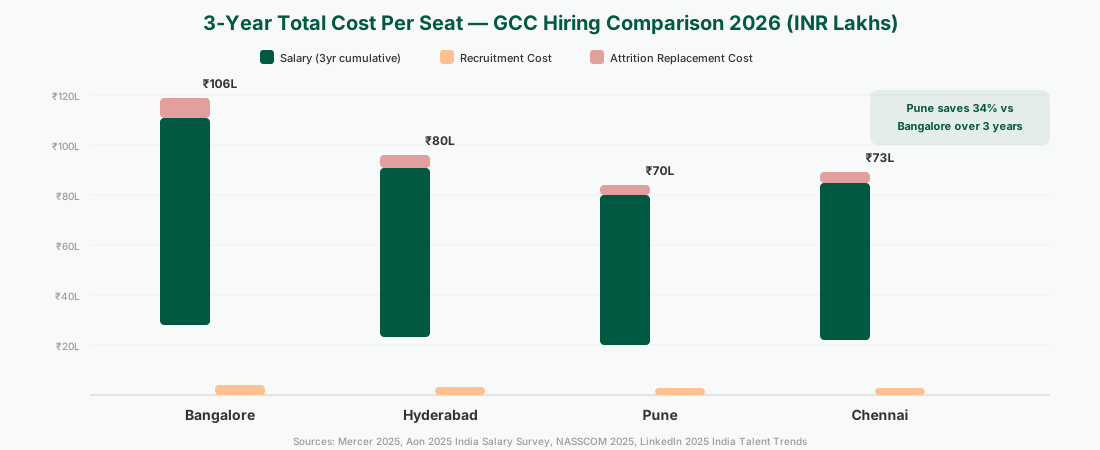
| 3-Year Total Cost/Seat | ₹98-115L | ₹72-88L | ₹62-78L | ₹65-82L |
The 3-year total cost per seat captures the full economic picture. According to Mercer's 2025 India TA Study, replacing an engineer who leaves within 12 months costs 1.5-2x their annual CTC when you include recruitment, onboarding, and productivity ramp-up. Bangalore's higher attrition rate compounds into significantly higher total cost over a 3-year window.
How Do Attrition Patterns Differ Across GCC Cities?
Attrition is not just a percentage — the pattern of who leaves and when varies significantly by city, and understanding these patterns changes hiring strategy.
Bangalore attrition is front-loaded and competition-driven. According to Aon's 2025 India Attrition Study, 60% of Bangalore GCC attrition occurs in the first 18 months, driven by engineers receiving better offers from competing employers. Counter-offers succeed 40% of the time in Bangalore — the highest rate of any Indian city.
Hyderabad attrition is more evenly distributed across tenure bands. Engineers who stay past 2 years in Hyderabad GCCs show significantly higher long-term retention (85% 5-year retention) compared to Bangalore (65%). The city's lower recruiter saturation means engineers receive fewer unsolicited offers, reducing passive attrition triggers.
Pune attrition spikes specifically around the 2-3 year mark, when engineers at automotive GCCs seek product company experience. GCCs that offer rotational programs or product ownership roles reduce this mid-tenure attrition by 30% according to NASSCOM's 2025 workforce data.
Chennai attrition is lowest overall but concentrates in senior roles (8+ years), where limited career progression within Chennai's GCC ecosystem pushes senior engineers toward Bangalore or international relocation. GCCs offering explicit international mobility commitments see 25% lower senior attrition in Chennai.
Which City Should You Choose Based on Your Industry?
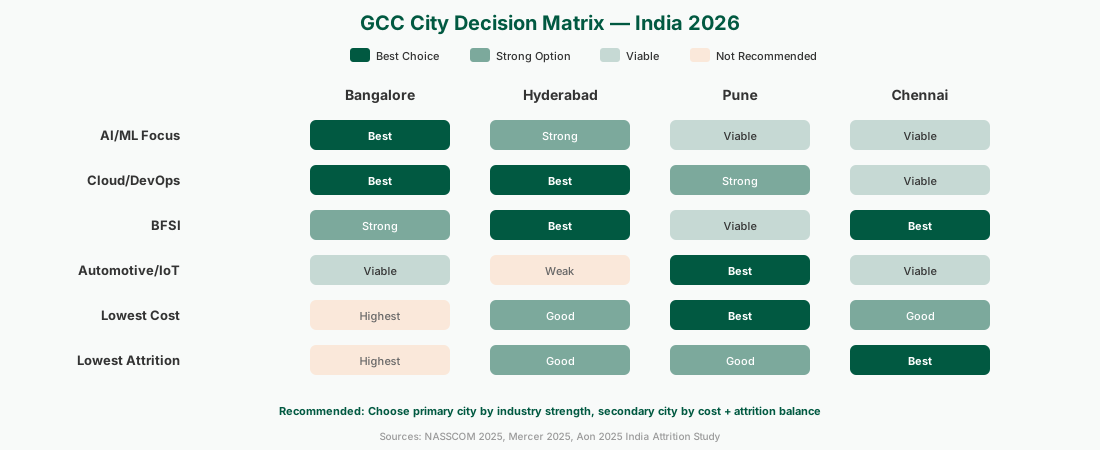
Industry alignment is the most underweighted factor in GCC location decisions. Each city has developed deep talent ecosystems around its anchor industries — hiring against these ecosystems is significantly harder and more expensive.
Choose Bangalore if your GCC focuses on AI/ML, cybersecurity, or cutting-edge technology where the talent pool is shallow nationally. Bangalore concentrates 60% of India's AI/ML professionals and 50% of its cybersecurity talent according to NASSCOM's 2025 AI Talent Report. The premium is worth paying when alternatives simply don't have enough qualified candidates.
Choose Hyderabad if your GCC focuses on cloud infrastructure, BFSI technology, or pharmatech. Amazon, Microsoft, and Google's massive Hyderabad engineering centres have created a deep cloud talent pipeline. BFSI GCCs benefit from proximity to India's second-largest banking cluster.
Choose Pune if your GCC focuses on automotive technology, SaaS, or embedded systems. Volkswagen, Mercedes-Benz, Cummins, and Tata Motors have shaped a talent pool with strong domain expertise in automotive electronics, IoT, and manufacturing-adjacent software.
Choose Chennai if your GCC focuses on BFSI core systems, semiconductor design, or IT services transformation. Chennai's talent pool has the deepest expertise in legacy modernisation, mainframe-to-cloud migration, and financial services compliance — skills that are rare in other cities.
For a broader view including tier-2 alternatives and multi-city strategy recommendations, see our best cities for GCC in India guide.
How Should Multi-City GCCs Split Headcount Across Cities?
Multi-city GCCs outperform single-city operations above 200 employees. According to the Everest Group's 2025 GCC Talent Report, dual-city GCCs report 25% lower aggregate attrition and 18% lower compensation costs compared to single-city equivalents.
The optimal split depends on your function mix. A 300-person GCC with a standard engineering workload might allocate 40% to Bangalore (leadership, AI/ML, architects), 35% to Hyderabad or Pune (mid-level engineering bulk), and 25% to Chennai (BFSI-specific or support functions). Quantalent AI's GCC recruitment services in Bangalore extend across all four cities with unified candidate experience and city-calibrated compensation advisory.
Key implementation detail: stagger city launches by 3-4 months. Starting all cities simultaneously fragments TA attention and produces lower-quality hires. Launch the primary city first, establish hiring manager calibration standards, then replicate those standards to secondary cities with local salary adjustments.
Key Takeaways
- Bangalore offers the widest talent pool (2.1M) but highest costs (₹98-115L 3-year cost per seat) and attrition (18-22%)
- Hyderabad provides the best cost-to-quality balance — 15-20% cheaper than Bangalore with comparable cloud and BFSI talent density
- Pune delivers the lowest metro attrition (14-16%) and strongest automotive/SaaS domain expertise at 20-25% salary savings
- Chennai offers the most stable workforce (13-17% attrition) with deep BFSI and semiconductor talent but slower time-to-fill
- Multi-city GCCs above 200 employees save 18% on compensation costs — stagger city launches by 3-4 months for quality control
Email contact@quantalent.ai or book a free consultation for a city-by-city hiring strategy tailored to your GCC's role mix and scale targets. Quantalent AI provides comparative sourcing data from active mandates across all four cities.