Hiring developers in Dubai in 2026 requires navigating a talent market with 2.5 open positions per qualified candidate, annual tech salaries ranging from AED 120,000 to AED 780,000+, and a hiring process that spans sourcing, visa processing, and relocation coordination. This guide covers every step — from understanding the market to building and scaling your team — with specific data, timelines, and strategies for Dubai's unique hiring environment. Quantalent AI has placed hundreds of tech professionals in Dubai and the wider Middle East, and this guide reflects what actually works in this market.
What Does the Dubai Tech Talent Market Look Like in 2026?
Dubai's technology sector employs over 200,000 professionals across 4,500+ companies, according to DMCC's 2025 Free Zone Report. The market is growing faster than the talent supply — creating a structural shortage that defines every aspect of tech hiring in the emirate.
Demand outstrips supply by 2.5:1. For every qualified candidate available, Dubai companies have 2.5 open positions. According to the Dubai Chamber of Digital Economy's 2025 Annual Report, unfilled tech roles cost UAE businesses an estimated AED 4.2 billion in lost productivity annually.
Salary inflation runs 8-12% annually. Tech salaries in Dubai rose significantly in 2025, driven by competition from international remote employers offering US and European rates to UAE-based talent. Companies using 2024 salary data for 2026 offers lose candidates before negotiations begin.
The talent pool is international. Unlike hiring in Silicon Valley or Bangalore where most candidates are domestic, Dubai's tech workforce draws from 50+ nationalities. Indian engineers represent the largest single group (40-45%), followed by Pakistani, Egyptian, British, Russian, and Filipino professionals. Each nationality brings different notice period norms, salary expectations, and relocation needs.
AI and cloud skills command premiums. According to IDC's 2025 Middle East IT Spending Forecast, AI/ML engineer demand grew 45% year-over-year while supply grew only 12%. Cloud architects, cybersecurity specialists, and data engineers face similar supply constraints. Companies hiring for these roles compete globally, not just locally.
How to Source Developers in Dubai
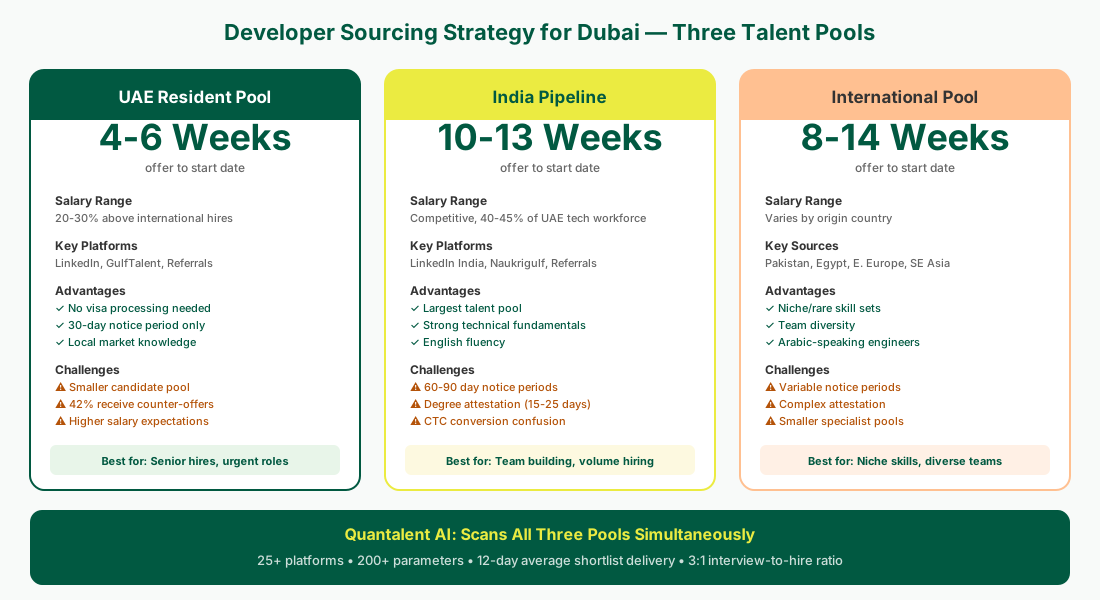
Effective sourcing in Dubai means tapping three distinct candidate pools — each with different timelines, costs, and conversion rates.
Pool 1: UAE-Resident Candidates
Engineers already living in Dubai or the wider UAE offer the fastest path to hiring. No visa processing or relocation required — just serve the 30-day notice period and start.
Where to find them: LinkedIn (82% of UAE tech professionals have active profiles), networking events (GITEX, STEP Conference Dubai, local meetups), referrals from existing employees, and GulfTalent (premium UAE-focused platform).
Advantages: Immediate availability (4-6 weeks to start), no relocation risk, familiarity with Dubai's business culture, existing support network.
Challenges: Smaller pool (high competition for the same candidates), higher salary expectations (20-30% premium over international hires), frequent counter-offers from current employers (42% receive counter-offers per Hays 2026 data).
Pool 2: Indian Engineers
India is the largest and most reliable source of tech talent for Dubai companies. According to the Ministry of Overseas Indian Affairs' 2025 data, Indian nationals hold 40-45% of tech roles in the UAE.
Where to find them: LinkedIn India, Naukrigulf (India-to-Gulf job platform), referrals from existing Indian team members, and direct sourcing from Indian tech hubs — Bangalore, Hyderabad, Pune, and Chennai. Quantalent AI maintains deep sourcing networks across India's major tech cities.
Advantages: Large talent pool with strong technical fundamentals, competitive salary expectations compared to UAE-resident candidates, willingness to relocate, and English fluency.
Challenges: 60-90 day notice periods (plan for 10-13 weeks from offer to start), degree attestation requirements (15-25 days), CTC-to-UAE-package conversion confusion, and cultural adjustment period.
Key planning detail: Start visa documentation and degree attestation during the candidate's notice period — not after. Parallel processing saves 3-4 weeks on the total timeline.
Pool 3: International Candidates
Beyond India, Dubai companies source from Pakistan (particularly Lahore and Islamabad tech hubs), Egypt (Cairo's growing startup ecosystem), Eastern Europe (Ukraine, Poland, Romania), and Southeast Asia (Philippines, Vietnam).
When to use this pool: When specific language skills are needed (Arabic-speaking engineers from Egypt), when building diverse teams, or when India pipelines are saturated for ultra-niche skills.
Platform strategy across all pools: Rather than manually searching each platform, Quantalent AI's AI-powered sourcing scans 25+ platforms simultaneously — LinkedIn, GitHub, Stack Overflow, AngelList, specialist Slack communities, and regional job boards — evaluating candidates across 200+ parameters. The result: a qualified shortlist in 12 days on average, compared to the industry average of 3-6 weeks.
How to Structure Compensation for Dubai Tech Roles
Getting compensation wrong is the fastest way to lose candidates in Dubai's competitive market. Engineers evaluate offers holistically — base salary, housing, flights, equity, and long-term financial trajectory all factor into their decision.
Salary Benchmarks for Common Roles (2026)
| Role | Monthly Base (AED) | Housing (AED/mo) | Total Annual Package (AED) |
|---|---|---|---|
| Junior Developer | 8,000-12,000 | 3,000-5,000 | 120,000-180,000 |
| Mid-Level Engineer | 15,000-25,000 | 5,000-8,000 | 220,000-370,000 |
| Senior Engineer | 25,000-40,000 | 7,000-10,000 | 370,000-560,000 |
| Staff/Principal Engineer | 35,000-50,000 | 8,000-12,000 | 500,000-700,000 |
| Engineering Manager | 35,000-55,000 | 8,000-12,000 | 500,000-780,000 |
| CTO / VP Engineering | 50,000-80,000+ | 10,000-15,000 | 720,000-1,200,000+ |
Source: Hays 2026 GCC Salary Guide, Robert Half 2026 Middle East Salary Guide, Quantalent AI placement data
Package Components That Win Candidates
Housing allowance matters more than base salary. Dubai rents rose 15-20% in 2025 according to the Dubai Land Department Rental Index. An engineer earning AED 30,000 base with AED 10,000 housing allowance is better positioned than one earning AED 35,000 base with AED 5,000 housing. Always benchmark housing against current rental market data, not last year's.
Annual flight tickets. Standard benefit for international hires: 1 annual return ticket to home country. Competitive packages offer tickets for the employee's family too. Cost: AED 3,000-8,000 per family member per year — minor cost with significant retention impact.
Learning and development budget. According to the Josh Bersin Company's 2025 HR Predictions report, companies investing more than 1% of payroll in L&D experience 24% higher retention. Allocate AED 5,000-15,000 per engineer annually for courses, certifications, and conferences.
Equity or profit-sharing. Increasingly common for senior roles, especially at startups. According to the Carta 2025 Equity Benchmarking Report, companies offering equity to engineers below VP level experience 18% lower turnover. For startups, 0.1-0.5% equity for senior engineers is standard in the Dubai startup ecosystem.
Comparing CTC for Indian Candidates
Indian engineers evaluate offers by comparing their current CTC (Cost to Company) against the Dubai package. A candidate earning INR 40 LPA in Bangalore calculates: base salary, employer PF contribution, gratuity, variable pay, and stock options — then compares the total against the Dubai offer minus living costs. The CTC structure comparison guide provides detailed conversion frameworks for making competitive offers.
How to Interview and Assess Developers in Dubai
The interview process determines whether you hire the right person or spend AED 630,000+ on a failed hire 12 months later. According to Harvard Business Review's 2025 Talent Management report, 80% of turnover traces to poor hiring decisions — making assessment quality the highest-ROI investment in your hiring process.
A Three-Stage Assessment Framework
Stage 1: Technical screening (45-60 minutes). A focused technical conversation assessing core competencies for the specific role — not a generic coding quiz. For backend engineers: API design, database modelling, system architecture. For frontend: component design, state management, performance optimisation. For DevOps: infrastructure as code, CI/CD pipeline design, monitoring strategies.
Stage 2: System design or take-home project (60-90 minutes). Senior candidates should demonstrate architectural thinking. Present a realistic design problem relevant to your product: "Design a payment processing system handling 10,000 transactions per minute" or "Architect a real-time notification service for 500K concurrent users." Evaluate reasoning process, trade-off analysis, and communication clarity — not just the solution.
Stage 3: Cultural alignment conversation (30-45 minutes). Not "culture fit" (which often means "someone like us") but cultural alignment — does this candidate's work style, communication preference, and values complement the existing team? According to Gallup's 2025 State of the Global Workplace report, 70% of engagement variance is determined by the direct manager, so include the hiring manager in this conversation.
Common Interview Mistakes in Dubai
Over-relying on LeetCode-style problems. Algorithmic puzzles test memorisation, not engineering ability. Senior engineers who build production systems daily may not have practised competitive programming problems recently — failing them on a LeetCode medium doesn't mean they can't architect your platform.
Ignoring cross-cultural communication. Dubai teams include multiple nationalities with different communication styles. An engineer from India may be more deferential in interviews than an engineer from the UK — both may be equally capable leaders. Assess substance over style.
Skipping reference checks. In a market where candidates receive multiple offers simultaneously, some exaggerate experience or misrepresent previous roles. Reference checks with former engineering managers (not just HR) catch discrepancies that interviews miss.
For a detailed interview playbook, see the best practices guide for interviewing developers in Dubai.
How to Build a Tech Team in Dubai From Scratch
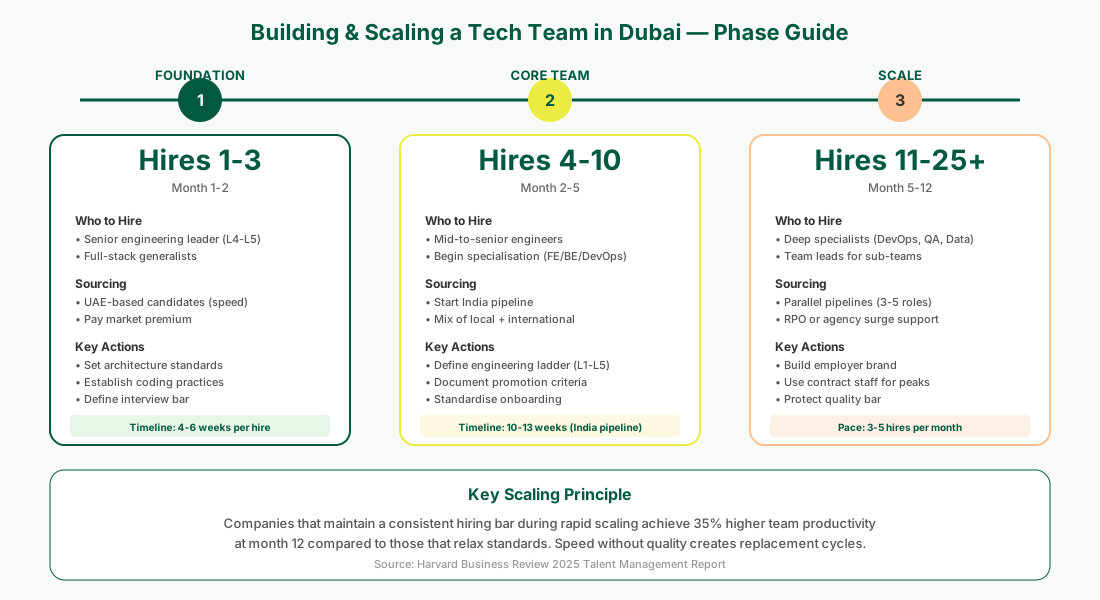
Building a tech team from zero requires different strategies than adding to an existing team. The first 5 hires define your engineering culture, set technical standards, and establish the hiring bar for everyone who follows.
Hire 1-3: The Foundation
Start with a senior engineering leader. Your first hire should be an L4-L5 level engineer (staff or principal) or engineering manager who can make architectural decisions, establish coding standards, and conduct technical interviews for subsequent hires. Hiring junior engineers first without senior guidance creates technical debt that compounds rapidly.
Prioritise versatility over specialisation. Early hires need to wear multiple hats — a full-stack engineer who can handle backend, frontend, DevOps, and occasional product discussions is more valuable at this stage than a deep specialist in one area.
Source locally for speed. Your first hires should be UAE-based to start quickly and build momentum. Local hires serve 30-day notice periods versus 60-90 days from India. Pay the market premium — these foundational hires set the trajectory.
Hire 4-10: Building the Core
Begin sourcing from India. With your foundation in place and senior leadership to onboard new team members, start the India pipeline. Plan 10-13 weeks from offer to start — initiate sourcing for hires 4-10 while onboarding hires 1-3.
Define your engineering ladder. Before hire 4, document your levels (L1-L5), promotion criteria, and compensation bands. Engineers who join without clarity on career progression start looking externally within 18 months. The retention strategies guide covers engineering ladders in detail.
Establish technical interview standards. Document your assessment process so every candidate is evaluated consistently. Quantalent AI's dual-validation approach — where candidates pass both AI assessment and domain expert evaluation before reaching you — reduces your interview burden while maintaining quality.
Hire 11-25: Scaling With Structure
Introduce specialisation. With a core team in place, hire for specific roles: dedicated DevOps engineer, QA lead, data engineer, security specialist. The team is now large enough to benefit from functional expertise rather than pure generalists.
Build your employer brand. Engineers talk to each other. Your first 10 hires' experience — positive or negative — shapes your ability to attract hires 11-25. Invest in tech blog posts, conference talks, and open-source contributions to make your company visible in Dubai's tech community.
Consider contract staffing for project surges. Not every role needs a permanent hire. Contract engineers for 3-6 month engagements handle project peaks without long-term commitment, giving you flexibility during rapid growth.
How to Scale an Engineering Team in Dubai Quickly
Scaling from 10 to 50 engineers in 12 months requires a fundamentally different approach than careful one-by-one hiring. According to the LinkedIn 2025 Talent Trends Middle East report, the top 5% of fastest-growing Dubai tech companies hire at 3-5x the rate of average companies — but only 40% of them maintain quality-of-hire metrics during rapid scaling.
Run parallel pipelines. Source for multiple roles simultaneously rather than sequentially. Each role has its own timeline — a UAE-based senior engineer may close in 5 weeks while an India-based mid-level developer takes 12 weeks. Staggering start dates across pipelines maintains a steady flow of new hires without overwhelming onboarding.
Use recruitment partners for surge capacity. Internal recruiters handle 4-6 open roles effectively. Beyond that, quality drops. Agencies like Quantalent AI provide dedicated sourcing for specific roles, delivering interview-ready candidates without overloading your TA team. For companies hiring 10+ roles, RPO engagements provide embedded recruitment capacity.
Standardise onboarding ruthlessly. Every new hire should receive the same structured 30-60-90 day onboarding plan: week 1 (environment setup, codebase walkthrough, team introductions), month 1 (first small feature shipped), month 2 (independent feature delivery), month 3 (full team contributor). Without standardised onboarding, rapid hiring creates a team of confused individuals rather than a functional unit.
Protect quality of hire. Speed pressure makes it tempting to lower the bar. Resist. Every engineer hired below your standard creates additional management overhead, slows the team, and eventually leaves — creating a replacement cycle that slows scaling further. According to Harvard Business Review's 2025 research, maintaining a consistent hiring bar during rapid scaling correlates with 35% higher team productivity at month 12 compared to companies that relaxed standards.
How to Handle Visas and Relocation for International Hires
Every international tech hire requires visa processing — a step that adds 2-4 weeks for mainland companies and 7-14 days for free zone entities. Planning visa logistics in parallel with notice periods prevents unnecessary delays.
Visa types at a glance: Standard employment visa (2-3 years, employer-sponsored), Golden Visa (10 years, for senior tech professionals earning AED 30,000+/month), and Green Visa (5 years, self-sponsored for AED 15,000+/month). The complete visa FAQ covers eligibility, costs, and processing details for each type.
Relocation budgets for international hires: Budget AED 25,000-40,000 per international hire for visa processing, flights, temporary accommodation, and setup costs. For Indian engineers specifically, add AED 2,000-3,000 for degree attestation. Against the AED 630,000+ cost of a failed hire, relocation investment is minor.
Practical relocation support: Provide a relocation checklist covering housing search areas (JLT, Business Bay, and Dubai Marina are popular with tech professionals), bank account setup (requires Emirates ID), mobile phone SIM, and public transport (nol card). The first month's experience heavily influences whether an international hire stays long-term or starts looking at 12 months.
Your Dubai Tech Hiring Checklist
Use this checklist to plan any tech hiring initiative in Dubai:
- Market intelligence: Benchmark salaries against current data, not last year's surveys
- Sourcing strategy: Define which candidate pools to target (UAE, India, international) based on timeline and budget
- Assessment process: Document a structured interview framework before opening the role
- Compensation structure: Prepare a total package (base + housing + benefits) that competes on market data
- Visa planning: Identify visa type and start documentation early — especially for India-sourced candidates
- Onboarding plan: Prepare a 30-60-90 day structured programme before the hire starts
- Retention foundation: Ensure career ladder, L&D budget, and stay interview cadence are in place
Ready to Start Hiring?
Whether you're building a tech team from scratch or scaling rapidly, Quantalent AI delivers interview-ready candidates within 12 days. Our dual-validation process — AI sourcing across 25+ platforms combined with domain expert evaluation — produces a 3:1 interview-to-hire ratio, meaning less time interviewing and more time building.
Get started: Email contact@quantalent.ai or book a free consultation. We'll map out a hiring plan tailored to your team size, timeline, and budget.