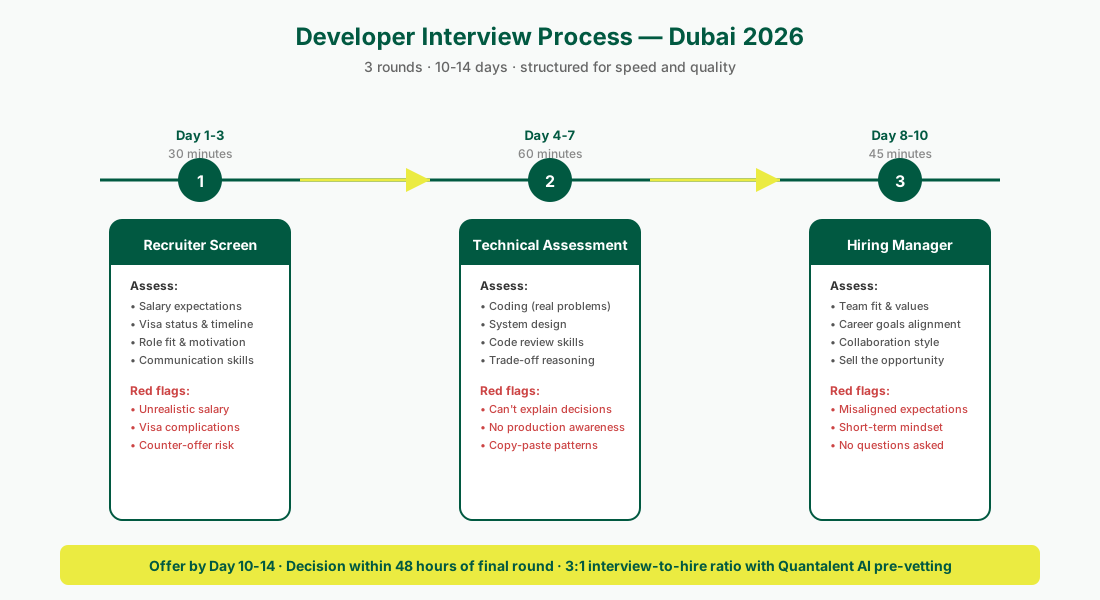
The best interview process for hiring developers in Dubai in 2026 has three rounds completed within 10-14 days: a recruiter screen, a structured technical assessment, and a hiring manager conversation. According to LinkedIn's 2025 Global Talent Trends report, companies that complete their interview process in under two weeks are 3.5x more likely to hire their first-choice candidate. Quantalent AI's process achieves a 3:1 interview-to-hire ratio by front-loading technical vetting before candidates reach your team.
Why Most Dubai Developer Interviews Are Broken
The average time-to-fill for a tech role in Dubai is 48 days. According to the SHRM 2025 Talent Acquisition Benchmarking Report, companies lose 60% of qualified tech candidates during the interview process itself — not because of salary, but because of slow decisions and poorly structured evaluations.
Dubai's interview problem has three root causes:
Too many rounds. Companies run 5-7 interview rounds spanning 4-6 weeks. In a market where senior developers receive 3-5 competing offers (according to the Hays 2026 GCC Salary Guide), every week of delay costs you candidates. The best developers accept offers within 10-14 days of first contact.
Wrong assessments. Whiteboard algorithm puzzles test memorisation, not engineering capability. A senior backend developer who can design a payment processing system at scale shouldn't be rejected because they forgot how to implement a red-black tree from memory.
One-way evaluation. With 2.5 open tech positions per candidate in the UAE, interviews are bilateral. Companies that treat interviews as interrogations rather than conversations lose candidates to companies that sell the opportunity.
How to Write a Tech Job Description That Attracts Dubai Developers
The interview process starts before the first call — it starts with the job posting. According to Indeed's 2025 Job Seeker Behaviour Report, 52% of tech candidates decide whether to apply within 14 seconds of seeing a job description. A vague or poorly structured posting filters out your best candidates before they even enter the pipeline.
What every Dubai tech job description must include
Exact tech stack. "Modern technologies" means nothing. "React 18, TypeScript, Node.js, PostgreSQL, deployed on AWS ECS" tells candidates exactly whether they're a fit. According to Stack Overflow's 2025 Developer Survey, job descriptions listing specific technologies receive 34% more qualified applications.
Salary range in AED. In Dubai's competitive market, 70% of tech candidates skip job postings without a salary range. Include a range — not a single number — and specify whether it includes housing allowance. Example: "AED 28,000-35,000/month base + AED 8,000 housing allowance."
Visa and location details. State clearly: Will you sponsor a new visa? Is visa transfer accepted? Is the role in a free zone (DIFC, DIC, DMCC) or mainland? What's the hybrid policy — 3 days office, 2 days remote? Candidates from abroad need this information to evaluate feasibility. For a full overview of visa categories, gratuity rules, and hiring process steps, see our UAE employment law FAQ for tech companies.
Interview process overview. Tell candidates upfront: "Our process has 3 steps and takes 10-14 days." Transparency about the process reduces dropout rates by 25% because candidates can plan their schedule accordingly.
What makes the role compelling. Go beyond "competitive salary and benefits." What technical problems will they solve? What's the team size and reporting structure? What's the career path from this role? Engineers join companies to build things — tell them what they'll build.
A template that works
[Role Title] — [Company] — [Location/Free Zone]

What you'll build: [2-3 sentences about the technical problems]
Stack: [Specific technologies]
Team: [Size, structure, who you'll report to]
Compensation: AED [range]/month + [housing allowance] + [other benefits]
Visa: [Sponsorship offered / Transfer accepted]
Work model: [Office days] in [location] + [remote days]
Process: [Number of rounds], [estimated timeline]
How to Structure Technical Assessments for Dubai Developer Roles
Technical assessment is where most Dubai companies fail. Either they test the wrong things (algorithm puzzles), test too much (8-hour take-homes), or don't test at all (hire on resume alone).
Stage 1: Async coding challenge (before live interview)
Send a 60-90 minute coding challenge that mirrors real work. Build challenges from actual problems your team has solved — not LeetCode puzzles. A backend challenge might involve building an API endpoint with authentication and rate limiting. A frontend challenge might involve implementing a responsive dashboard component with state management.
Platforms that work well: HackerRank (custom challenges), CodeSignal, or a private GitHub repository with instructions. Keep the time limit strict — candidates juggling 3-5 interview processes can't spend 4 hours on each one.
What to evaluate: Code organisation, error handling, test coverage, and whether the solution would pass a production code review. Do NOT evaluate algorithmic complexity unless the role specifically requires it.
Stage 2: Live system design (during interview)
For mid-to-senior roles, system design reveals more than coding tests. Give candidates a relevant problem: "Design a notification system that handles 10 million users" or "Architect a real-time payment processing pipeline."
What to evaluate: Trade-off reasoning (SQL vs NoSQL, monolith vs microservices), scalability awareness, experience with similar systems, and communication clarity. A senior engineer should explain their design decisions, not just draw boxes and arrows.
Stage 3: Code review exercise (optional, for senior roles)
Present a pull request with 3-5 intentional issues — a security vulnerability, a performance bottleneck, a missing edge case, and unclear naming. Ask the candidate to review it as they would review a teammate's code.
What this reveals: Engineering maturity. Junior developers find syntax issues. Senior developers find architectural problems, ask about context, and suggest alternative approaches.
What Quantalent AI does differently
Quantalent AI's dual-validation approach front-loads this technical evaluation before candidates reach your team. Every candidate is assessed by an AI system across 200+ technical parameters, then evaluated by a domain expert — an engineer who has built production systems in the candidate's technology area. Only candidates who pass both gates appear on your shortlist, resulting in a 3:1 interview-to-hire ratio compared to the industry average of 8:1.
How to Evaluate Cultural Fit in Dubai's Diverse Workforce
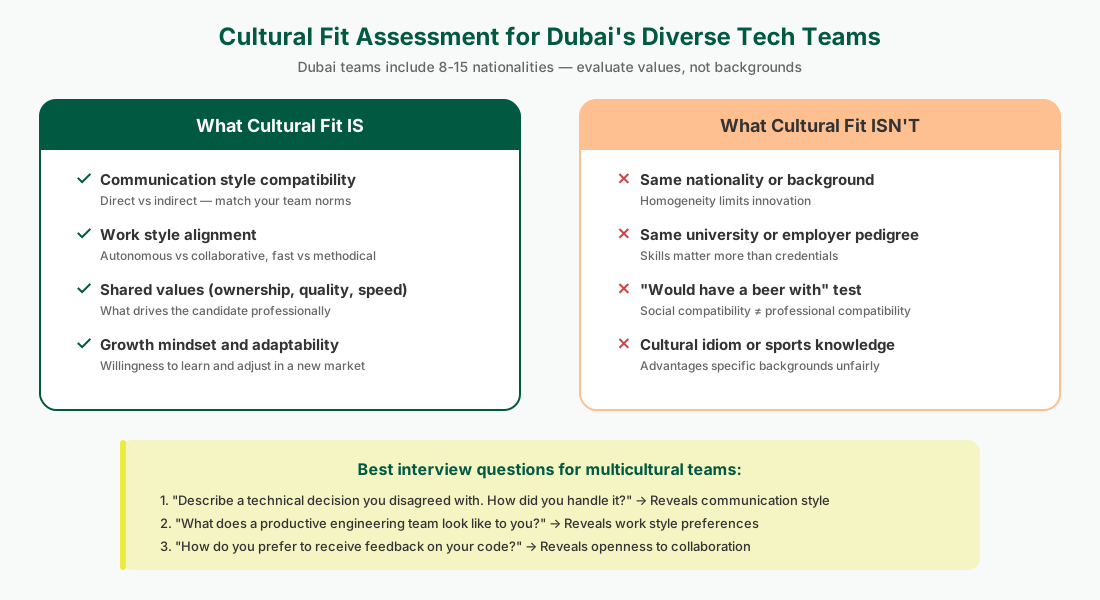
Dubai's tech teams typically include engineers from 8-15 different nationalities. According to the Dubai Statistics Centre, over 200 nationalities live in the emirate. Cultural fit assessment must account for this diversity — it cannot mean "hire people like us."
What cultural fit actually means in Dubai
Communication style alignment. Some cultures are direct (German, Dutch, Israeli); others are indirect (Indian, Japanese, Emirati). Neither is wrong, but your team needs compatible communication norms. Ask scenario-based questions: "How would you tell a colleague their code approach won't work?"
Work style compatibility. Assess whether candidates thrive in your specific environment — autonomous vs collaborative, fast-moving vs methodical, flat vs hierarchical. A senior engineer from a hierarchical Indian IT services company may need adjustment time in a flat startup structure, and vice versa.
Values alignment, not background similarity. Evaluate whether candidates share your team's values (ownership, quality, speed, customer focus) rather than whether they "fit in" culturally. According to Harvard Business Review's 2025 Inclusive Hiring Report, diverse teams outperform homogeneous ones by 35% on innovation metrics when cultural values — not cultural backgrounds — are aligned.
Interview questions that work across cultures
- "Describe a technical decision you disagreed with. How did you handle it?" (reveals communication style)
- "What does a productive engineering team look like to you?" (reveals work style preferences)
- "Tell me about a time you shipped something you weren't fully satisfied with. What were the trade-offs?" (reveals quality standards and pragmatism)
- "How do you prefer to receive feedback on your code?" (reveals openness to collaboration)
Avoid questions that advantage specific cultural backgrounds: sports references, local idioms, or assumptions about educational systems.
5 Common Interview Mistakes That Cost Dubai Companies Top Developers
1. Taking too long to decide
Every week of delay after the final interview increases candidate dropout by 15%. In Dubai's market, the best developers have 3-5 active opportunities. Make a decision within 48 hours of the final round. If you need internal approvals, get them pre-authorised before the interview starts.
2. Not selling the role during the interview
Interviewers spend 100% of the time evaluating and 0% selling. Dedicate 15 minutes per round to answering the candidate's questions about the team, technology, and career growth. According to Glassdoor's 2025 Candidate Experience Survey, 65% of developers rank "interesting technical challenges" above salary when choosing between offers.
3. Testing irrelevant skills
Algorithm puzzles from competitive programming do not predict on-the-job performance for most engineering roles. Test what the job actually requires: building APIs, debugging production issues, designing scalable systems, reviewing code.
4. Inconsistent evaluation across interviewers
Without a structured scorecard, each interviewer evaluates different things. One focuses on algorithms, another on communication, a third on resume credentials. Create a shared rubric with specific criteria and a numerical scale. Every interviewer evaluates the same dimensions.
5. Ignoring the candidate experience
Candidates who have a poor interview experience tell others. In Dubai's tight-knit tech community, word travels fast. Respond within 24 hours after each stage. Provide constructive feedback to rejected candidates. Offer water, coffee, and a comfortable environment for in-person interviews.
Building Your Interview Playbook
The best interview process for hiring software engineers in Dubai follows these principles:
Speed: 3 rounds, 10-14 days, decision within 48 hours of final round.
Relevance: Test what the job requires. Build custom assessments from real problems your team faces.
Structure: Use consistent scorecards. Every interviewer evaluates the same criteria.
Respect: Sell the opportunity. Communicate quickly. Give feedback.
Diversity awareness: Evaluate values and skills, not cultural backgrounds.
Companies that implement this framework consistently report 30-40% improvement in offer acceptance rates and significantly lower 90-day attrition. For companies that want this vetting done before candidates reach their interview pipeline, Quantalent AI's dual-validation process delivers pre-assessed, interview-ready shortlists within 5 business days.
"Quantalent was instrumental in filling our niche roles by tapping into talent from diverse communities and unconventional platforms." — Harsha Kadimisetty, CEO, Aerchain
Ready to Fix Your Developer Interview Process?
Whether you want to redesign your internal process or let Quantalent AI handle the sourcing and technical vetting so your team only interviews pre-qualified candidates, we can help.
Get started: Email contact@quantalent.ai or book a free consultation. We'll share how our 3-round assessment framework and AI-powered vetting deliver a 3:1 interview-to-hire ratio — saving your engineering team 20-30 hours per hire.