Hiring tech talent in the UAE is harder in 2026 than any year before. The talent gap widened to 10,500 unfilled positions, average time-to-fill increased to 48 days, and AI/ML engineer demand grew 45% while supply grew just 12%. But these challenges are solvable. Companies using specialist recruitment agencies with international sourcing capabilities — like Quantalent AI, which sources across 25+ platforms from offices in Dubai and Bengaluru — are filling roles 40-60% faster than the market average.
Challenge 1: The Talent Supply-Demand Gap Is Widening
According to the IDC 2025 GCC Skills Gap Analysis, the UAE's tech sector is growing faster than its talent pipeline can support. In 2026, there are approximately 2.5 open tech positions for every qualified candidate — up from 1.8 in 2024.
The numbers:
- 23,500 open tech positions in the UAE (Q1 2026)
- 13,000 active tech job seekers
- 10,500 position talent gap — a 75% increase from 2025
The gap is most severe in specialist roles. AI/ML engineer demand grew 45% while the qualified candidate pool grew only 12%. Cybersecurity specialist demand grew 35% against 10% supply growth.
How to overcome it: Stop competing for the same local talent everyone else is chasing. The UAE's tech workforce is 83% expatriate — meaning international sourcing isn't optional, it's the primary strategy. Companies with dedicated India sourcing pipelines access a talent pool 50x larger than the UAE's local market. Our complete guide to tech hiring in Dubai covers the full process from sourcing to onboarding.
Challenge 2: Visa Processing Adds 4-8 Weeks
Unlike hiring in the US or UK where an accepted offer leads to a start date within 2-4 weeks, every expatriate hire in Dubai requires a work visa. The process involves medical tests, Emirates ID registration, labour card issuance, and bank account setup — adding 4-8 weeks between offer acceptance and the employee's first day.
The real cost: That AED 420,000/year senior engineer seat sits empty for 4-8 additional weeks beyond the normal hiring timeline. At roughly AED 35,000/month in salary equivalent, that's AED 35,000-70,000 in lost productivity per hire.
How to overcome it: Start visa processing earlier. Use an agency that begins document preparation during the interview stage, not after offer acceptance. Some free zones (DIFC, ADGM) offer expedited processing. And consider candidates already in the UAE on existing visas — status changes are faster than new visa applications.
Challenge 3: Notice Periods in India Are 60-90 Days
India is the largest source market for UAE tech talent. But Indian tech companies enforce 60-90 day notice periods — and many have non-negotiable buyout clauses. A candidate who accepts your offer in January won't start until March or April.
The compounding effect: During that 90-day wait, 15-20% of accepted candidates receive counter-offers from current employers or alternative offers from other companies. Some don't show up at all. The longer the gap between acceptance and joining, the higher the dropout risk.
How to overcome it: Build a pipeline rather than hiring one role at a time. When you engage a specialist agency for hiring Indian developers, start sourcing for your next quarter's needs before current roles are filled. This way, notice periods overlap with your planning cycle rather than creating gaps.
Challenge 4: Salary Inflation Is Outpacing Budgets
Tech salaries in the UAE rose 8-12% year-over-year from 2025 to 2026. AI/ML salaries jumped 20-25%. Most companies budget 3-5% annual salary increases — meaning their offers are falling behind the market.
What's driving it:
- Limited supply of senior engineers (less than 0.5 qualified local candidates per senior role)
- Remote work enabling Dubai-based engineers to earn US/EU salaries
- Government entities and big tech paying premium rates
- Crypto/Web3 companies aggressively bidding up AI and blockchain talent
How to overcome it: Use real-time salary data, not last year's benchmarks. Quantalent AI provides current salary benchmarks based on actual placement data. We help employers craft competitive offers that close candidates without overpaying — because our data shows exactly where the market is, not where it was six months ago.
Challenge 5: Competition from Big Tech and Government
Dubai is home to regional offices for Google, Amazon (AWS), Microsoft, Meta, and dozens of other global tech companies. These firms offer premium salaries, strong employer brands, and global career pathways. Government entities like DEWA, Smart Dubai, and ADNOC's tech divisions offer exceptional job security and benefits.
The result for mid-size companies: Your ideal candidate has three offers — one from a big tech company, one from government, and yours. Competing on salary alone is a losing strategy.
How to overcome it: Compete on what big tech and government can't offer:
- Speed: Make offers within 2 weeks. Big tech takes 6-8 weeks.
- Impact: Engineers at a 50-person company ship to production daily. At a 50,000-person company, they wait months for deployment windows.
- Growth: A senior engineer at your startup can become VP Engineering in 2 years. At big tech, that same progression takes 6-8 years.
- Equity: Offer meaningful ownership. A 0.5% stake in a growing startup is worth more than 50 RSUs at a trillion-dollar company.
Challenge 6: Quality Assessment for Remote Candidates Is Difficult
When 83% of hires come from abroad, you're evaluating candidates you've never met in person. Video interviews reveal communication skills but don't reliably assess system design ability, code quality, or debugging skills. Resume keywords match poorly with actual competence.
The consequence: Companies either over-interview (8-10 rounds, losing candidates to faster employers) or under-assess (hire based on resume and one call, leading to expensive bad hires).
How to overcome it: Use structured technical assessment that's both rigorous and fast. Quantalent AI's dual-validation approach solves this:
- AI assessment evaluates candidates across 200+ technical parameters before any human interview
- Domain expert interview — a practicing specialist in the candidate's technology area conducts a focused technical evaluation
- Result: Only pre-vetted, technically validated candidates reach your interview stage. Our 3:1 interview-to-hire ratio means you hire 1 in every 3 candidates we present — your team spends 5-8 hours interviewing to make a hire, not 30-40 hours.
Challenge 7: Employer Brand Isn't Strong Enough
Candidates research companies before responding to recruiters. If your company has no engineering blog, no Glassdoor reviews, no conference presence, and no visible tech culture — response rates drop below 10%. Top candidates simply won't engage.
The data: According to LinkedIn's 2025 Global Talent Trends report, companies with strong employer brands (visible engineering culture, content, and community presence) achieve 2-3x higher response rates from passive candidates and 30% lower cost-per-hire.
How to overcome it (quick wins):
- Publish 1-2 engineering blog posts per month (team members write about problems they solved)
- Encourage Glassdoor reviews from current engineers
- Sponsor or speak at local tech meetups (Dubai JS, GDG Dubai, AWS User Group UAE)
- Maintain an active company LinkedIn with engineering content
- While building your brand, use an agency with a strong reputation — candidates respond to known recruiters even when they ignore unknown companies
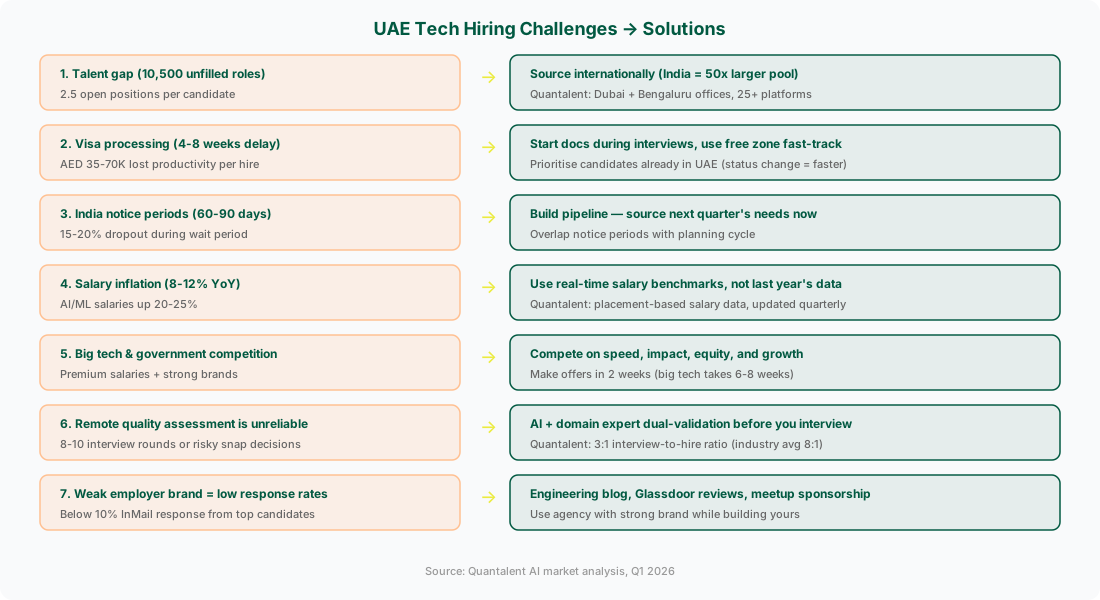
Why International Sourcing Solves Most UAE Hiring Challenges
Six of these seven challenges share the same root cause — the UAE's tech talent market is too small for its demand. The solution isn't to compete harder for the same local pool. It's to source internationally, particularly from India, which produces 1.5 million+ engineering graduates annually and is the largest source market for GCC tech hiring.
Quantalent AI is purpose-built for this. Our dual-office model (Dubai + Bengaluru) gives UAE companies direct access to India's tech talent pool without the trial-and-error of working with unfamiliar Indian recruitment agencies. Our AI sources from 25+ platforms — not just LinkedIn — finding candidates on GitHub, Stack Overflow, and specialist communities that local sourcing misses.
"Quantalent transformed our recruitment by engaging passive talent. Their outreach and precise matching turned overlooked professionals into valuable, active contributors." — Saiteja Veera, CEO, Gamyam
Stop Fighting the Market — Work With It
The UAE tech hiring market is challenging, but companies that adapt their approach are hiring effectively. The companies still struggling are the ones using 2020 strategies in a 2026 market.
Get a free hiring assessment: Email contact@quantalent.ai or book a consultation. We'll review your open roles, identify which challenges are costing you the most, and recommend a sourcing strategy that works with the market rather than against it.