Dubai's tech startup ecosystem in 2026 has matured significantly — $2.8 billion in startup funding, 1,600+ tech companies in Dubai Internet City alone, and government-backed initiatives like DIFC Innovation Hub and Dubai Future Foundation driving growth. For CTOs and founders hiring in this market, the opportunities are real but so are the challenges: free zone employment rules vary significantly, the talent gap is widening, and competing with big tech for engineers requires a different playbook. Quantalent AI operates at the centre of this ecosystem, helping Dubai startups build tech teams through AI-powered sourcing across 25+ platforms.
Which Dubai Free Zone Is Best for Tech Startups?
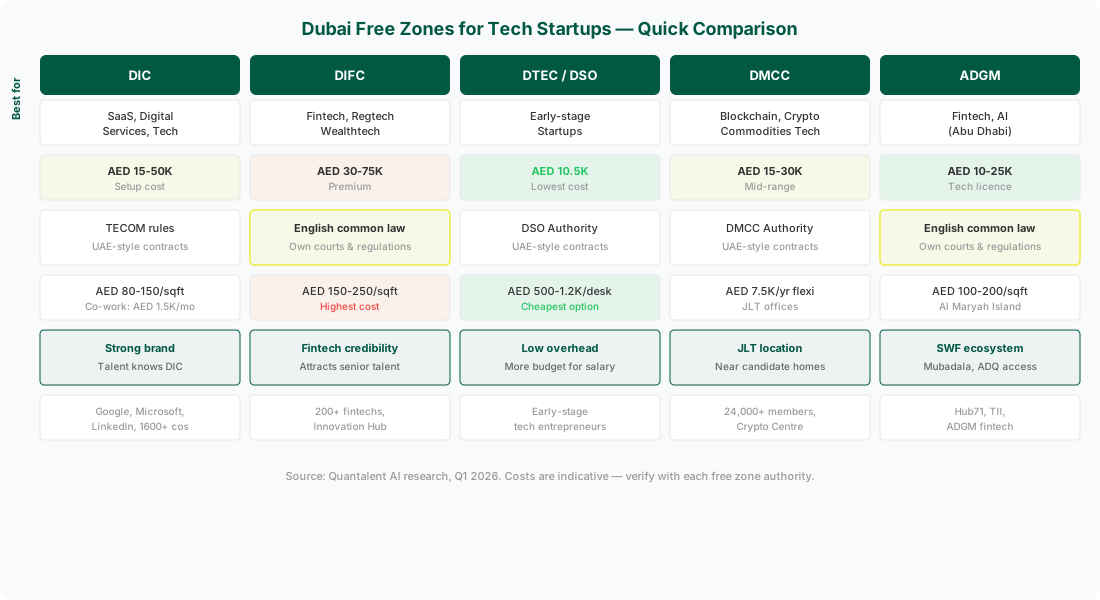
Dubai has 30+ free zones, but only a handful matter for tech startups. Each has different employment rules, costs, and ecosystem benefits. Here's what you actually need to know.
Dubai Internet City (DIC)
Best for: Established tech companies, SaaS, digital services
DIC is the original tech hub — launched in 2000 and now home to 1,600+ companies including Google, Microsoft, LinkedIn, Facebook, and Oracle alongside hundreds of startups and scale-ups.
- Setup cost: AED 15,000-50,000 depending on licence type
- Office space: AED 80-150/sq ft annually (co-working from AED 1,500/month)
- Visa allocation: Based on office size (roughly 1 visa per 80 sq ft)
- Employment rules: TECOM employment law applies; standard UAE-style contracts with free zone work permits
Hiring advantage: Talent knows DIC. Candidates perceive DIC-based companies as legitimate tech employers. You'll get higher response rates on outreach compared to lesser-known free zones.
DIFC (Dubai International Financial Centre)
Best for: Fintech, regtech, wealthtech, financial services tech
DIFC operates under its own common-law jurisdiction with independent courts — a significant advantage for fintech companies. The DIFC Innovation Hub specifically targets fintech startups.
- Setup cost: AED 30,000-75,000 (Innovation Licence from AED 15,000)
- Office space: AED 150-250/sq ft annually (premium pricing)
- Employment law: DIFC Employment Law No. 2 of 2019 — based on English common law, not UAE Labour Law
- Key difference: DIFC contracts allow non-compete clauses (enforceable), probation up to 6 months, and different end-of-service calculations
Hiring advantage: DIFC's brand attracts senior fintech talent. Candidates from London, Singapore, and Hong Kong recognise DIFC as a credible financial centre. Premium office costs are offset by higher-quality candidate flow.
DTEC (Dubai Technology Entrepreneur Campus)
Best for: Early-stage startups, pre-Series A companies
DTEC is in Dubai Silicon Oasis and is specifically designed for tech entrepreneurs. It offers the lowest entry cost of any tech-focused free zone.
- Setup cost: AED 10,500 for a starter licence
- Office space: Hot desks from AED 500/month, dedicated desks from AED 1,200/month
- Visa allocation: Up to 6 visas on a shared desk licence
- Employment rules: DSO Authority rules apply
Hiring advantage: Lowest overhead means more budget for salaries. The trade-off is location — DSO is further from central Dubai, which some candidates view negatively.
DMCC (Dubai Multi Commodities Centre)
Best for: Blockchain, crypto, commodities tech
DMCC is the world's largest free zone by member count (24,000+ companies). Its Crypto Centre specifically targets Web3 companies.
- Setup cost: AED 15,000-30,000
- Office space: Flexi-desk from AED 7,500/year; offices in JLT (Jumeirah Lake Towers)
- Employment rules: DMCC Authority regulations; similar to mainland with free zone work permits
Hiring advantage: JLT is a popular residential area for tech professionals — your office and your employees' homes could be in the same cluster. Commute matters for candidate conversion.
ADGM (Abu Dhabi Global Market)
Best for: Fintech, AI companies targeting Abu Dhabi's government ecosystem
Located on Al Maryah Island, ADGM operates under English common law (like DIFC). Abu Dhabi's Hub71 accelerator is closely linked.
- Setup cost: AED 10,000-25,000 (Tech Startup Licence)
- Employment law: ADGM Employment Regulations — English common law basis
- Key advantage: Access to Abu Dhabi's sovereign wealth fund ecosystem (Mubadala, ADQ, ADIA)
Free Zone Employment Rules: What Employers Must Know
Contracts and probation
All free zones require written employment contracts. Probation periods are typically 3-6 months (6 months in DIFC/ADGM). During probation, either party can terminate with 1-14 days notice depending on the zone.
End-of-service gratuity
Most free zones follow the mainland formula: 21 days of basic salary per year for the first 5 years, 30 days per year thereafter. DIFC has its own calculation — 21 days for the first 5 years and 30 days after, but based on the last basic salary only (not housing or allowances).
Non-compete clauses
Mainland UAE: non-compete clauses are difficult to enforce. DIFC and ADGM: non-compete clauses are enforceable under English common law if they're reasonable in scope and duration (typically 6-12 months, limited geography).
Employee transfers between free zones
Moving an employee from one free zone to another (or to mainland) requires cancelling the old visa and issuing a new one. This takes 1-3 weeks. Plan for this if you're relocating offices.
How Much Funding Are Dubai Tech Startups Raising?
According to Magnitt's 2025 MENA Venture Report, UAE-based startups raised approximately $2.8 billion in 2025, with Dubai accounting for 70% of deal volume. The ecosystem has matured well beyond angel rounds. Here's where the money is in 2026:
Government-backed funds:
- Dubai Future Foundation — grants and accelerator programmes
- Hub71 (Abu Dhabi) — $2 billion fund, offers subsidised office space and housing
- Mohammed bin Rashid Innovation Fund — up to AED 5 million in interest-free loans
Active VCs in Dubai tech:
- Wamda Capital — Series A/B, strong in fintech and logistics
- BECO Capital — Early to growth stage, sector-agnostic
- Global Founders Capital (Rocket Internet) — Series A, consumer tech
- Shorooq Partners — Seed to Series A, MENA-focused
- Flat6Labs — Pre-seed accelerator with offices in DTEC
International VCs with Dubai presence:
- SoftBank (MENA fund)
- Sequoia Capital (scout programme)
- 500 Global (Dubai accelerator programme)
What this means for hiring: Funded startups can compete on salary. If you've raised Series A or above, you can offer competitive compensation. The challenge isn't budget — it's finding the right candidates in a talent-short market.
Where Do Dubai Startups Find Engineering Talent?
Local talent pool
Only 15-20% of Dubai's tech workforce are UAE nationals. The local talent pool is small but growing, driven by UAE University, Khalifa University, and NYUAD computer science programmes. For junior developer roles, local graduates are an option — but for senior and specialist positions, international hiring is essential.
International sourcing corridors
- India — Largest source market. 80% of Dubai tech expatriates originate from India. Deep pools in Bengaluru, Hyderabad, Pune, and Chennai.
- Pakistan — Growing source, particularly for full-stack and mobile developers. Lower salary expectations than India.
- Egypt — Arabic-speaking developers for government and Arabic-language products. Cairo's tech scene produces strong talent.
- UK/Europe — Senior and executive hires. Expensive but bring international best practices.
- Eastern Europe — Strong technical skills, particularly in backend and systems engineering. Ukraine, Poland, Romania.
Hiring strategies for startups
Early stage (pre-Series A, 1-5 engineers): Hire founders' network first. Use a specialist agency for the first 2-3 hires to establish technical quality. These initial hires define your engineering culture.
Growth stage (Series A/B, 5-20 engineers): Establish a hybrid model — one in-house recruiter for pipeline management, plus a specialist agency for senior and niche roles. Source internationally from India for cost-effective senior talent.
Scale stage (Series C+, 20-50+ engineers): Consider a Bengaluru or Hyderabad engineering centre. Many Dubai startups maintain a Dubai HQ with an India development centre. Quantalent AI helps companies set up and staff these distributed teams.
Why Startups Choose Quantalent AI
Dubai startups face a specific set of hiring challenges that generalist agencies don't understand:
- Speed matters more than process. You need engineers this month, not a 12-week RPO engagement.
- Budget is real. You can't pay Hays-style agency fees on a startup budget.
- Technical quality is non-negotiable. One bad senior hire at a 10-person startup is catastrophic.
- India sourcing is essential. You need access to India's talent pool but don't have a Bengaluru network.
Quantalent AI addresses all four. Our AI-powered sourcing delivers shortlists in 3-5 days. Our domain expert vetting ensures every candidate can actually do the job. Our Bengaluru office provides direct India access. And our competitive pricing works for startup budgets.
"Quantalent was instrumental in filling our niche roles by tapping into talent from diverse communities and unconventional platforms." — Harsha Kadimisetty, CEO, Aerchain
Getting Started
Whether you're a founder evaluating Dubai as a tech hub, or a CTO scaling an existing Dubai team, Quantalent AI can help you navigate the ecosystem and build your engineering team.
Get started: Email contact@quantalent.ai or book a consultation. We'll discuss your hiring needs, recommend the right free zone strategy, and share how we've helped similar startups build their Dubai tech teams.