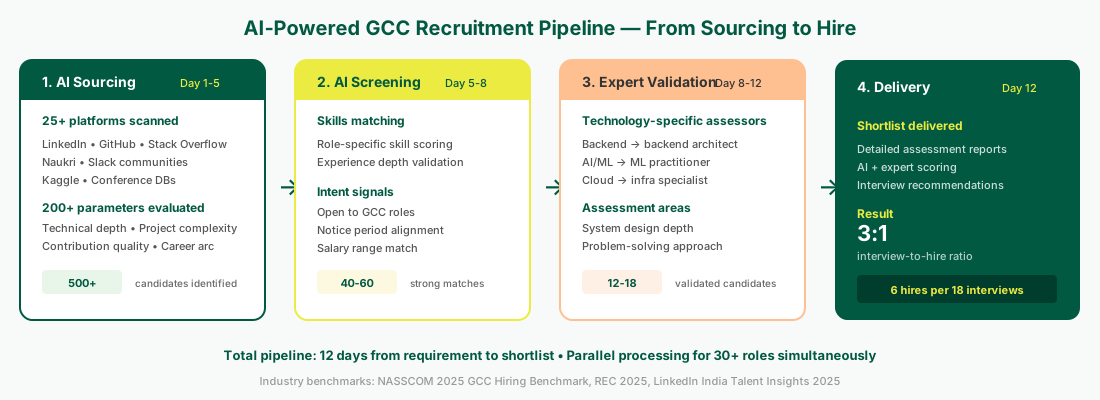
Quantalent AI is an AI-powered recruitment agency built for global capability center hiring. Our system scans 25+ platforms — LinkedIn, GitHub, Stack Overflow, Naukri, specialist communities, and tier-2 city talent pools — evaluating candidates across 200+ parameters to build shortlists 10x faster than manual sourcing. Every AI-sourced candidate then passes through domain expert validation by a specialist in that technology area. The result: a 3:1 interview-to-hire ratio and 12-day average time-to-shortlist, maintained even when filling 30+ GCC roles simultaneously.
Why Do Traditional Recruitment Agencies Fail at GCC Scale?
Global capability centers don't hire like normal companies. A typical GCC mandate involves 10-50 positions across multiple technology clusters — backend engineering, data science, cloud infrastructure, and AI/ML — all running in parallel with different skill requirements, seniority levels, and assessment criteria. Traditional recruitment agencies were built for single-role searches, and their processes break down at GCC volume.
According to the Everest Group's 2025 GCC Talent Report, 58% of GCC leaders rate their recruitment agency's performance as "inadequate for scale hiring." The core problems are structural:
Database-dependent sourcing misses passive candidates. Traditional agencies source from 2-3 platforms (typically LinkedIn and one local job board) using keyword matching on outdated databases. According to LinkedIn's 2025 India Talent Insights, 73% of senior engineers in India are passive candidates — not actively job-seeking and not responding to job board postings. These are the candidates GCCs most need, and traditional sourcing systematically misses them.
Manual screening can't maintain quality at volume. When a recruiter handles 5-8 roles simultaneously (the industry standard per the Recruitment & Employment Confederation's 2025 benchmarks), each role receives approximately 6 hours of active sourcing per week. For a GCC mandate of 20 roles, traditional agencies either spread recruiters thin — resulting in shallow candidate pools — or assign junior recruiters who lack the technical judgment to evaluate specialist candidates.
No technology-specific assessment capability. GCC roles require deep technical evaluation. A backend engineer hiring for a BFSI GCC needs different assessment than a backend engineer for a SaaS GCC — regulatory domain knowledge, security awareness, and distributed systems experience vary significantly. Traditional agencies rely on generic technical screening that cannot differentiate between surface-level knowledge and production-grade expertise.
How Does AI-Powered Recruitment Solve These Problems for GCCs?
Quantalent AI's approach addresses each structural limitation of traditional recruitment through a combination of AI-powered sourcing and human domain expertise.
AI sourcing across 25+ platforms reaches the 73% of candidates traditional agencies miss. Our engine simultaneously scans LinkedIn, GitHub (contribution patterns, repository quality, code review activity), Stack Overflow (answer quality, reputation trajectory), Naukri, specialist Slack communities, Kaggle, conference speaker databases, and university alumni networks. For each platform, the AI evaluates candidates across 200+ parameters — not just keyword matches but signals of genuine technical depth: commit frequency, project complexity scores, open-source contribution quality, and career progression patterns.
Parallel pipeline processing handles GCC volume without quality loss. When a GCC needs 15 backend engineers and 10 data engineers simultaneously, the AI runs both searches in parallel — producing independent shortlists optimised for each role's specific requirements. Each shortlist maintains the same quality bar as a single-role search because the AI doesn't have the capacity constraints of human recruiters. According to NASSCOM's 2025 GCC Hiring Benchmark, the average interview-to-hire ratio for Indian recruitment agencies is 8:1. Quantalent AI maintains a 3:1 ratio even at volume.
Domain expert validation adds the technical judgment AI cannot provide. Every candidate on the AI shortlist undergoes assessment by a human domain expert who has built production systems in that specific technology area. Backend candidates are assessed by senior backend architects. Data engineering candidates are assessed by data engineering leads. This dual-validation — AI sourcing plus human expert evaluation — is what separates Quantalent AI from both traditional agencies and pure AI hiring platforms.
Which GCC Roles Benefit Most from AI Recruitment?
AI-powered sourcing provides the greatest advantage for roles where the talent pool is small, largely passive, and distributed across non-traditional channels. According to Analytics India Magazine's 2025 Skills Report and NASSCOM's GCC Hiring Benchmark, these are the hardest GCC roles to fill using traditional methods:
AI and machine learning engineers. India produces approximately 15,000 qualified AI/ML specialists annually against demand for 50,000+. Most are passive candidates discoverable through Kaggle profiles, research paper authorship, GitHub ML repositories, and conference presentations — channels that traditional recruiters don't systematically search. AI sourcing identifies these candidates and evaluates the quality of their technical contributions, not just their job titles. For a deep dive into AI/ML talent sourcing, salaries, and assessment, see our guide to hiring AI/ML engineers for GCC India.
Cloud and platform architects. Multi-cloud expertise (AWS + Azure or GCP) commands a 15-25% salary premium and is held by fewer than 12% of cloud professionals according to the Hays 2026 India Technology Report. AI sourcing identifies multi-cloud candidates through certification cross-referencing, GitHub infrastructure-as-code repositories, and community contributions across multiple cloud ecosystems.
Cybersecurity specialists. India has approximately 40,000 qualified cybersecurity professionals against demand for 100,000+ according to DSCI's 2025 Cybersecurity Workforce Report. These candidates are particularly difficult to source because many maintain low public profiles for professional reasons. AI sourcing reaches them through security conference networks, bug bounty platform activity, and specialist community participation.
Data engineers at scale. GCCs building data platforms need engineers with experience across Spark, Kafka, Airflow, and modern lakehouse architectures. AI sourcing evaluates candidates' actual data pipeline complexity — not just tool familiarity — by analysing GitHub repositories, open-source contributions, and technical blog content.
For a comprehensive comparison of GCC hiring across Indian cities, including which cities have the deepest talent pools for each role type, see our GCC hiring partner Bangalore page, which includes a city-by-city comparison infographic.
What Results Should a GCC Expect from AI Recruitment?
The measurable difference between AI-powered and traditional GCC recruitment shows up across four metrics:
| Metric | Traditional Agency | Quantalent AI |
|---|---|---|
| Time to shortlist | 25-40 days | 12 days average |
| Interview-to-hire ratio | 8:1 industry average | 3:1 |
| Passive candidate reach | 2-3 platforms | 25+ platforms |
| Parallel role capacity | 5-8 per recruiter | Unlimited (AI) |
These improvements compound at GCC scale. A capability center hiring 50 engineers per year that switches from an 8:1 to a 3:1 interview-to-hire ratio saves approximately 250 hours of engineering interview time annually — equivalent to 6 weeks of a senior engineer's productive output. The faster time-to-shortlist (12 vs 30 days average) means positions are filled 18 days sooner, reducing the revenue impact of vacancies.
For GCCs evaluating recruitment partners, we recommend focusing on interview-to-hire ratio as the single most important quality metric — it directly measures how well a recruitment agency understands your technical requirements and can identify candidates who will succeed in your environment. For a comprehensive overview of GCC talent markets across all six Gulf countries and India, see our GCC tech talent landscape 2026 guide.
Ready to Upgrade Your GCC Recruitment?
Whether you're hiring 5 niche specialists or scaling a 200-person engineering floor, Quantalent AI delivers the speed and quality that GCC hiring demands. Our AI sources from 25+ platforms while domain experts validate every candidate — maintaining a 3:1 interview-to-hire ratio at any volume.
Get started: Email contact@quantalent.ai or book a free consultation. We'll analyse your open roles, map the addressable talent pool by technology cluster, and show you exactly how AI-powered sourcing expands your candidate reach.