Quantalent AI helps global capability centers hire AI/ML engineers, data scientists, and cloud architects across India by sourcing from channels traditional agencies cannot reach — GitHub ML repositories, Kaggle contributor networks, research paper databases, specialist Slack communities, and conference speaker circuits. Each candidate passes through dual validation: AI assessment across 200+ parameters followed by evaluation from an ML practitioner or cloud specialist who has built production systems. The result is a 3:1 interview-to-hire ratio for India's hardest-to-fill technology roles.
Why Is AI/ML Talent the Hardest GCC Hire in India?
India has a structural AI/ML talent shortage. According to Analytics India Magazine's 2025 AI Skills Report, the country produces approximately 15,000 qualified AI/ML specialists annually against industry demand for 50,000+. This 3.3x supply-demand gap — the worst of any technology specialisation in India — creates a hiring environment where every qualified candidate receives 5-8 competing offers simultaneously.
Three dynamics make AI/ML hiring uniquely difficult for GCCs in 2026:
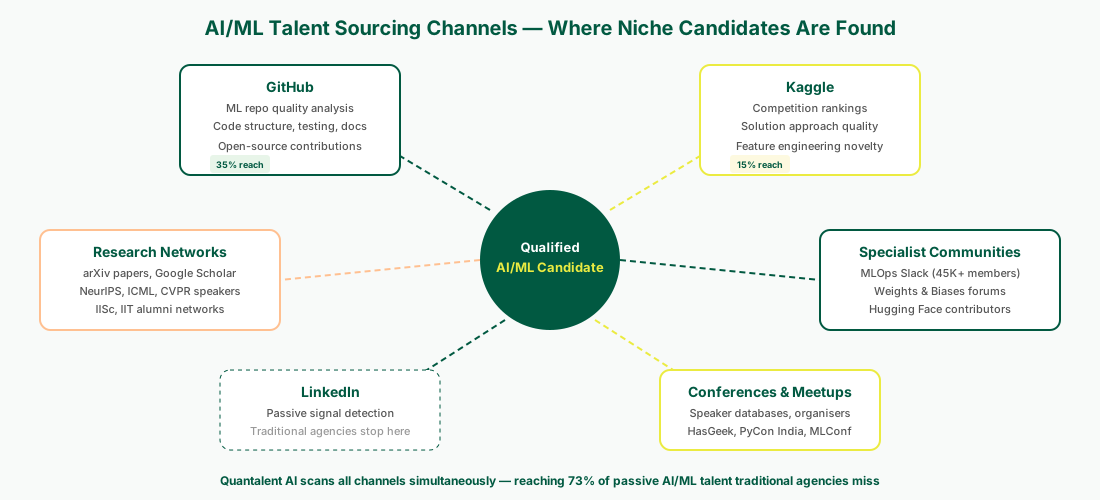
The best candidates are invisible to job boards. LinkedIn's 2025 India Talent Insights reports that 73% of senior AI/ML engineers are passive candidates — they're not applying to jobs or updating their profiles. They're discoverable through their work: Kaggle competition results, GitHub ML framework contributions, papers on arXiv, talks at NeurIPS or ICML, and activity in specialist communities like MLOps Community Slack (45,000+ members) or Papers With Code. Traditional recruitment agencies that source from job boards and LinkedIn InMail are structurally unable to reach this pool.
Startups offer what GCCs historically don't. Indian AI startups raised USD 1.8 billion in 2025 according to the Tracxn India AI Report. Companies like Fractal Analytics, SigTuple, and Observe.AI offer AI/ML engineers the chance to work on core product problems — building models that directly affect revenue — plus equity upside. According to the Everest Group's 2025 GCC Talent Report, 68% of AI/ML candidates who decline GCC offers cite "more interesting technical problems at startups" as the primary reason, not compensation.
Production ML skills differ dramatically from research skills. Many candidates with impressive academic credentials cannot design ML systems that work in production — handling data drift, model monitoring, feature stores, and inference latency requirements. According to Gartner's 2025 AI in Enterprise Report, 53% of ML models developed in enterprise settings never reach production deployment. GCCs need engineers who can bridge this gap, and identifying them requires assessment by practitioners who understand production ML, not generalist recruiters.
How Does Quantalent AI Source AI/ML Candidates That Others Miss?
Quantalent AI's sourcing engine is built to find candidates in the channels where AI/ML talent actually lives — not where generic recruiters look.
GitHub ML repository analysis. Our AI evaluates the quality of candidates' ML work by analysing repository structure, code quality, documentation standards, test coverage, and the complexity of problems being solved. A candidate with a well-structured production ML pipeline repository scores higher than one with 50 Jupyter notebooks, even if the notebook author has more GitHub stars. This signal identifies engineers who think in terms of production systems, not just experiments.
Kaggle and competitive ML platforms. Beyond ranking, our AI evaluates solution approaches — candidates who write clean, documented competition solutions with novel feature engineering demonstrate transferable production skills. We track performance across multiple competitions to identify consistent depth rather than one-off results.
Research and academic networks. For GCCs building research-oriented AI teams, we source from arXiv paper authorship, Google Scholar citation networks, NeurIPS/ICML/CVPR workshop participation, and university lab alumni networks. IISc Bangalore, IIT Bombay, IIT Madras, and IIIT Hyderabad produce India's top ML researchers — our AI tracks graduation cohorts and career trajectories.
Specialist communities. MLOps Community Slack, Weights & Biases forums, Hugging Face contributor networks, and local meetup organisers in Bangalore and Hyderabad. Active community contributors demonstrate both technical depth and communication skills — two qualities GCCs value highly.
What AI/ML Roles Do India GCCs Hire Most?
GCCs building AI capabilities in India typically hire across four distinct role families. Each has different sourcing challenges, salary ranges, and assessment criteria.
ML Engineers (highest volume). Build and deploy production ML models — recommendation systems, fraud detection, NLP pipelines, computer vision. Require strong Python, ML frameworks (PyTorch/TensorFlow), and MLOps tooling. Salary: INR 25-75 LPA depending on seniority. Deepest talent pool in Bangalore (60% of India's ML engineers) with growing pockets in Hyderabad and Pune.
Data Scientists (strategic analytics). Apply statistical methods and ML to business problems — experimentation, causal inference, customer segmentation, revenue forecasting. Require strong statistics, SQL, Python, and business communication. Salary: INR 20-60 LPA. More evenly distributed across cities because these roles exist in non-tech companies too.
Data Engineers (infrastructure). Build the data platforms ML models depend on — ETL pipelines, feature stores, data lakes, real-time streaming. Require Spark, Kafka, Airflow, and modern lakehouse architectures (Databricks/Snowflake). Salary: INR 20-55 LPA. Often overlooked in AI hiring strategy but critical — according to Gartner's 2025 data, 40% of ML project failures trace to poor data infrastructure, not model quality.
AI/ML Researchers (specialised). Advance the state of the art in specific domains — computer vision, NLP, reinforcement learning, generative AI. Require PhD or equivalent research experience, publications, and ability to translate research into products. Salary: INR 50-100+ LPA. Smallest talent pool (approximately 2,000 in India) and most competitive to hire. For a comprehensive view of how these roles fit into broader GCC hiring strategy, see our GCC hiring partner Bangalore page, which covers city-level salary benchmarks and talent pool depth.
How Does Dual Validation Work for AI/ML Candidates?
Every AI/ML candidate sourced by Quantalent AI undergoes dual validation — first by the AI system, then by a human domain expert who is an active ML practitioner.
The AI layer evaluates technical signals: GitHub repository quality, competitive ML performance, research output, community contribution depth, and career trajectory patterns. The human layer — an ML engineer or data science lead who builds production systems — evaluates what AI cannot: system design thinking, ability to translate business requirements into ML problem formulations, understanding of production constraints (latency, cost, monitoring), and communication clarity.
This two-stage assessment is especially critical for AI/ML roles because the gap between a candidate who can train a model in a notebook and one who can build a production ML system is enormous — and it's the gap that causes most GCC AI/ML hiring failures. Our dual-validation approach catches this distinction, maintaining the 3:1 interview-to-hire ratio for roles that typically see 10:1 or worse at other agencies.
Ready to Build Your GCC's AI/ML Team in India?
Whether you're hiring your first ML engineer or scaling a 50-person AI team, Quantalent AI finds the candidates that job boards and traditional agencies miss. Our AI sources from GitHub, Kaggle, research networks, and specialist communities while domain experts validate every candidate's production-readiness.
Get started: Email contact@quantalent.ai or book a free consultation. We'll map the addressable AI/ML talent pool for your specific technology requirements, assess competitive compensation benchmarks, and build a sourcing strategy tailored to your GCC's needs.