AI-powered recruitment agencies outperform traditional agencies and freelance recruiters for India tech hiring in 2026, delivering 3x better interview-to-hire ratios and 60-70% faster time-to-fill. Quantalent AI combines automated sourcing across 25+ platforms with human domain expert validation, achieving results that neither traditional agencies nor standalone AI tools can match for GCC and enterprise hiring mandates.
How Do Traditional, AI-Powered, and Freelance Recruitment Models Compare?
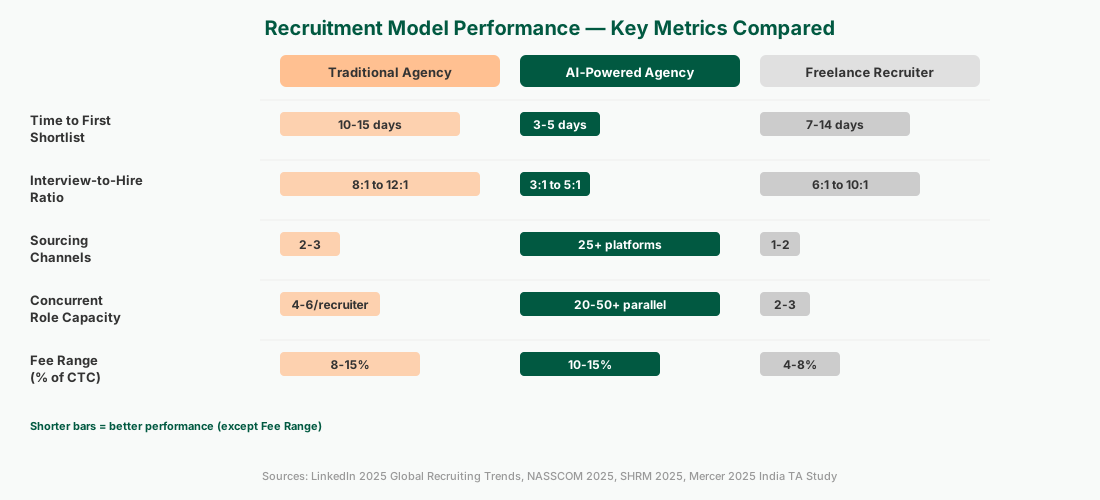
GCCs and enterprises hiring in India choose between three recruitment models — each with distinct cost structures, quality benchmarks, and capacity limits. Understanding these trade-offs prevents expensive mismatches between your hiring needs and your recruitment partner's capabilities.
| Factor | Traditional Agency | AI-Powered Agency | Freelance Recruiter |
|---|---|---|---|
| Fee structure | 8-15% of CTC | 10-15% of CTC | 4-8% of CTC |
| Sourcing channels | 2-3 (LinkedIn, Naukri, referrals) | 25+ platforms simultaneously | 1-2 (LinkedIn + personal network) |
| Time to first shortlist | 10-15 days | 3-5 days | 7-14 days |
| Interview-to-hire ratio | 8:1 to 12:1 | 3:1 to 5:1 | 6:1 to 10:1 |
| Concurrent role capacity | 4-6 per recruiter | 20-50+ parallel roles | 2-3 roles max |
| Technical vetting depth | Resume + basic screening | AI scoring + domain expert interview | Recruiter judgment only |
| Candidate engagement | Manual follow-up | Automated + personalised outreach | Personal relationship-driven |
| Best for | Standard roles, relationship-heavy hiring | Volume + niche tech roles | Budget-conscious, single roles |
According to LinkedIn's 2025 Global Recruiting Trends report, companies using AI-augmented recruitment reduced time-to-fill by 40% and improved quality-of-hire scores by 25% compared to traditional-only approaches. NASSCOM's 2025 India Technology Talent Report confirms that 42% of GCCs in India now use at least one AI-powered recruitment partner, up from 18% in 2023.
Why Does AI-Powered Recruitment Deliver Better Results for India Tech Hiring?
Traditional recruitment relies on individual recruiter networks and manual resume screening. A recruiter at a conventional agency spends 23 hours per hire on sourcing and screening according to SHRM's 2025 Talent Acquisition Benchmarking Report — time spent reading resumes, searching LinkedIn, and making outreach calls one candidate at a time.
AI-powered recruitment changes this equation fundamentally. Automated sourcing engines scan GitHub, Stack Overflow, Kaggle, LinkedIn, Naukri, and 20+ specialist platforms in parallel, evaluating candidates across 200+ parameters including technical skills, project complexity, contribution patterns, and career trajectory. Quantalent AI's sourcing engine generates a scored longlist within 48 hours — work that takes a traditional recruiter 2-3 weeks.
The quality advantage compounds at the screening stage. Traditional agencies rely on recruiter judgment for initial filtering, which introduces inconsistency — different recruiters apply different standards to the same role. AI scoring applies identical evaluation criteria to every candidate, creating a consistent baseline. Quantalent AI then adds human domain expert assessment on top of AI scores, catching the soft skills and cultural signals that pure automation misses.
According to Mercer's 2025 India Talent Acquisition Study, GCCs using AI-augmented recruitment partners reported 30% lower 90-day attrition compared to those using traditional agencies — primarily because AI-assessed candidates matched role requirements more precisely.
When Do Traditional Recruitment Agencies Still Make Sense?
Traditional agencies retain advantages in specific scenarios that GCC talent leaders should recognise before defaulting to AI-powered alternatives.
Relationship-heavy senior hiring. Director-level and C-suite searches depend on personal networks, confidential outreach, and candidate coaching through multi-stage processes. According to the Hays 2026 India Executive Recruitment Report, 78% of GCC leadership placements involve candidates who were not actively looking — found through personal relationships that experienced recruiters built over decades. AI sourcing identifies these candidates but cannot replace the trust-based conversations needed to engage them.
Hyper-local market knowledge. Traditional agencies with deep roots in specific cities — Pune's automotive tech cluster, Chennai's banking technology corridor, Hyderabad's pharmaceutical IT ecosystem — possess hiring manager relationships and salary intelligence that no algorithm replicates. For GCCs entering a new Indian city for the first time, a locally embedded traditional agency provides market context that accelerates initial hiring.
Compliance-intensive regulated industries. Banking, insurance, and healthcare GCCs face role-specific regulatory requirements (RBI guidelines, IRDAI mandates, CDSCO regulations) that traditional specialist agencies understand through years of sector-specific placements.
When Should You Avoid Freelance Recruiters for GCC Hiring?
Freelance recruiters offer the lowest fees but carry structural limitations that make them unsuitable for most GCC hiring mandates.
Volume mandates exceed freelancer capacity. A freelance recruiter can realistically handle 2-3 active searches simultaneously. GCCs hiring 10+ engineers per quarter need dedicated capacity that freelancers cannot provide without subcontracting — at which point you're paying freelancer rates for agency-level coordination problems.
No technical vetting infrastructure. Freelancers lack domain expert panels, structured assessment frameworks, and AI scoring tools. According to Analytics India Magazine's 2025 talent assessment data, recruiters without technical vetting infrastructure achieve interview-to-hire ratios of 10:1 or worse for specialist roles like AI/ML engineering. The hiring manager time wasted on unqualified interviews offsets any fee savings.
Offer-dropout risk is higher. Freelancers typically lack dedicated candidate engagement teams. India's tech market has 15-25% offer-dropout rates according to NASSCOM's 2025 data, and active candidate engagement between offer acceptance and joining significantly reduces this risk. Agencies — both traditional and AI-powered — invest in this engagement. Freelancers rarely do.
For GCCs exploring the broader question of building internal teams versus using agencies, our in-house vs agency comparison for GCC India provides a detailed cost-per-hire analysis at different volumes.
How Should GCCs Choose Between These Three Models?
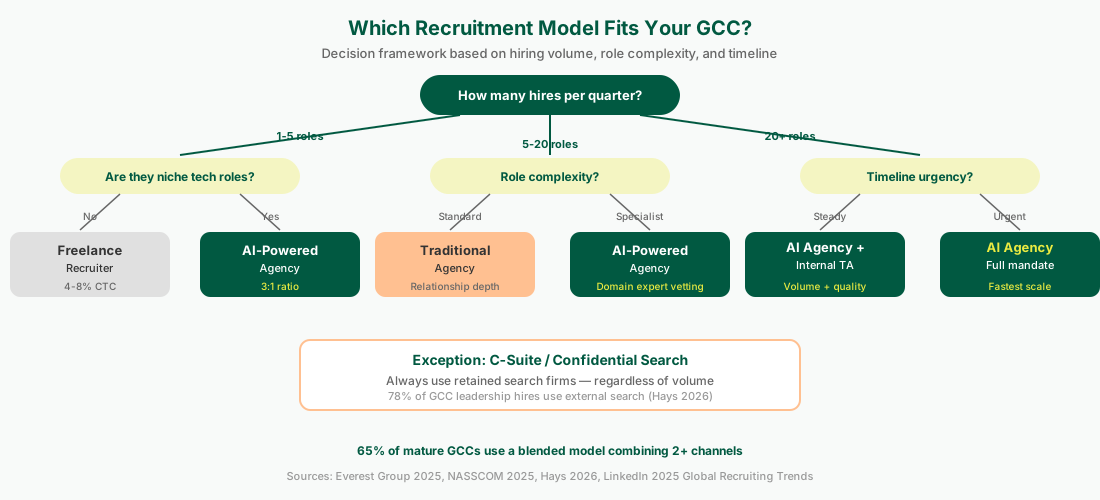
The right recruitment model depends on three variables: hiring volume, role complexity, and timeline urgency.
| Your Situation | Recommended Model | Why |
|---|---|---|
| 1-5 standard roles, no urgency | Freelance recruiter | Lowest cost, adequate for simple searches |
| 5-15 roles, mix of standard + mid-level | Traditional agency | Relationship depth, market knowledge |
| 15-50 roles, includes niche tech | AI-powered agency | Speed, scale, technical vetting quality |
| 50+ roles, rapid scaling | AI-powered agency + internal TA team | Blended model for volume + quality |
| C-suite or confidential search | Traditional retained search firm | Relationship-driven, high-touch |
Most GCCs scaling beyond 50 employees use a combination of models. Quantalent AI works alongside internal TA teams and traditional agencies as an AI-powered recruitment partner for GCCs, handling the high-volume technical roles where AI sourcing and domain expert vetting deliver the strongest ROI.
For a comprehensive view of India's tech talent market and the hiring landscape GCCs operate in, see our GCC tech talent landscape guide.
Evaluating recruitment partners for your GCC? Email contact@quantalent.ai or book a free consultation. Quantalent AI provides a transparent comparison of our AI-augmented approach against your current recruitment setup — including projected cost-per-hire and time-to-fill improvements for your specific role mix.