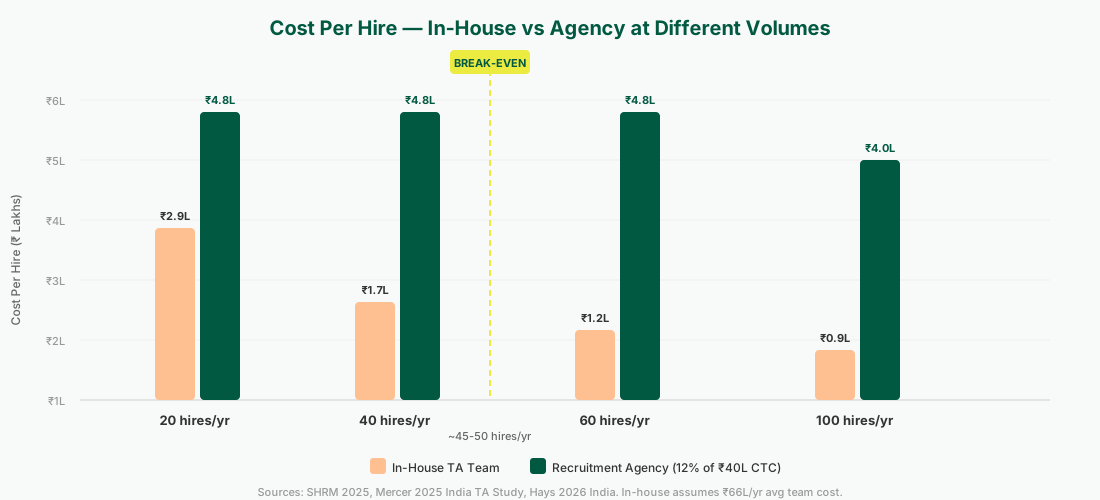
In-house recruitment teams cost less for GCCs in India hiring 50+ people per year in standardised roles. Below that threshold — and especially in 2026 as niche technology salaries continue rising — agencies like Quantalent AI deliver better cost-per-hire for specialist roles and rapid scaling. The Everest Group's 2025 GCC Talent Report found 65% of large GCCs in India use a blended model: internal teams for volume hiring and specialist agencies for hard-to-fill positions.
How Much Does In-House Recruitment Actually Cost for a GCC in India?
The visible cost of in-house recruitment is recruiter salaries. The total cost is significantly higher. According to SHRM's 2025 Talent Acquisition Benchmarking Report, companies routinely underestimate internal recruitment costs by 40-60% because they exclude infrastructure, tools, and opportunity costs.
A realistic cost breakdown for a GCC in-house TA team in India:
| Cost Component | Annual Cost (INR) | Notes |
|---|---|---|
| TA Lead (1) | 15-25 LPA | Experienced hire, manages team and strategy |
| Recruiters (2) | 16-24 LPA total | INR 8-12 LPA each, mid-level |
| ATS License | 3-8 LPA | Greenhouse, Lever, or Workday Recruiting |
| LinkedIn Recruiter | 4-7 LPA | 2-3 seats, annual subscription |
| Naukri/Job Boards | 2-4 LPA | Premium listings, database access |
| Employer Branding | 5-15 LPA | Careers page, Glassdoor, social content, events |
| Training & Development | 1-3 LPA | Recruiter upskilling, market knowledge |
| Total | 46-86 LPA | Before overheads and management time |
At 50 hires per year, the in-house cost per hire is INR 92,000-1.72 lakhs. At 30 hires per year, it rises to INR 1.53-2.87 lakhs per hire — approaching or exceeding typical agency fees for mid-level roles.
The hidden cost most GCCs miss: hiring manager time. According to LinkedIn's 2025 Global Recruiting Trends report, hiring managers spend an average of 12 hours per hire on screening, interviewing, and decision-making when working with internal recruiters — versus 6 hours per hire when working with a specialist agency that pre-screens effectively. For a GCC engineering director managing 20 hires per year, the difference is 120 hours of productive time.
What Are the Real Costs of Using a Recruitment Agency for a GCC?
Recruitment agencies in India charge 8-15% of the candidate's annual CTC per successful placement. For a senior engineer earning INR 40 LPA, the fee ranges from INR 3.2-6 lakhs per hire. Volume discounts of 2-4 percentage points apply for mandates of 10+ hires.
The agency cost structure is simpler but varies by model:
| Model | Cost | What You Get |
|---|---|---|
| Contingency (pay on hire) | 8-15% of CTC | Standard sourcing, resume screening |
| Specialist tech agency | 12-18% of CTC | Multi-platform sourcing, technical vetting |
| Retained search | 20-30% of CTC | Executive/leadership roles, confidential search |
| Dedicated pods | Monthly retainer + reduced % | Ongoing partnership, cultural calibration |
The agency advantage is zero fixed cost — you pay only for successful hires. For a GCC hiring 20 engineers at INR 40 LPA average through a specialist agency at 12%, the total cost is INR 9.6 lakhs per hire × 20 = INR 96 lakhs. An in-house team handling the same 20 hires costs INR 46-86 lakhs in fixed costs plus management overhead — making the agency model comparable or slightly more expensive, but with zero ramp-up time and no ongoing commitment.
For a detailed breakdown of agency fee structures and negotiation strategies, see our recruitment agency fees FAQ.
When Does In-House Recruitment Win for GCCs?
In-house recruitment delivers better ROI in specific scenarios. According to Mercer's 2025 India Talent Acquisition Study, GCCs with mature internal TA functions achieve 15-20% lower cost-per-hire than agency-dependent GCCs — but only after reaching steady-state operations (typically 12+ months).
High-volume standardised hiring. When a GCC hires 50+ engineers per year in repeatable role profiles (junior-to-mid backend, QA, DevOps), internal recruiters build pattern recognition for what works. Referral programs — which account for 30-40% of GCC hires according to NASSCOM's 2025 data — require internal relationship management that agencies cannot replicate.
Strong employer brand leverage. GCCs with established employer brands (Goldman Sachs, Google, Microsoft) attract significant inbound applications. Internal recruiters manage this inflow more efficiently than agencies because they control the brand narrative, careers page, and candidate experience end-to-end.
Long-term cultural calibration. Internal recruiters who work inside your GCC for 12+ months develop an intuitive understanding of team dynamics, engineering culture, and candidate-team fit that no external agency can match. According to the Hays 2026 India Talent Report, internal hires have 12% higher 1-year retention rates than agency hires in GCC environments — primarily due to better cultural screening.
When Does Agency Recruitment Win for GCCs?
Agency recruitment outperforms in-house hiring in equally specific scenarios — and these tend to be the scenarios where hiring failures are most costly.
Niche technology roles. AI/ML engineers, cybersecurity specialists, and cloud architects require sourcing from non-traditional channels (GitHub, Kaggle, specialist communities) and assessment by domain experts. Internal recruiters typically source from 2-3 platforms (LinkedIn, Naukri) and lack the technical depth to evaluate specialist candidates. According to Analytics India Magazine's 2025 data, GCCs using specialist agencies for AI/ML roles achieve a 3:1 interview-to-hire ratio versus 10:1 with internal teams — because domain expert assessment filters out candidates who interview well but lack production-grade skills.
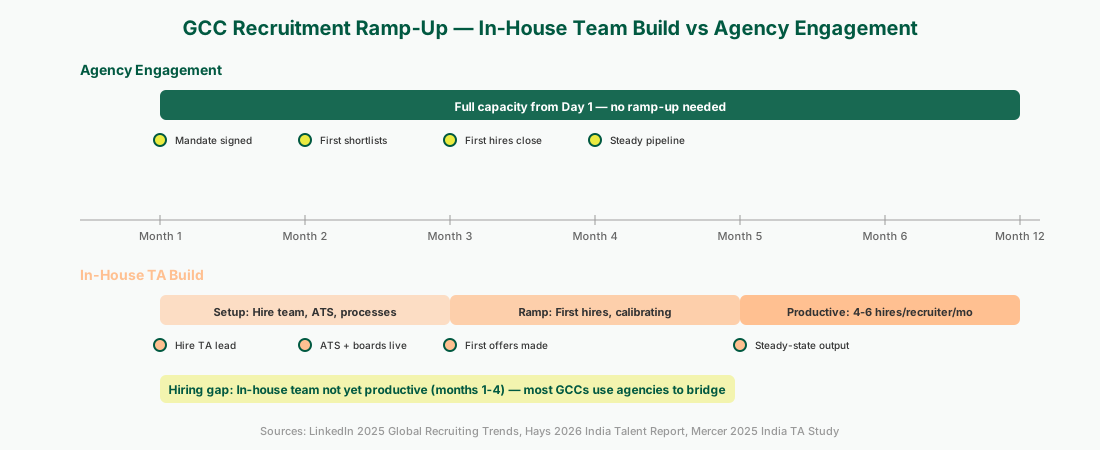
Rapid scaling periods. When a GCC needs to hire 30+ engineers in a quarter — common during new centre launches or major product initiatives — internal teams hit capacity limits. Adding internal recruiters takes 2-3 months to hire and onboard. Agencies scale instantly.
Quantalent AI's dual-validation gate combines domain-expert assessment with parallel pipeline processing, handling multiple role types simultaneously without the capacity constraints of human recruiters.
New GCC launch (first 6 months). A GCC opening a new India centre has no employer brand, no referral network, and no hiring manager relationships established. Building an internal team while simultaneously hiring 20-50 engineers creates a chicken-and-egg problem. Agencies bridge this gap — providing hiring velocity while the internal function ramps up.
Engineering leadership and executive roles. Director-level and above roles require confidential search, candidate coaching, and compensation benchmarking that general internal recruiters aren't trained to handle. Retained search through specialist firms is standard practice — 78% of GCC leadership hires use external search according to the Hays 2026 India Executive Recruitment Report.
What Does the Optimal Blended Model Look Like?
The most successful GCCs in India don't choose between in-house and agency — they use both strategically. The blended model assigns each channel to the role types where it performs best.
| Role Category | Recommended Channel | Why |
|---|---|---|
| Junior engineers (0-3 yrs) | In-house + referrals | High volume, strong brand pull, lower assessment complexity |
| Mid-level engineers (3-7 yrs) | In-house primary, agency overflow | Internal can handle steady-state; agency for spikes |
| Senior engineers (7-12 yrs) | Specialist agency | Passive candidates, competitive market, domain assessment needed |
| AI/ML, cybersecurity, cloud | Specialist agency | Niche sourcing channels, domain expert validation critical |
| Engineering managers/directors | Retained search or specialist agency | Confidential, requires leadership assessment |
| Bulk hiring (20+ same role) | In-house + agency partnership | Internal manages process, agency expands candidate funnel |
For GCCs evaluating delivery models, Quantalent AI offers both specialist agency and dedicated pod partnerships — our RPO vs recruitment agency comparison provides additional context on managed recruitment versus per-hire engagement.
How Should Your GCC Decide: Build, Buy, or Blend?
| Your GCC Situation | Recommended Model | Expected Cost Per Hire |
|---|---|---|
| New GCC, first 20 hires | Agency only | INR 3-6 lakhs (no fixed cost) |
| Established, 30-40 hires/year | Agency primary + 1 internal recruiter | INR 2-4 lakhs blended |
| Established, 50-80 hires/year | In-house team + agency for niche | INR 1.5-3 lakhs blended |
| Large GCC, 100+ hires/year | Full in-house team + agency for specialists | INR 1-2.5 lakhs blended |
| Rapid scaling (30+ in one quarter) | Agency-led with internal support | INR 3-5 lakhs (speed premium) |
Need help deciding? Email contact@quantalent.ai or book a free consultation. Quantalent AI works as both a specialist agency and a dedicated pod partner — we'll recommend the model that fits your GCC's hiring volume, role complexity, and timeline.