Quantalent AI is a GCC recruitment agency serving Pune and Chennai, using AI-powered sourcing across 25+ platforms combined with human domain expert vetting to fill technology roles for capability centres in both cities. In 2026, Pune hosts 180+ GCCs concentrated in automotive, SaaS, and fintech, while Chennai hosts 200+ GCCs anchored by BFSI and semiconductor operations — and Quantalent AI delivers a 3:1 interview-to-hire ratio across both markets.
Why Are GCCs Expanding to Pune and Chennai in 2026?
Bangalore's cost escalation is pushing GCCs to establish or expand operations in Pune and Chennai. According to NASSCOM's 2025 GCC India Report, Pune and Chennai together attracted 22% of new GCC setups in 2024-25 — a 40% increase from the previous year. Both cities offer structural cost advantages while maintaining access to deep, specialised talent pools that Bangalore's generalist market cannot match.
Pune's appeal centres on engineering depth. The city's proximity to India's automotive manufacturing corridor (Tata Motors, Bajaj Auto, Mahindra & Mahindra) has created India's largest concentration of embedded systems, AUTOSAR, and automotive software engineers. According to the Hays 2026 India Talent Report, Pune has 45% more automotive tech professionals per capita than any other Indian city. GCCs in the EV, autonomous driving, and connected vehicle space find talent in Pune that simply doesn't exist in sufficient density elsewhere.
Chennai's strength is operational maturity. Home to India's oldest IT corridor along the Old Mahabalipuram Road (OMR), Chennai's workforce brings decades of enterprise IT and BFSI experience. According to Mercer's 2025 India Talent Acquisition Study, Chennai GCCs report the highest average employee tenure among India's top-4 GCC cities — 3.8 years versus 2.9 years in Bangalore. For GCCs building stable, long-tenured engineering teams, Chennai's low-attrition culture is a strategic advantage.
What Are the Key Salary Benchmarks for Pune and Chennai GCCs?
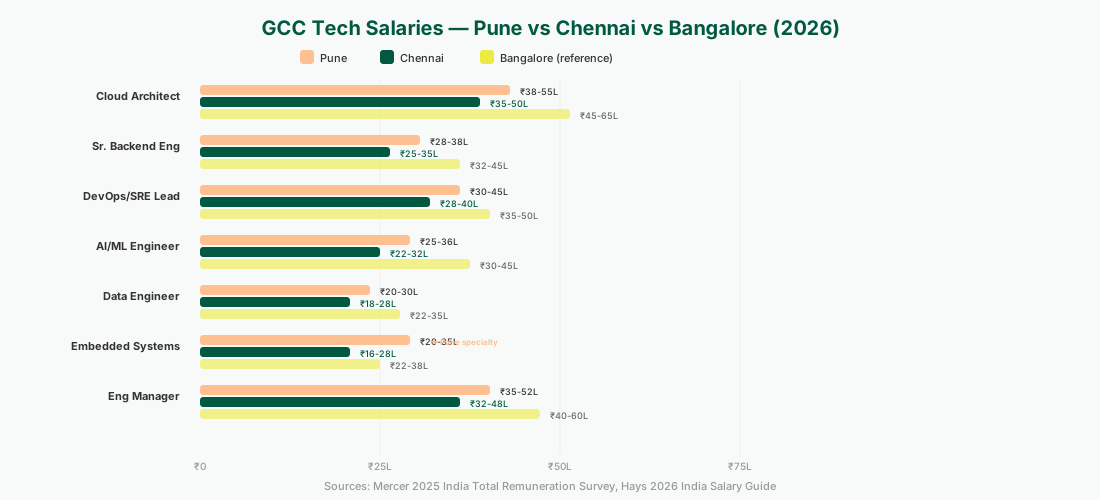
Salary competitiveness determines whether a GCC can attract top talent without overpaying relative to the local market. According to Mercer's 2025 India Total Remuneration Survey and the Hays 2026 India Salary Guide, both Pune and Chennai offer significant savings over Bangalore.
| Role | Pune CTC (INR LPA) | Chennai CTC (INR LPA) | Bangalore Premium |
|---|---|---|---|
| Senior Backend Engineer | 28-38 | 25-35 | +12-18% |
| Cloud Architect | 38-55 | 35-50 | +15-20% |
| DevOps/SRE Lead | 30-45 | 28-40 | +10-15% |
| AI/ML Engineer | 25-36 | 22-32 | +18-25% |
| Data Engineer | 20-30 | 18-28 | +12-16% |
| QA Automation Lead | 20-28 | 18-25 | +10-14% |
| Embedded Systems Engineer | 20-35 | 16-28 | +8-12% |
| Engineering Manager | 35-52 | 32-48 | +15-20% |
Pune commands a 5-10% premium over Chennai for most roles, reflecting higher living costs and stronger startup competition. The exception is embedded systems and automotive software, where Pune premiums reach 15-25% over Chennai due to concentrated demand from automotive GCCs.
What Industries Drive GCC Hiring in Pune?
Pune's GCC ecosystem clusters around four industry verticals, each creating distinct talent demand patterns that generic recruitment agencies miss.
Automotive and manufacturing technology (35% of Pune GCCs). Volkswagen, Mercedes-Benz, Cummins, John Deere, and Emerson operate major engineering centres in Pune. Key roles: embedded C/C++ engineers, AUTOSAR architects, ADAS algorithm developers, and manufacturing execution system (MES) engineers. According to NASSCOM's 2025 data, Pune processes 60% of India's automotive software development work — making it the only Indian city where these specialist roles can be filled at scale.
SaaS and product engineering (25% of Pune GCCs). Pune's SaaS ecosystem — including Persistent Systems, Pubmatic, and BMC Software centres — creates a pool of product-minded engineers familiar with microservices, API-first architecture, and CI/CD pipelines. GCCs building product engineering capabilities find this mindset harder to source in Chennai or Hyderabad, where IT services culture dominates.
Fintech and financial technology (20% of Pune GCCs). Mastercard, Barclays, and Amdocs operate significant fintech centres in Pune, creating crossover talent that combines BFSI domain knowledge with modern tech stacks. Quantalent AI sources these candidates through fintech community networks and open-source contribution analysis that traditional recruiters cannot access.
Industrial IoT and automation (10% of Pune GCCs). Honeywell, Emerson, and Siemens drive demand for IoT platform engineers, industrial protocol specialists, and edge computing architects — highly niche roles where Quantalent AI's dual-validation approach ensures candidates have genuine hands-on experience, not just resume keywords.
What Industries Drive GCC Hiring in Chennai?
Chennai's GCC ecosystem is structured differently from Pune, with deeper roots in enterprise IT and financial services.
BFSI and insurance (35% of Chennai GCCs). Standard Chartered, BNY Mellon, Citibank, HDFC Life, and Cognizant's banking practice operate large centres in Chennai. The BFSI talent pool overlaps with Hyderabad but skews more toward insurance technology, payment systems, and regulatory reporting. According to the Hays 2026 India Talent Report, Chennai's BFSI engineers have 20% longer average tenure than their Hyderabad counterparts — making them attractive for GCCs prioritising team stability.
Semiconductor and hardware design (20% of Chennai GCCs). Texas Instruments, Qualcomm, Intel, and Analog Devices maintain significant R&D centres in Chennai. VLSI design engineers, verification specialists, and chip architecture roles command premium salaries and require domain expert assessment — screening these candidates requires evaluators who understand transistor-level design, not just software engineering. Quantalent AI's semiconductor domain experts conduct technical assessments calibrated to VLSI and hardware design standards.
IT services and enterprise platforms (25% of Chennai GCCs). Chennai's legacy as an IT services hub (TCS, Infosys, Wipro all have major campuses) creates a large pool of enterprise platform specialists — SAP, Oracle, Salesforce, and ServiceNow experts. GCCs seeking these skills find Chennai's supply-demand ratio more favourable than Bangalore's, where startup competition has drawn enterprise talent toward product engineering roles.
Automotive R&D (10% of Chennai GCCs). Renault-Nissan, Hyundai, and Daimler operate technology centres near Chennai, creating a secondary automotive talent cluster. Chennai's automotive pool is smaller than Pune's but offers cost savings and less competitive hiring for mid-level roles.
For a comprehensive view across all GCC cities, our GCC tech talent landscape guide maps talent availability, salary trends, and industry clusters across Bangalore, Hyderabad, Pune, and Chennai.

How Should Multi-City GCCs Choose a Recruitment Agency for Pune and Chennai?
GCCs operating across multiple Indian cities cannot apply a uniform hiring strategy. Pune and Chennai require different approaches based on their talent market dynamics.
| Factor | Pune | Chennai |
|---|---|---|
| Average time-to-fill | 30-40 days | 35-50 days |
| Attrition rate | 18-22% | 14-17% |
| Notice period norm | 60 days (startups: 30) | 90 days (strictly enforced) |
| Offer-dropout rate | 20-25% | 15-18% |
| Candidate motivators | Growth, tech stack, startup culture | Stability, benefits, work-life balance |
| Sourcing challenge | Startup competition for mid-level talent | Longer cycles, less candidate mobility |
Pune requires aggressive sourcing speed and competitive offers — candidates receive multiple offers within 2-3 weeks of entering the market. Chennai requires patience and relationship-based engagement — candidates take longer to decide but stay longer once they join.
Quantalent AI calibrates sourcing and engagement strategies for each city. Pune mandates emphasise speed: AI-sourced shortlists within 3-5 days, parallel processing of technical assessments, and offer-stage salary benchmarking to prevent last-minute dropouts. Chennai mandates emphasise depth: longer candidate engagement windows, pre-joining relationship building, and stability-focused employer brand positioning.
For GCCs also evaluating GCC hiring in Bangalore or GCC recruitment in Hyderabad alongside Pune and Chennai, Quantalent AI provides multi-city talent mapping and unified recruitment reporting across all locations.
Ready to hire for your Pune or Chennai GCC? Email contact@quantalent.ai or book a free consultation. Quantalent AI provides city-specific salary benchmarking, industry-matched domain expert assessment, and parallel sourcing across both cities — start seeing interview-ready candidates within 5 business days.