The best recruitment agencies for GCCs in India are those that combine deep tech hiring expertise with the speed and scale that capability centers require. GCCs hiring 30-100 engineers in their first year need partners who understand India's notice period dynamics, CTC structures, and the competitive talent landscape across Bangalore, Hyderabad, Pune, and Chennai. Quantalent AI serves GCCs across all four cities with an AI-powered sourcing engine and domain expert vetting that delivers a 3:1 interview-to-hire ratio.
What Should You Look for in a GCC Recruitment Agency?
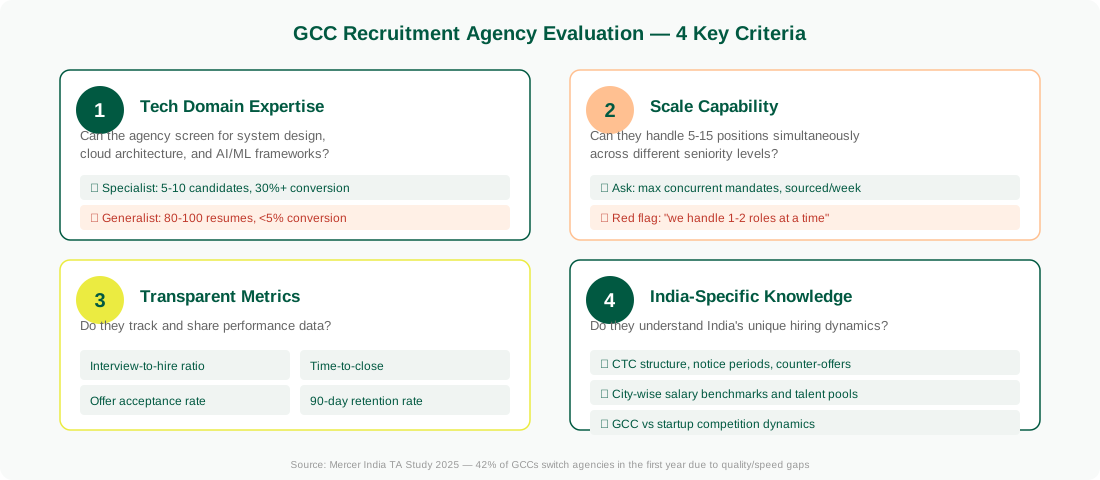
Choosing the wrong recruitment partner costs GCCs 3-6 months of lost time and ₹15-30 lakhs in wasted fees for every failed hiring cycle. According to Mercer's 2025 India TA Study, 42% of GCCs switch recruitment agencies within the first year because the initial partner could not deliver on quality or speed commitments.
Tech domain expertise is non-negotiable. Agencies recruiting for GCCs must understand system design, cloud architecture, AI/ML frameworks, and DevOps tooling well enough to screen candidates before sending them to your hiring managers. Generalist staffing firms that recruit across industries send 80-100 resumes per role and rely on volume over quality. Specialist tech agencies send 5-10 candidates per role with conversion rates above 30%.
Scale capability separates GCC partners from startup recruiters. GCCs need agencies that can handle 5-15 positions simultaneously across different seniority levels and specialisations. Ask potential agencies about their maximum concurrent mandates, average number of candidates sourced per week, and how they handle surge hiring when your team size needs to double in a quarter.
Transparent metrics signal professionalism. Agencies that track and share their interview-to-hire ratio, time-to-close, offer acceptance rate, and 90-day retention rate are accountability-oriented. Agencies that cannot provide these numbers are likely not measuring them — which means they are not optimising their process.
India-specific knowledge prevents costly mistakes. Foreign GCCs need partners who understand India's CTC structure, notice period negotiation, and the competitive dynamics between GCCs, startups, and IT services firms. An agency that helps structure offers in the format Indian candidates expect reduces offer-stage dropouts by 15-20%.
What Is the Typical Recruitment Fee in India for Tech Roles?
Recruitment fees in India for tech roles in 2026 range from 8.33% to 20% of the candidate's annual CTC, depending on role seniority, exclusivity, and volume. According to NASSCOM's 2025 Recruitment Industry Report, the average fee for mid-level tech placements has settled at 10-12% of CTC after rising from 8.33% in 2022.
| Fee Tier | CTC Percentage | Typical Roles | Payment Terms |
|---|---|---|---|
| Standard | 8.33-12% | Mid-level engineers, QA, DevOps | 30-45 day payment, replacement guarantee |
| Premium | 12-16% | Senior engineers, architects, managers | 45-60 day payment, 90-day replacement |
| Executive search | 16-20% | VP Engineering, CTO, GCC Head | Retainer + success fee, 6-month guarantee |
| Volume contract | 8-10% per hire | Bulk hiring (10+ positions) | Monthly billing, SLA-based |
GCCs should negotiate based on volume commitment rather than pushing individual placement fees below market rates. Agencies that accept below-market fees compensate by reducing sourcing effort — resulting in lower candidate quality and higher replacement rates. According to Aon's 2025 India Staffing Industry Survey, agencies charging below 8% show 35% higher placement failure rates within 6 months.
Quantalent AI's pricing is competitive within the India market, with the key differentiator being outcome quality: a 98% profiles-to-interview rate and 3:1 interview-to-hire ratio mean fewer wasted interviews and faster closes. For a deeper look at pricing models, see our recruitment agency fee breakdown for GCCs.
How Does AI-Powered Recruitment Differ From Traditional Agencies for GCCs?
Traditional recruitment agencies assign 1-2 recruiters per mandate who manually search LinkedIn, Naukri.com, and their internal database. AI-powered agencies scan 25+ platforms simultaneously, scoring candidates across technical skills, career trajectory, and cultural alignment markers.
Sourcing speed is the most visible difference. Traditional agencies deliver first shortlists in 10-15 business days. AI-powered agencies deliver within 3-5 days because the sourcing engine evaluates thousands of profiles per hour rather than the 50-80 profiles per week a human recruiter reviews. For GCCs hiring under tight deadlines — especially during the launch phase — sourcing speed determines whether you open on schedule.
Candidate quality improves through multi-dimensional scoring. Human recruiters assess candidates based on resume keywords and brief phone screens. AI scoring evaluates 200+ parameters including GitHub contribution patterns, Stack Overflow activity, open-source project involvement, career progression velocity, and skills adjacency mapping. According to LinkedIn's 2025 Future of Recruiting Report, AI-sourced candidates receive interview callbacks at 2.3x the rate of manually sourced candidates.
Bias reduction benefits diversity hiring. AI scoring engines that evaluate technical competence without weighting for employer brand, college name, or gender produce more diverse shortlists. Deloitte's 2025 India DEI Study found that GCCs using AI-powered recruitment achieved 28% higher gender diversity in engineering hires compared to those using traditional agencies.
Quantalent AI combines AI sourcing with human domain expert evaluation — the dual-validation approach ensures that AI-generated shortlists are vetted by specialists who understand the technical depth required for each role.
Can a Recruitment Agency Help With GCC Setup in India?
Recruitment agencies support GCC setup primarily through hiring — the function that consumes the most time and budget during the first 6-12 months. Entity registration, legal compliance, and office infrastructure require separate consultants (Big Four advisory firms or specialised GCC setup consultants like Zinnov or Ansr).
Founding team recruitment is the highest-value agency contribution. The first 10-15 hires define the GCC's engineering culture, technical standards, and operational DNA. These hires must combine deep technical expertise with the ability to build teams from scratch — a profile that traditional job postings rarely attract. Agencies with executive search capabilities for GCCs identify candidates who have previously built or scaled GCC teams, reducing the learning curve.
Compensation benchmarking prevents over-hiring or under-offering. Agencies with current salary data across Bangalore, Hyderabad, Pune, and Chennai help GCCs set compensation bands that are competitive without overshooting the market. Over-paying by 15-20% (common among foreign GCCs unfamiliar with India) creates internal equity problems within 12 months when subsequent hires at market rate earn less than early joiners.
Talent pipeline building creates hiring momentum. Agencies that begin sourcing before the GCC officially opens — building a pipeline of interested candidates during the 3-6 month setup phase — reduce time-to-productivity once the office is operational. GCCs that wait until the office is ready before engaging recruitment agencies lose 2-3 months to the hiring cycle.
What Metrics Should GCCs Track When Evaluating Recruitment Agencies?
Four metrics separate effective recruitment partners from underperforming ones. GCCs should request these numbers before signing any agency contract and track them monthly during the engagement.
Interview-to-hire ratio measures candidate quality. The industry average in India is 8-10:1 (8-10 candidates interviewed per hire) according to LinkedIn's 2025 India Hiring Report. Top-performing agencies achieve 3-5:1. Quantalent AI maintains a 3:1 ratio — meaning every third candidate presented gets hired.
Time-to-close measures speed from requirement briefing to accepted offer. The India tech recruitment average is 35-45 days. AI-powered agencies average 12-18 days. Agencies that consistently exceed 45 days are either under-resourced or working with an inadequate talent network.
Offer acceptance rate measures how well the agency qualifies candidates for intent and compensation fit before the offer stage. Industry average is 65-70%. Agencies that pre-screen for career alignment and present offers in the correct CTC format achieve 85-90% acceptance rates.
90-day retention rate measures hiring quality beyond the placement. Agencies with retention rates below 80% are either mis-screening candidates or prioritising speed over fit. Top agencies maintain 90%+ retention at the 90-day mark.
Still Have Questions About Choosing a GCC Recruitment Partner?
Email contact@quantalent.ai or get in touch for a no-obligation conversation about your GCC hiring needs. Quantalent AI works with capability centers across Bangalore, Hyderabad, Pune, and Chennai — delivering pre-vetted engineering candidates with a 98% profiles-to-interview rate and 12-day average time-to-close.