A global capability center (GCC) is an offshore business unit owned and operated by a parent company to deliver technology, operations, and innovation functions from a lower-cost, high-talent location. India hosts over 1,800 GCCs in 2026 employing 1.9 million professionals across Bangalore, Hyderabad, Pune, Chennai, and emerging tier-2 cities. Quantalent AI helps GCCs source, vet, and hire tech talent at scale across these hubs.
What Is a Global Capability Center?
A global capability center is a legal entity owned by a multinational corporation and set up in a different country to deliver internal services. The term replaced "captive center" as the industry matured beyond cost arbitrage into strategic work. Modern GCCs own products, run engineering centers of excellence, handle global finance and HR operations, and increasingly lead AI and data science mandates.
The distinguishing feature of a GCC is ownership. A GCC is legally part of the parent company, staffed by parent-company employees, and aligned with parent-company strategy. Vendors and outsourcing firms are third parties operating under contracts. GCCs offer stronger IP control, tighter quality alignment, and long-term strategic integration at the cost of higher initial investment and a longer setup timeline.
The GCC model has evolved through three waves. The first wave (2000 to 2010) focused on cost arbitrage for back-office and IT support. The second wave (2010 to 2020) expanded into engineering services, analytics, and shared-services for finance and HR. The third wave, now underway, positions GCCs as innovation hubs: Deloitte's 2025 Global Shared Services Survey found that 62 percent of India GCCs own end-to-end product development, up from 31 percent in 2018.
How Many GCCs Operate in India in 2026?
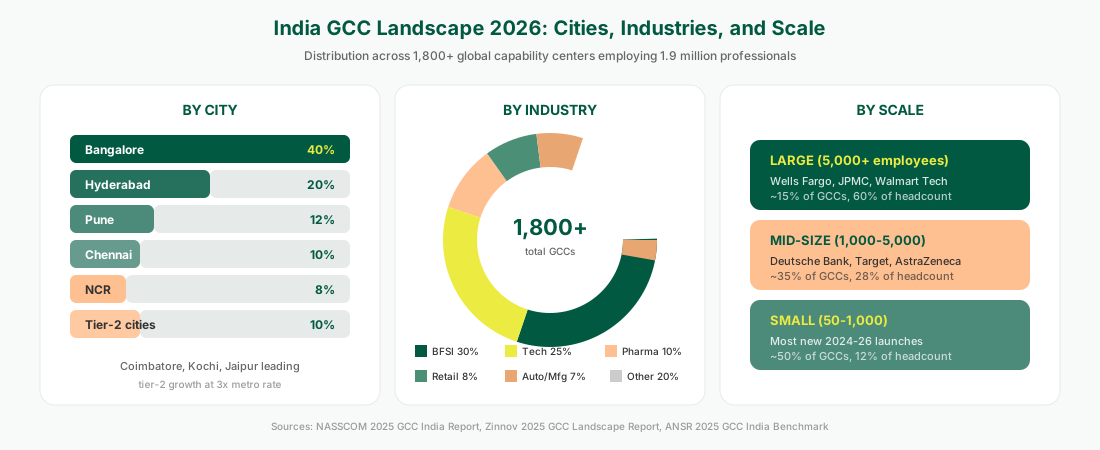
India hosts over 1,800 global capability centers in 2026 according to NASSCOM's 2025 GCC India Report. The sector employs 1.9 million professionals, generates $64 billion in annual revenue, and has added over 200 new centers between 2024 and 2026. Growth has averaged 12 to 15 percent annually for the past five years, with financial services, technology, and healthcare leading new setups.
Distribution by city is concentrated but shifting. Bangalore still houses approximately 40 percent of all GCCs, though its share has declined from 45 percent in 2023 as other hubs absorb new mandates. Hyderabad hosts 20 percent, Pune 12 percent, and Chennai 10 percent. Gurugram and Noida together contribute 8 percent, and emerging tier-2 cities (Coimbatore, Kochi, Jaipur, Ahmedabad, Indore) account for the remaining 10 percent.
Scale varies widely across GCCs. The largest India GCCs exceed 40,000 employees (Wells Fargo, JPMorgan Chase, Walmart Global Tech). Mid-size centers typically operate with 1,000 to 5,000 employees. An increasing share of new GCCs open with 50 to 300 engineers and plan to scale over 3 to 5 years, rather than the large-scale launches common in the 2010s.
For a detailed view of how India's tech talent market supports GCCs at each scale, see our GCC tech talent landscape report for 2026.
What Does It Cost to Set Up a GCC in India?
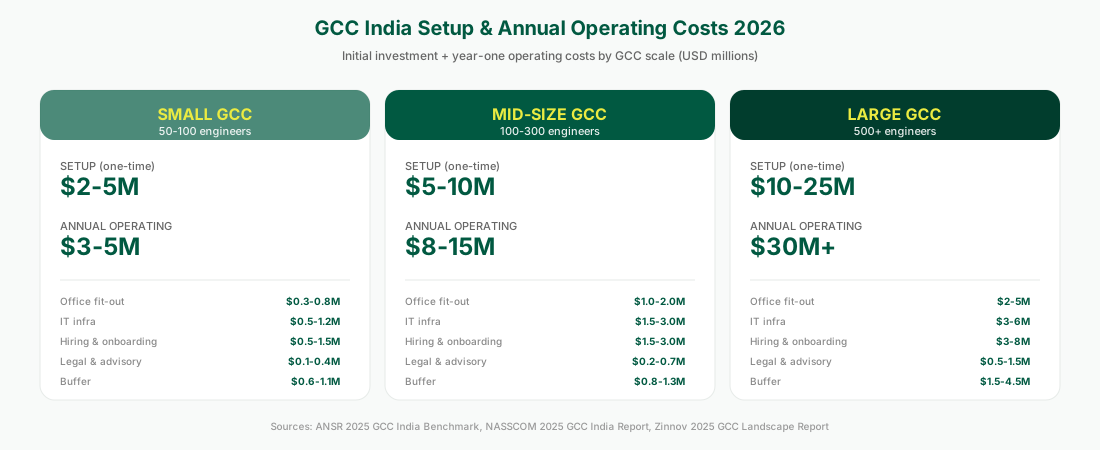
Setting up a GCC in India typically costs $2 million to $25 million in initial investment depending on scale, with annual operating costs of $3 million to $30 million or more. Cost ranges vary by target headcount, city, and function mix, but breakdown patterns are consistent across mandates.
Initial investment (months 1 to 12):
- Legal entity setup, registrations, and permits: $50,000 to $200,000
- Office fit-out and real estate deposits: $300,000 to $3 million
- IT infrastructure (hardware, licenses, security): $500,000 to $5 million
- Recruitment and onboarding costs: $500,000 to $4 million for the initial 50 to 300 hires
- Advisory and consulting fees: $100,000 to $1 million
Annual operating costs (ongoing):
- Compensation: 55 to 65 percent of total cost, scaling with headcount
- Real estate and facilities: 10 to 15 percent
- IT and infrastructure: 15 to 20 percent
- Legal, tax, compliance, and transfer pricing: 3 to 5 percent
- Corporate services (travel, training, HR): 5 to 7 percent
A small GCC of 50 to 100 engineers typically needs $2 to $5 million for setup plus $3 to $5 million annually. A mid-size GCC of 100 to 300 engineers needs $5 to $10 million setup plus $8 to $15 million annually. A large GCC of 500+ engineers requires $10 to $25 million for setup plus $30 million or more annually, per ANSR's 2025 GCC India Benchmark. Tier-2 cities reduce annual operating costs by 25 to 35 percent compared to Bangalore, primarily through lower salaries and real estate.
Do GCCs Need to Register Separately in India?
Yes. A GCC operating in India must establish a separate legal entity from the parent company. The three common structures are private limited company, limited liability partnership (LLP), and branch office, each with different compliance burdens and operational constraints.
Private limited company is the dominant structure for new GCCs. Incorporated under the Companies Act 2013, it offers limited liability protection, operational flexibility, and eligibility for India's Software Technology Parks (STPI) or Special Economic Zone (SEZ) tax benefits. Incorporation takes 2 to 4 weeks and costs $3,000 to $10,000 in legal and registration fees. Ongoing compliance includes annual filings with the Ministry of Corporate Affairs, quarterly GST returns, and statutory audits.
Limited liability partnership (LLP) suits smaller GCCs with under 50 employees or specific advisory functions. LLPs have simpler compliance (no statutory audit below certain thresholds), pass-through tax treatment in some cases, and lower ongoing administrative costs. LLPs cannot issue stock options in the same form as private limited companies, which limits their use for technology GCCs that rely on RSUs or equity incentives for talent retention.
Branch office is rarely used for GCCs because the Reserve Bank of India restricts its permitted activities to specific categories (export promotion, research, professional services). Most technology, financial services, and operations GCCs cannot operate through a branch office structure. Liaison offices are even more restrictive and cannot conduct any commercial activity.
Every structure requires registration with the Ministry of Corporate Affairs, GST registration, PAN and TAN issuance, compliance with the Companies Act, adherence to Indian labor laws, data protection under the Digital Personal Data Protection Act 2023, and transfer pricing documentation for all inter-company transactions with the parent.
Which Industries Have the Most GCCs in India?
Industry distribution across India's 1,800+ GCCs is led by financial services and technology, with healthcare, retail, and manufacturing making up the next tier, per Zinnov's 2025 GCC Landscape Report.
Banking, financial services, and insurance (BFSI) accounts for approximately 30 percent of India GCCs. Major players include JPMorgan Chase, Wells Fargo, HSBC, Deutsche Bank, Citi, Goldman Sachs, and Morgan Stanley. BFSI GCCs focus on quantitative research, risk analytics, technology platforms, operations, and increasingly AI and machine learning for fraud detection and trading.
Technology and software represents about 25 percent. Google, Microsoft, Amazon, IBM, Oracle, SAP, Adobe, and Salesforce operate large India GCCs focused on product engineering, cloud infrastructure, AI research, and global platform development. Many technology GCCs have shifted from support functions to owning end-to-end product development.
Pharma and healthcare contributes 10 percent, including Pfizer, Novartis, GSK, Merck, Johnson & Johnson, and AstraZeneca. Pharma GCCs handle regulatory affairs, clinical data management, R&D informatics, and increasingly AI-driven drug discovery.
Retail and consumer packaged goods makes up 8 percent, with Target, Walmart, Lowe's, Home Depot, Unilever, and Procter & Gamble running technology and analytics centers in India. Automotive and manufacturing add another 7 percent through European and Japanese OEMs (Mercedes-Benz, BMW, Volkswagen, Toyota, Hitachi). The remaining 20 percent spans energy, telecom, logistics, aerospace, media, and emerging verticals including climate tech and quantum computing.
What Is the Difference Between a GCC and an ODC?
A global capability center and an offshore development center serve different purposes, carry different commercial structures, and suit different organizational needs. The distinction matters because choosing the wrong model creates either cost overruns or control problems.
Ownership model. A GCC is owned by the parent company as a legal entity staffed by parent-company employees. An ODC (offshore development center) is typically a vendor-operated arrangement where a services firm manages a dedicated team for the client under a contract. In an ODC, the employees legally work for the vendor, not the client.
Setup timeline and cost. GCCs take 12 to 18 months to establish fully and require $2 to $25 million in initial investment. ODCs can be operational in 3 to 6 months because the vendor provides infrastructure, compliance, and staffing. ODCs have near-zero setup cost to the client but carry a 15 to 25 percent markup on labor cost because the vendor embeds its margin.
Strategic scope. GCCs cover broad scope: technology, operations, analytics, finance, HR, R&D, and innovation. ODCs tend to be narrower and task-specific, often focused on software development for a particular product or platform. GCCs that grow past 500 to 1,000 employees typically own entire business capabilities end to end; ODCs rarely scale beyond a few hundred and operate within defined workstreams.
IP control and talent retention. GCC IP ownership is clean because employees are parent-company staff. ODC IP ownership depends on contract terms and can be contested. Talent retention is structurally better in GCCs because employees build careers within the parent brand; ODC engineers may rotate across client projects based on vendor priorities. For ongoing tech hiring needs once the structure is chosen, see our AI-powered GCC recruitment guide.
How Can Quantalent AI Help You Set Up or Scale a GCC in India?
Quantalent AI supports GCC setup and scaling across two fronts: fast initial team building and ongoing high-volume recruitment at maintained quality. For a new GCC launching with 50 to 300 engineers, Quantalent AI provides pre-vetted shortlists within 5 business days across Bangalore, Hyderabad, Pune, Chennai, and tier-2 cities. The 12-day average time-to-close and 3:1 interview-to-hire ratio compress what traditionally takes 4 to 6 months into 8 to 12 weeks of active hiring.
For established GCCs scaling beyond 500 employees, Quantalent AI handles ongoing senior and specialist hiring including AI/ML engineers, cloud architects, cybersecurity leads, and engineering managers. The dual-validation approach combines AI sourcing across 25+ platforms with human domain expert interviews, which reduces mis-hires that drive 12-month attrition.
Key Takeaways
- A global capability center is a legal offshore unit owned by a parent MNC that delivers technology, operations, analytics, and innovation functions; it differs from outsourcing because GCC employees work for the parent, not a vendor
- India hosts 1,800+ GCCs in 2026 employing 1.9 million professionals per NASSCOM's 2025 report; Bangalore leads with 40 percent, followed by Hyderabad, Pune, and Chennai
- Setting up a GCC in India costs $2 to $25 million in initial investment and $3 to $30 million or more annually depending on scale, with compensation accounting for 55 to 65 percent of ongoing costs per ANSR's 2025 benchmark
- GCCs must register as separate legal entities in India, most commonly as private limited companies under the Companies Act 2013; LLP is an option for smaller operations while branch office is rarely viable
- BFSI leads industry distribution at 30 percent, followed by technology at 25 percent, pharma at 10 percent, and retail at 8 percent per Zinnov's 2025 GCC Landscape Report
- A GCC differs from an ODC in ownership (parent vs vendor), timeline (12 to 18 months vs 3 to 6 months), scope (broad vs task-specific), and commercial structure (direct cost vs marked-up vendor contract)
Email contact@quantalent.ai or book a free consultation to discuss GCC hiring for Bangalore, Hyderabad, Pune, Chennai, or a tier-2 city launch. Quantalent AI delivers pre-vetted shortlists within 5 business days and supports GCC builds from initial 50-person launches through ongoing scale across 1,000+ engineer mandates.