Quantalent AI is a SaaS recruitment agency in India that specialises in hiring for product-led SaaS companies and compliance-aware fintech startups. We source product engineers, payment developers, growth engineers, and ML specialists from 25+ platforms, then vet each candidate through our dual-validation process — AI assessment plus domain expert interview. Average time-to-close: 12 days.
Why SaaS and Fintech Hiring in India Needs a Specialist
India's SaaS and fintech sectors are the two largest recipients of venture capital in the country. According to Inc42's 2025 State of Indian Startup report, Indian SaaS companies raised USD 4.6 billion in 2025, while fintech attracted USD 3.2 billion. Bangalore alone accounts for 40% of India's SaaS workforce and over 35% of fintech engineering talent.
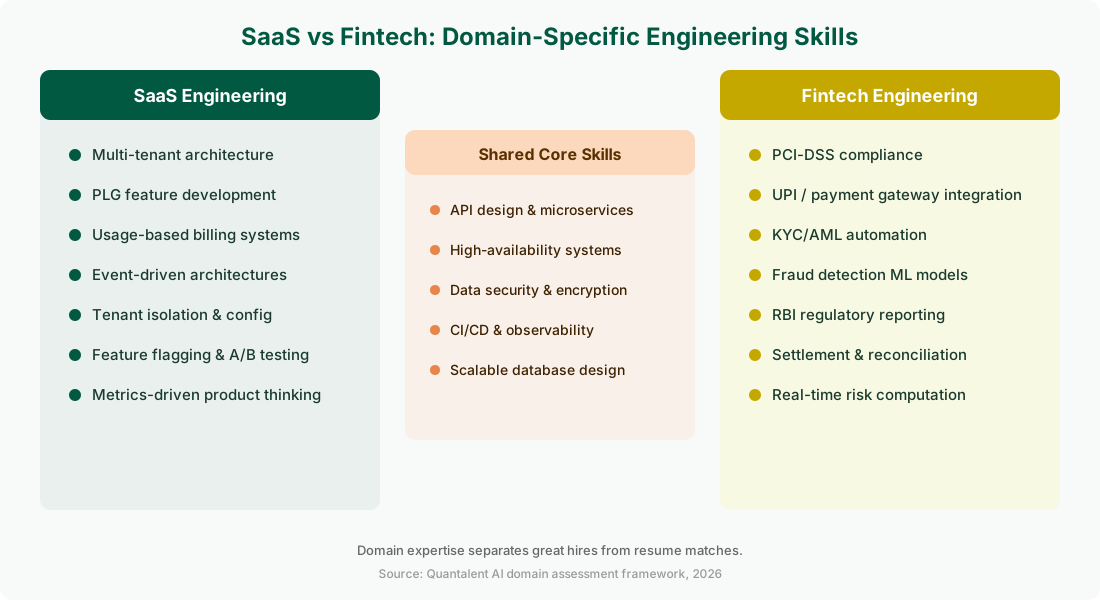
The hiring challenge is straightforward: both verticals need engineers who combine deep technical skills with domain-specific knowledge. A React developer who has never built a multi-tenant dashboard won't succeed at a B2B SaaS company. A backend engineer with no exposure to PCI-DSS or UPI settlement flows won't survive their first sprint at a payments startup.
General recruitment agencies treat SaaS and fintech roles as standard software engineering positions. The result is a 10:1 interview-to-hire ratio and a 45-60 day hiring cycle. Quantalent AI closes these roles in 12 days with a 3:1 ratio because our domain experts evaluate candidates on the skills that actually matter in these verticals.
What Makes SaaS Hiring Uniquely Challenging in India
Product-led SaaS companies need a specific type of engineer — one who thinks about customer outcomes, not just code. Hiring for SaaS means evaluating candidates on capabilities that don't appear on a standard resume.
Multi-tenant architecture expertise. B2B SaaS products serve hundreds or thousands of customers on shared infrastructure. Engineers need to understand tenant isolation, data partitioning, and per-tenant configuration without compromising performance. According to NASSCOM's 2025 SaaS landscape report, 78% of Indian SaaS companies operate multi-tenant architectures, yet fewer than 20% of senior backend candidates have production experience with tenant-aware systems.
Product engineering mindset. SaaS engineers ship features that directly affect revenue metrics — activation rates, churn, expansion revenue. A product engineer at a PLG (product-led growth) SaaS company makes architectural decisions based on user behaviour data, not just technical requirements. Quantalent AI's domain expert interviews assess this product thinking through scenario-based evaluations, not checkbox questionnaires.
Growth and infrastructure engineering. Scaling a SaaS product from 1,000 to 100,000 users requires engineers who understand event-driven architectures, usage metering, billing system integration, and observability at scale. These roles are among the hardest to fill because they sit between backend engineering and DevOps — and most candidates specialise in one or the other.
What Makes Fintech Hiring Different From General Tech Recruitment
India's fintech ecosystem processes real money in real time. The Reserve Bank of India (RBI) reported that UPI handled 16.6 billion transactions worth INR 23.4 lakh crore in January 2026 alone. Engineers building these systems carry regulatory and financial liability that general software engineers don't face.
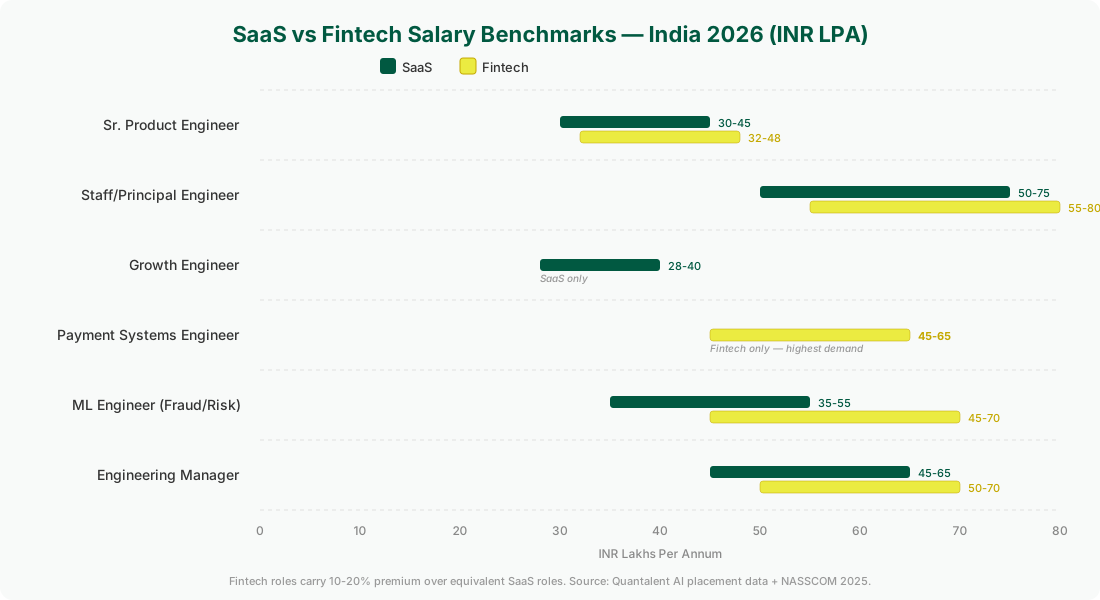
Payment systems engineers. Companies like Razorpay, PhonePe, and Paytm have created a deep pool of payment engineers in India — but these candidates are in extreme demand. A senior payment engineer in Bangalore with UPI and PCI-DSS experience commands INR 45-65 LPA. Sourcing passive candidates from this pool requires scanning GitHub contributions to payment SDKs, participation in NPCI developer forums, and direct outreach through fintech-specific communities that generalist recruiters never access.
Compliance and regulatory engineering. RBI's 2024 Digital Lending Guidelines and the updated KYC norms require fintech companies to embed compliance directly into their technology stack. Compliance engineers who understand both the regulatory framework and the technical implementation are rare. The candidate pool in India for senior compliance engineers with hands-on RBI reporting experience is estimated at fewer than 3,000 professionals nationwide.
Fraud detection and risk ML engineers. Every lending platform and payment company needs ML engineers who can build real-time fraud scoring models. These engineers need expertise in feature engineering for financial data, model explainability for audit compliance, and low-latency inference systems. Quantalent AI sources these specialists from fintech companies, banking R&D labs, and academic research groups — not from general ML job boards.
"Quantalent was instrumental in filling our niche roles by tapping into talent from diverse communities and unconventional platforms." — Harsha Kadimisetty, CEO, Aerchain (Supply Chain Tech)
Salary Benchmarks: SaaS and Fintech Engineers in India 2026
Compensation expectations in SaaS and fintech diverge significantly from general software engineering. CTOs and VPs of Engineering need accurate benchmarks to craft competitive offers and reduce offer dropouts.
| Role | SaaS (INR LPA) | Fintech (INR LPA) | Experience |
|---|---|---|---|
| Senior Product Engineer | 30-45 | 32-48 | 5-8 years |
| Staff/Principal Engineer | 50-75 | 55-80 | 8-12 years |
| Growth Engineer | 28-40 | — | 4-7 years |
| Payment Systems Engineer | — | 45-65 | 5-9 years |
| ML Engineer (Fraud/Risk) | 35-55 | 45-70 | 4-8 years |
| Compliance Engineer | — | 30-50 | 5-8 years |
| Engineering Manager | 45-65 | 50-70 | 8-12 years |
Fintech roles consistently command a 10-20% premium over equivalent SaaS roles at the same experience level. Payment engineers and fraud ML engineers see the highest premiums because of the regulatory complexity and the direct financial impact of their work.
Offer dropout rates in India for senior SaaS and fintech roles hover around 25-30%, according to NASSCOM's 2025 talent trends report. The primary drivers are counteroffers from current employers and competing offers from well-funded startups. Quantalent AI mitigates this through candidate engagement strategies tailored for startup hiring — including continuous communication during notice periods and structured onboarding support.
How Quantalent AI Sources for SaaS and Fintech Roles
Standard recruitment databases miss the best SaaS and fintech candidates. Engineers who have scaled a B2B SaaS platform from 100 to 10,000 customers — or built a real-time payment reconciliation system processing millions of daily transactions — rarely respond to InMail from generalist recruiters.
Quantalent AI's sourcing engine scans 25+ platforms with fintech and SaaS-specific filters: open-source contributions to payment libraries, activity in SaaS architecture communities, conference talks at SaaSBOOMi or Fintech Festival India, and employment history at recognised product companies. Our AI scores candidates across 200+ parameters before a human recruiter reviews a single profile.
Domain expert interviews separate capable engineers from resume-polished candidates. For SaaS roles, our evaluators probe multi-tenant design decisions, feature flagging strategies, and metrics-driven product thinking. For fintech roles, evaluators assess understanding of settlement finality, idempotent transactions, and compliance reporting workflows.
"Quantalent transformed our recruitment by engaging passive talent. Their outreach and precise matching turned overlooked professionals into valuable, active contributors." — Saiteja Veera, CEO, Gamyam (Logistics Tech)
For companies also hiring AI and ML engineers alongside their SaaS or fintech teams, Quantalent AI applies the same domain-expert vetting approach — see our AI engineer hiring services for Indian startups.
Ready to Build Your Team?
India's SaaS and fintech sectors are hiring aggressively in 2026, and the best engineers are off the market within 10 days of starting their search. Whether you need a product engineer for your PLG SaaS platform, a payment specialist for your fintech startup, or an ML engineer for fraud detection, Quantalent AI delivers vetted candidates with domain expertise — not just matching keywords.
Get started: Email us at contact@quantalent.ai or book a consultation. Share your open roles, and we'll have your first shortlist of interview-ready candidates within 5 business days.