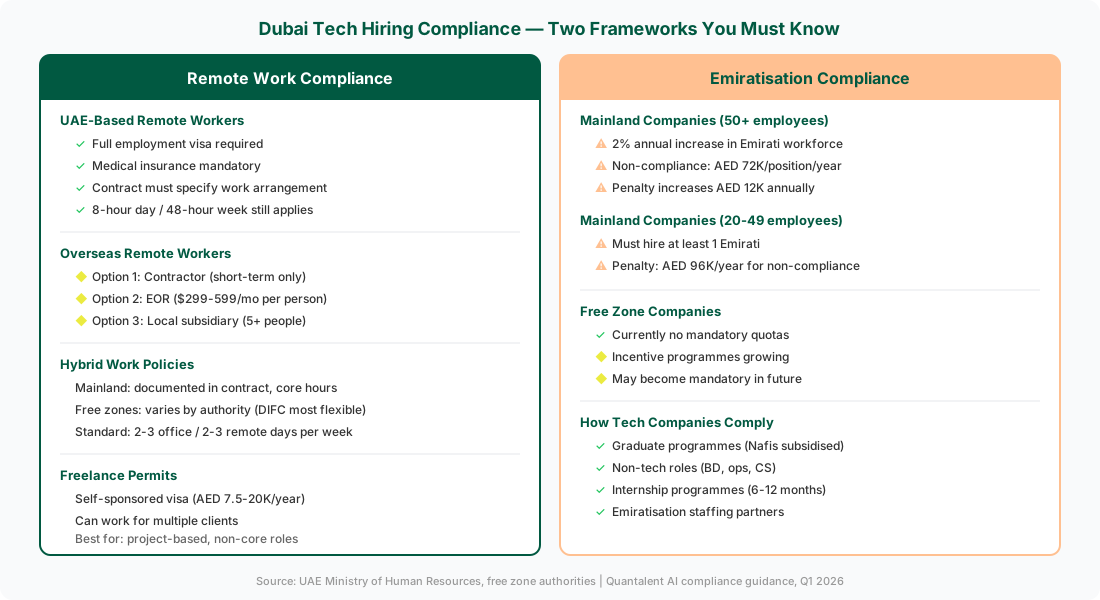
Dubai companies hiring remote workers must navigate two distinct compliance frameworks: UAE remote work regulations (including the Virtual Working Programme, freelance permits, and hybrid work policies) and Emiratisation requirements that mandate Emirati national hiring targets. In 2026, tech companies with 50+ employees on mainland must increase Emirati headcount by 2% annually, while free zone companies face growing pressure through incentive programmes. Quantalent AI helps companies build compliant hiring strategies that balance international tech talent sourcing with local workforce requirements.
What Are the Remote Work Regulations in the UAE?
According to the UAE Ministry of Human Resources and Emiratisation (MOHRE), the UAE has embraced remote and flexible work more rapidly than most Gulf countries, issuing updated guidance on hybrid work arrangements in late 2025. The regulatory framework is still evolving. Here's what employers need to know in 2026.
Hiring remote workers inside the UAE
Any employee physically working in the UAE — whether from home, a co-working space, or your office — must have a valid UAE work permit. There is no "work from home exemption" from visa requirements. Remote work simply changes the physical location, not the legal employment relationship.
Key rules for UAE-based remote employees:
- Full employment visa required (same as office-based employees)
- Employer remains responsible for visa sponsorship and medical insurance
- Employment contract must specify the work arrangement (remote, hybrid, or office-based)
- Employer must provide necessary equipment and cover internet costs for fully remote workers
- Working hours regulations still apply — UAE Labour Law mandates 8-hour days, 48-hour weeks
The Virtual Working Programme (for foreign remote workers)
The UAE's Virtual Working Programme is designed to attract digital nomads and remote professionals who work for companies outside the UAE. This is not a hiring tool for Dubai employers — it's a residency programme.
How it works:
- 1-year renewable visa, costs approximately AED 1,100
- Holder can live in the UAE and use local infrastructure
- Cannot work for UAE-registered companies
- Must prove monthly income of $3,500+ or equivalent
- Gets Emirates ID, UAE bank account, and residency
Why it matters for hiring: These visa holders are in your talent pool. Many Virtual Working Programme holders eventually want local employment. They're already in Dubai, understand the culture, and don't need relocation. Hiring them is faster (status change vs new visa) and cheaper (no relocation package).
Hybrid work policies in free zones vs mainland
Mainland companies: The Ministry of Human Resources allows hybrid work arrangements provided they're documented in the employment contract. Companies must maintain a physical office and ensure employee attendance during core hours if specified. No specific legislation governs the split between office and remote days — it's contractual.
Free zone companies: Each free zone authority sets its own rules. DIFC explicitly allows flexible working arrangements under its employment law. Dubai Internet City and DMCC generally follow mainland guidance. Some free zones require a minimum physical office size based on employee count, which can conflict with fully remote setups.
Practical recommendation: For tech companies in Dubai, a 2-3 day office / 2-3 day remote hybrid is the standard in 2026. Candidates expect flexibility — companies mandating 5-day office attendance lose candidates to competitors offering hybrid arrangements.
How Can a Dubai Company Hire Remote Workers Abroad?
Many Dubai tech companies want to hire engineers in India, Pakistan, or Eastern Europe without relocating them. This is legally permissible but requires careful structuring.
Option 1: Independent contractor agreement
The simplest approach. Your Dubai company engages the remote worker as a self-employed contractor. The worker invoices you, handles their own taxes, and receives no employee benefits.
When it works: Short-term projects, clearly defined deliverables, non-exclusive engagement.
When it doesn't: If the relationship looks like employment (fixed hours, company laptop, exclusive work, indefinite duration), most countries will reclassify the contractor as an employee. In India, this exposes you to back-taxes, PF contributions, and potential legal action.
Option 2: Employer of Record (EOR)
An EOR like Deel, Remote, or Papaya Global becomes the legal employer in the worker's country. They handle payroll, taxes, benefits, and compliance. You manage the worker day-to-day.
Cost: $299-599/month per employee (varies by country and provider)
Best for: 1-5 remote employees in a single country. Beyond that, a local entity is more cost-effective.
Option 3: Local subsidiary
Set up a private limited company in the worker's country (e.g., an Indian Pvt Ltd for Indian developers). This gives you full control over hiring, IP, and operations.
Cost: $5,000-15,000 to incorporate + ongoing compliance ($2,000-5,000/year)
Best for: 5+ employees in a single country, long-term commitment, IP-sensitive work.
Quantalent AI helps Dubai companies navigate these options. Our Bengaluru office facilitates India hiring whether you need contractors, EOR employees, or help setting up an Indian entity.
What Are the Emiratisation Requirements for Tech Companies?
Emiratisation is the UAE government's programme to increase Emirati employment in the private sector. According to the Nafis programme's 2025 Annual Report, over 80,000 Emiratis were placed in private-sector roles since the programme's inception — but technology companies consistently report the highest difficulty meeting targets due to limited local STEM graduates. It's the most significant compliance requirement affecting hiring strategy for larger companies.
Current requirements (2026)
Mainland companies with 50+ employees:
- Must increase Emirati workforce by 2% annually
- Target is calculated based on total "skilled worker" positions
- Non-compliance penalty: AED 72,000 per unfilled Emirati position per year (AED 6,000/month)
- Penalties increase by AED 12,000 per position annually for continued non-compliance
Mainland companies with 20-49 employees:
- Must hire at least 1 Emirati in 2026 (requirement expanded from 50+ threshold)
- Penalty for non-compliance: AED 96,000 per year
Free zone companies:
- Currently not subject to mandatory Emiratisation quotas in most zones
- DIFC, ADGM, DMCC, DIC operate independently
- Growing incentive programmes: fee reductions, extra visa allocations, preferential treatment for companies hiring Emiratis
- Federal government has signalled potential future mandatory requirements
How tech companies are meeting Emiratisation targets
Graduate programmes. Partner with UAE University, Khalifa University, or NYUAD to hire computer science and engineering graduates into junior developer and data analyst roles. Starting salaries for Emirati graduates are AED 15,000-25,000/month (government may subsidise a portion through Nafis).
Non-technical roles with Emiratis. Hire Emiratis for business development, account management, customer success, and operations roles — functions where local market knowledge and Arabic language skills are genuine advantages. This satisfies quotas while keeping your engineering team internationally sourced.
Emiratisation-as-a-service. Some companies partner with Emirati staffing firms that provide compliant placements. The employee is technically on your payroll but the staffing firm handles sourcing and management.
Internship programmes. The Nafis programme subsidises Emirati internships with monthly stipends. A 6-12 month internship programme lets you assess fit before full hiring and counts toward your Emiratisation numbers.
Emiratisation and recruitment agencies
When working with a recruitment agency in the UAE, ensure they understand your Emiratisation position. A good agency will:
- Flag whether your company is subject to quotas
- Source Emirati candidates for appropriate roles alongside international candidates
- Help you identify roles where Emirati hiring adds genuine value (not just compliance)
- Advise on Nafis subsidies and training programmes
Quantalent AI incorporates Emiratisation awareness into our client consultations. We help companies build hiring plans that satisfy compliance requirements while ensuring technical excellence through international sourcing.
How Do UAE Freelance Permits Work for Tech Companies?
The UAE freelance permit system offers a middle ground between full employment and international contracting.
How freelance permits work
- Individual obtains their own visa through a free zone (DIC, DMC, DMCC offer freelance licences)
- Freelancer can work for multiple clients simultaneously
- No employer sponsorship required — the freelancer is self-sponsored
- Costs: AED 7,500-20,000/year depending on the issuing free zone
- Freelancer handles their own medical insurance and Emirates ID
When to use freelancers vs full-time hires
| Factor | Full-Time Employee | Freelancer |
|---|---|---|
| Best for | Core team, IP-sensitive work | Project-based, overflow |
| Commitment | Long-term | Per-project |
| Employer obligations | Visa, insurance, gratuity | Contract terms only |
| Emiratisation counting | Counts toward headcount | Does not count |
| Cost | Higher (salary + benefits) | Lower (day/project rate) |
| IP protection | Stronger (employment agreement) | Requires separate IP clause |
| Availability | Dedicated to you | May have other clients |
For tech companies: Use freelancers for QA testing, DevOps support, design sprints, and overflow development. Keep core engineering, product, and architecture roles as full-time employees for IP protection and team cohesion.
Building a Compliant Hiring Strategy
The optimal hiring strategy for a Dubai tech company in 2026 balances three priorities:
1. Technical excellence — Hire the best engineers regardless of nationality. This means international sourcing, particularly from India.
2. Emiratisation compliance — Meet quota requirements through strategic Emirati placements in roles where local knowledge is an advantage.
3. Cost efficiency — Use the right employment model for each role (full-time for core team, freelance for projects, EOR for remote international hires).
Quantalent AI helps companies build this balanced approach. We source international tech talent through our AI-powered platform while advising on Emiratisation strategy and compliance-aware team structure.
"Quantalent transformed our recruitment by engaging passive talent. Their outreach and precise matching turned overlooked professionals into valuable, active contributors." — Saiteja Veera, CEO, Gamyam
Need Compliance-Aware Hiring Support?
Navigating UAE employment regulations while building a world-class tech team is complex. Quantalent AI provides recruitment services that account for visa requirements, Emiratisation targets, and the Dubai startup ecosystem's regulatory landscape.
Get started: Email contact@quantalent.ai or book a consultation. We'll review your compliance position and help you build a hiring plan that meets both technical and regulatory requirements.