Hiring 100 engineers in India for a GCC in 6 months requires a phased approach, AI-powered sourcing to compress timelines, and disciplined quality controls that prevent screening standards from dropping under volume pressure. Quantalent AI helps GCCs execute rapid hiring ramps across Bangalore, Hyderabad, Pune, and Chennai — delivering a consistent 3:1 interview-to-hire ratio at any mandate size, with first shortlists within 3-5 business days.
How Do I Hire 100 Engineers in India in 6 Months for a GCC?
A 100-engineer ramp in 6 months is achievable but requires phased execution — not a single massive hiring sprint. According to NASSCOM's 2025 GCC India Report, GCCs that attempt to fill all positions simultaneously experience 35% higher early attrition because rushed screening lets mismatched candidates through.
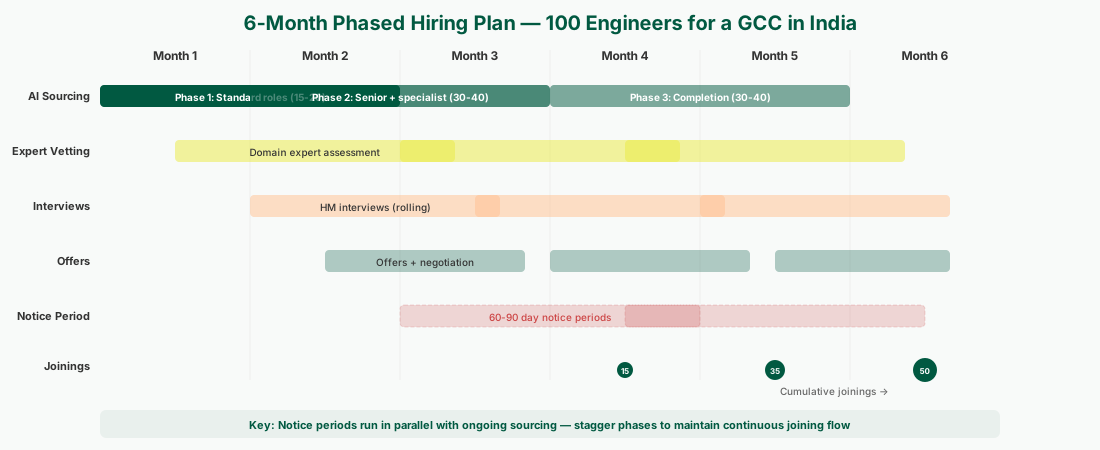
Phase 1 (Month 1-2): Foundation — 15-20 hires. Start with standardised mid-level roles — backend engineers, QA analysts, DevOps engineers — where candidate supply is deepest. Use an AI-powered agency like Quantalent AI for rapid sourcing across 25+ platforms. Simultaneously hire 1-2 internal TA coordinators who will manage the referral program in later phases.
Phase 2 (Month 3-4): Acceleration — 30-40 hires. Expand to senior engineers, tech leads, and specialist roles (data engineering, cloud architecture). Leverage Phase 1 hires as referral sources — NASSCOM's 2025 data shows referrals account for 30-40% of GCC hires once a critical mass of 15+ employees exists. Run specialist agency sourcing in parallel for AI/ML and cybersecurity positions.
Phase 3 (Month 5-6): Completion — 30-40 hires. Close remaining positions using the combined momentum of agency pipelines, referral networks, and employer brand awareness built during Phases 1-2. Focus internal TA capacity on offer management and candidate engagement during notice periods to minimise dropout rates.
For a detailed breakdown of how AI-powered agencies handle bulk mandates differently from traditional firms, see our bulk hiring agency guide for MNC India.
How Do I Hire at Scale in India for an MNC?
Scale hiring for an MNC in India requires parallel infrastructure — not sequential expansion of the same approach that works for 5-10 hires. According to Mercer's 2025 India Talent Acquisition Study, MNCs that treat scale hiring as "regular hiring but faster" experience 2x the cost overruns and 40% longer timelines compared to those who build dedicated scaling infrastructure from day one.
Dedicated hiring infrastructure includes: a primary recruitment agency partner with AI-powered sourcing capability, an internal TA coordinator managing candidate experience and offer logistics, standardised technical assessment frameworks calibrated with hiring managers, and weekly pipeline review cadences with clear volume targets per role family.
Multi-city sourcing is essential at scale. No single Indian city has sufficient supply to fill 50+ tech roles in one quarter without overheating the local talent market and driving up salaries. Quantalent AI sources across Bangalore, Hyderabad, Pune, and Chennai simultaneously, calibrating salary offers to each city's benchmarks while maintaining a unified candidate experience.
What Is the Realistic Timeline for Bulk Tech Hiring in India?
Realistic timelines depend on three variables: role complexity, notice period distribution, and pipeline volume. According to the Hays 2026 India Talent Report, average time-to-fill for mid-level tech roles through agencies is 35-45 days — but this metric measures sourcing-to-offer, not sourcing-to-joining.
| Mandate Size | Sourcing to Offers | Offers to Joining | Total Elapsed Time |
|---|---|---|---|
| 20 hires | 4-6 weeks | 8-12 weeks (notice) | 12-18 weeks |
| 50 hires | 6-10 weeks | 8-12 weeks (notice) | 14-22 weeks |
| 100 hires | 8-14 weeks (phased) | 8-14 weeks (rolling) | 22-28 weeks |
The critical insight: notice periods run in parallel with ongoing sourcing, not sequentially. Once Phase 1 offers are accepted, Phase 2 sourcing is already running — candidates from different phases join on rolling timelines throughout the 6-month window.
Should I Use Multiple Agencies or One for Volume Hiring?
One primary agency handles 70-80% of roles. One specialist agency handles niche positions. More than two agencies creates coordination problems that slow hiring rather than accelerating it.
The multi-agency trap. GCCs instinctively split mandates across 3-4 agencies, assuming competition drives speed. According to the Everest Group's 2025 GCC Talent Report, the opposite occurs: multiple agencies contact the same candidates through different channels, creating a disjointed experience that damages the GCC's employer brand.
Candidates who receive approaches from 3 different recruiters for the same company conclude the company is disorganised — and 25% disengage entirely.
The single-partner advantage. Quantalent AI's dual-validation approach maintains consistent screening standards across all roles in a bulk mandate. A single partner develops hiring manager calibration over the engagement — understanding what "good" looks like for each team — while multiple agencies each start from zero.
When to add a second agency. Add a specialist agency only for roles where your primary partner lacks domain expertise — typically AI/ML, cybersecurity, or executive-level positions. This creates a clean split: primary agency for 80% of volume, specialist for 20% of niche roles.
How Do I Maintain Quality While Hiring at High Volume?
Quality at scale is a process design problem, not a willpower problem. According to Deloitte's 2025 Global Human Capital Trends report, organisations that embed structured evaluation gates into their hiring workflows see 45% less quality variance at volume compared to those relying on recruiter judgment alone.
Quality at scale requires three structural controls — automated scoring against objective criteria, domain expert validation, and regular hiring manager calibration sessions. For a detailed breakdown of how these controls work at 50-500+ volumes, see our bulk hiring quality framework.
The real risk is invisible drift. When a GCC ramps from 10 to 50 hires per quarter, the screening bar shifts gradually — not in one dramatic drop. Quantalent AI tracks interview pass-through rates weekly during scaling mandates, flagging any deviation beyond 5% from baseline. This early-warning system catches quality erosion before it compounds into attrition problems 6 months later.
Calibration frequency matters more than calibration quality. Bi-weekly sessions where hiring managers review recent decisions keep expectations anchored to actual team needs. PwC's 2025 India Workforce Study found that GCCs running fortnightly calibration during scaling sprints experienced 22% lower 90-day attrition than those calibrating monthly.
For GCCs weighing whether to build internal quality controls versus relying on agency processes, our in-house vs agency comparison provides cost and quality analysis at different volumes.
What Is the Cost Per Hire for Bulk Tech Recruitment in India?
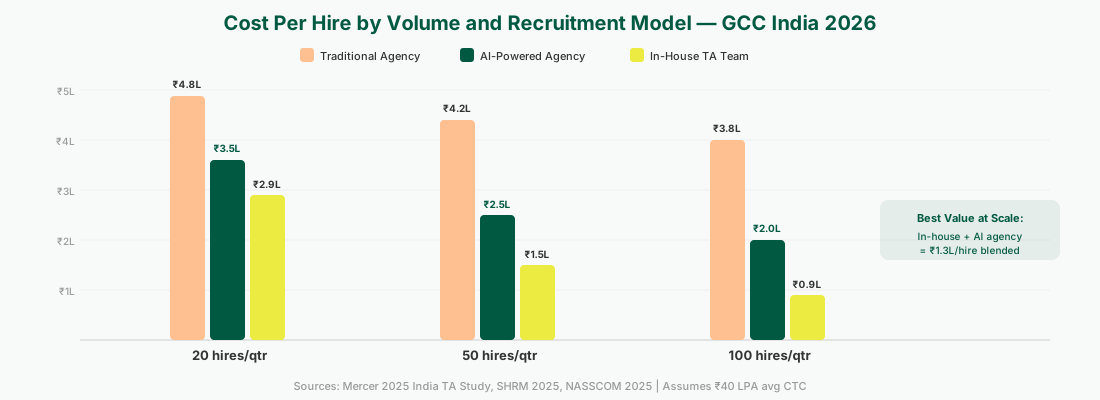
Cost per hire decreases at volume — but the rate of decrease varies dramatically by recruitment model. According to Mercer's 2025 India Talent Acquisition Study, the average cost per hire for GCCs in India ranges from INR 1.5-5 lakhs depending on volume and model.
Across traditional agencies, AI-powered agencies, and in-house teams, expect INR 2-5 lakhs per hire at lower volumes (20/quarter), dropping to INR 0.9-2 lakhs at 100+ hires per quarter. The blended model — internal TA for standardised roles plus an AI-powered agency like Quantalent AI for specialist and overflow — delivers the strongest value at scale, averaging ₹1.3L per hire at 100+ quarterly volume while maintaining quality through structured vetting.
For a detailed cost comparison across all recruitment models and volume tiers, see our bulk hiring cost analysis.
Still Have Questions About Scaling Your GCC?
Email contact@quantalent.ai or book a free consultation. Quantalent AI provides a customised scaling plan within 48 hours — including a phased hiring timeline, city-by-city sourcing strategy, and projected cost-per-hire for your specific role mix and volume targets.