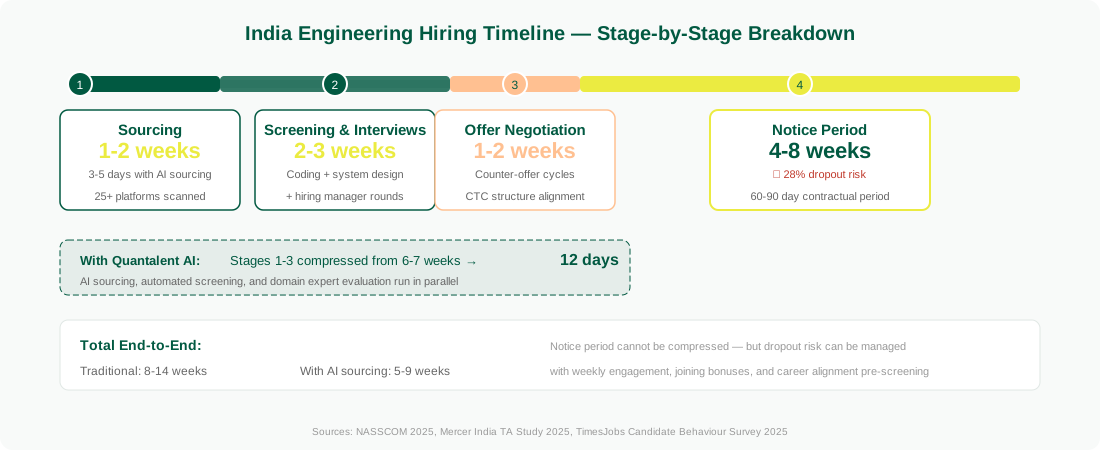
Hiring an engineer in India typically takes 8 to 14 weeks end-to-end, from role opening to first day on the job. The distribution shifts sharply by role seniority, sourcing channel, and notice period duration, with senior AI/ML roles stretching to 16 weeks. Quantalent AI compresses the active hiring phase to a 12-day average close by combining AI sourcing across 25+ platforms with pre-vetted shortlists, leaving notice period as the only uncontrollable delay for most Indian tech hires.
What Is the Typical End-to-End Hiring Timeline for Engineers in India?
End-to-end hiring timelines for Indian engineers in 2026 fall into three bands by seniority. According to the Naukri JobSpeak 2025 hiring report, junior engineers with 0 to 3 years of experience close in 6 to 9 weeks, mid-level engineers (4 to 7 years) in 9 to 12 weeks, and senior engineers with 8 or more years in 12 to 16 weeks. AI/ML specialists and hard-to-fill niche roles extend the senior band up to 18 weeks.
The variance is driven primarily by notice period rather than by sourcing or interview speed. Junior engineers in India typically serve 30-day notice periods; mid-level engineers serve 60 days; senior engineers serve 60 to 90 days, with some GCCs and banks enforcing 90 days contractually. Active hiring (sourcing, screening, interviews, offer issuance) usually takes 3 to 5 weeks across all bands, so two-thirds of the total timeline is notice-period wait.
Role type affects speed within each band. Backend engineers close fastest because supply is deepest. Frontend engineers close 15 percent slower on average because of React and TypeScript specialization requirements. AI/ML and MLOps roles close 40 to 60 percent slower than generalist engineering roles, reflecting the 3x demand-supply gap NASSCOM reported in its 2025 GCC India Report.
How Does Each Stage of the India Hiring Process Break Down?
Each stage of the India hiring process has a measurable standard duration. Understanding the stage breakdown helps GCCs identify where their own process deviates from the market norm and where to compress.
Sourcing (Week 1 to Week 3). Traditional agency sourcing takes 10 to 15 business days to produce a viable first shortlist for a mid-level engineer role. AI-powered sourcing across 25+ platforms compresses this to 2 to 4 business days because it parallelizes candidate evaluation. Internal recruiters without external agency support average 18 to 25 business days for the first shortlist, according to LinkedIn's 2025 India Talent Trends report.
Screening and first interview (Week 2 to Week 4). Initial recruiter screens take 30 to 45 minutes per candidate. Technical screens by domain experts add another 45 to 60 minutes. A well-structured hiring funnel moves a candidate from shortlist to first interview in 5 to 8 business days. Delayed hiring manager availability is the single biggest driver of timeline slippage at this stage.
Second-round technical and onsite interviews (Week 3 to Week 5). Most India GCCs run 2 to 3 technical rounds (coding, system design, behavioral) plus a hiring manager conversation. Total interview time per candidate is 6 to 10 hours of combined interviewer effort. Scheduling typically consumes 5 to 10 calendar days because multiple senior interviewers need to align.
Offer and negotiation (Week 5 to Week 6). Offer generation takes 2 to 4 business days in most GCCs because of compensation committee approvals. Negotiation adds 3 to 7 days. Senior candidates may receive and compare 2 to 4 competing offers during this window.
Notice period (Week 6 to Week 14). Notice period is the single longest stage. For senior Indian tech engineers, 60 to 90 days is the norm. Notice period buyout is possible at 15 to 25 percent of base salary per unserved month but is uncommon outside fintech and crypto.
Onboarding and first day (Week 14+). Background verification (BGV) takes 7 to 14 calendar days for standard checks. GCCs running extended checks (criminal, education, international) can extend BGV to 30 days, delaying the actual first day.
Why Is the Offer Dropout Rate So High in India and How Do You Prevent It?
Offer dropout is the defining pain point of Indian tech hiring in 2026. SHRM India's 2025 Talent Acquisition Report put dropout rates at 28 percent across GCCs and 38 percent at Indian product startups. Dropout rates above 40 percent were recorded at Series B and C startups offering aggressive equity, where candidates accept multiple offers and pick closer to the joining date.
The three primary dropout drivers are well-documented. Counter-offers from the current employer account for 42 percent of dropouts, because Indian employers routinely match or exceed external offers rather than lose senior talent. Competing offers arriving during the 60 to 90 day notice period account for another 31 percent of dropouts: a candidate who accepted an offer at Week 6 is approached by three more companies during Weeks 7 through 12. Buyer's remorse about role fit accounts for 18 percent of dropouts, driven by unclear role scope at the offer stage.
Preventing offer dropout requires active engagement during notice period, not passive waiting. Weekly engagement calls between the hiring manager and the accepted candidate reduce dropout by 45 percent according to PwC's 2025 India Workforce Study. Early-joining bonuses (signing bonuses contingent on joining by a specific date) reduce dropout by 30 percent. Fast-tracked BGV and pre-onboarding engagement (team introductions, project previews, equipment shipped early) produce measurable commitment effects.
Structural changes help too. Offering signing bonuses above 10 percent of base, providing joining bonuses split across first three months, and offering clear 6-month and 12-month role milestones at the offer stage all correlate with lower dropout rates. For a deeper view of the hiring challenges foreign companies face in India, see our guide to hiring challenges in India for foreign companies.
How Does India Compare to Philippines and Eastern Europe for Hiring Timelines?
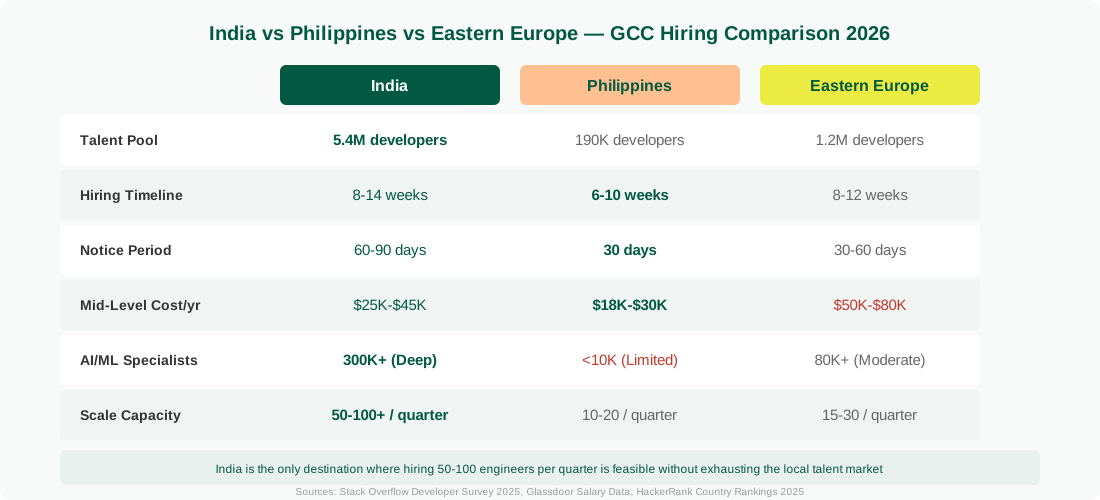
GCCs choosing between India, Philippines, and Eastern Europe should compare three dimensions: talent depth, cost, and timeline. The trade-offs differ sharply by role type.
India. Talent pool of 5.4 million software engineers per NASSCOM's 2025 report. Senior engineer cost of $55,000 to $95,000 annually in Bangalore, $40,000 to $70,000 in tier-2 cities. Average hiring timeline of 8 to 14 weeks with notice period as the bottleneck. Time-zone overlap: 2 to 4 hours with Europe, 9 to 12 hours with US East Coast.
Philippines. Talent pool of 1.2 million developers per the Philippine Software Industry Association 2025 report. Senior engineer cost of $30,000 to $55,000 annually, 35 to 45 percent cheaper than India. Hiring timelines are shorter at 4 to 8 weeks because notice periods are typically 15 to 30 days. Strength lies in English fluency and customer-facing roles, weakness lies in senior engineering depth for product development, and the time-zone aligns with Asia-Pacific.
Eastern Europe (Poland, Romania, Ukraine). Combined talent pool of approximately 1.9 million developers per the Eurostat 2025 ICT Workforce Report. Senior engineer cost of $80,000 to $140,000 in Poland and $55,000 to $95,000 in Romania, which is 40 to 60 percent more expensive than India tier-2 cities. Hiring timelines of 6 to 10 weeks with notice periods of 30 to 60 days. Strongest on time-zone overlap with Western Europe and on product engineering maturity.
The decision pattern by role type: India wins for scale AI/ML centers, platform engineering, and 24x7 operations. Philippines wins for cost-optimized customer-facing engineering and back-office tech. Eastern Europe wins for product-led teams serving European markets with tight time-zone requirements. GCCs running multi-region strategies often combine India (scale) with Eastern Europe (EU coverage) or Philippines (AsiaPac).
How Does AI-Powered Sourcing Cut the Hiring Timeline?
The sourcing phase is the most compressible part of the Indian hiring timeline. Traditional agency sourcing takes 10 to 15 business days for a mid-level engineer role because recruiters manually search LinkedIn, Naukri, internal databases, and references in sequence. The quality of the first shortlist is inconsistent, often requiring a second or third pass before the hiring manager sees qualified candidates.
AI-powered sourcing parallelizes the search across 25+ platforms simultaneously, including GitHub, LinkedIn, Naukri, specialist communities, and open-source contributor graphs. Each candidate is scored against 200+ parameters (tech stack, role history, company trajectory, engagement signals) in the first pass, which eliminates 70 percent of weak fits before human review. The result is a qualified shortlist in 2 to 4 business days versus 10 to 15 days for traditional sourcing.
The time compression compounds at the screening stage. When AI delivers a shortlist where 80 percent of candidates match the role precisely, the recruiter's screening effort drops from 40 candidates to 8 to 10 high-fit candidates. Hiring manager review time drops proportionally. A process that used to consume 3 to 4 weeks of recruiter time from sourcing to first interview now takes 5 to 8 business days.
For high-volume GCC hiring where multiple roles are open in parallel, see our bulk hiring agency guide for MNC India covering how AI sourcing scales across concurrent requirements.
What Does Quantalent AI's 12-Day Close Actually Mean?
Quantalent AI's 12-day average time-to-close refers to the active hiring window from requirement briefing to accepted offer, not the full end-to-end timeline including notice period. The 12 days cover sourcing (2 to 4 days), recruiter screening (1 to 2 days), domain expert interview (1 to 2 days), client interview scheduling and completion (3 to 4 days), and offer issuance (1 to 2 days).
The 12-day close depends on three conditions being met. Hiring manager availability within 48 hours of shortlist delivery is the single biggest factor; delays at the hiring manager interview stage consume 30 to 40 percent of total slippage in traditional processes. Clear role requirements at briefing time eliminate re-sourcing rounds that add 5 to 10 days each. Decisive offer timing after final interview (within 48 hours) prevents the candidate from entertaining competing offers that would add days or derail the offer entirely.
The dual-validation approach that combines AI sourcing with domain expert interviews is what produces the 98 percent profile-to-interview conversion rate and 3:1 interview-to-hire ratio Quantalent AI reports. For GCCs planning large concurrent hiring ramps, understanding the 12-day close matters because it multiplies across all open roles: 20 roles at 12-day close means 20 parallel 12-day cycles with offer dates clustered, not 240 sequential days.
Key Takeaways
- End-to-end engineer hiring in India takes 8 to 14 weeks in 2026 for most roles, extending to 18 weeks for AI/ML specialists, with notice period driving 60 to 70 percent of total timeline per Naukri JobSpeak 2025
- Offer dropout rates sit at 28 percent across GCCs and 38 percent at startups per SHRM India's 2025 Talent Acquisition Report, driven primarily by counter-offers and competing offers during notice period
- Active engagement during notice period (weekly calls, early-joining bonuses, pre-onboarding) reduces dropout by 30 to 45 percent per PwC's 2025 India Workforce Study
- India retains a 3 to 5x talent depth advantage over Philippines (1.2M developers) and combined Eastern Europe (1.9M) for senior engineering roles, despite being 35 to 45 percent more expensive than Philippines per NASSCOM 2025
- AI-powered sourcing compresses the sourcing phase from 10 to 15 days down to 2 to 4 days; Quantalent AI's 12-day close refers to the active hiring window and depends on hiring manager responsiveness
Email contact@quantalent.ai or book a free consultation to design a hiring timeline and dropout-prevention plan for your India GCC. Quantalent AI operates across Bangalore, Hyderabad, Pune, Chennai, and tier-2 cities, and delivers pre-vetted shortlists within 5 business days of role briefing.