AI recruitment uses machine learning to automate candidate sourcing, screening, and matching across multiple talent platforms simultaneously. The technology scans profiles on LinkedIn, GitHub, Stack Overflow, and 20+ other platforms, evaluates candidates against hundreds of parameters, and produces a ranked shortlist in days instead of weeks. According to Gartner's 2025 HR Technology Survey, 76% of HR leaders consider AI-based recruitment tools essential for talent acquisition. Quantalent AI combines this AI sourcing with human domain expert validation — a dual-validation approach that delivers a 3:1 interview-to-hire ratio.
How Does AI Find and Screen Candidates?
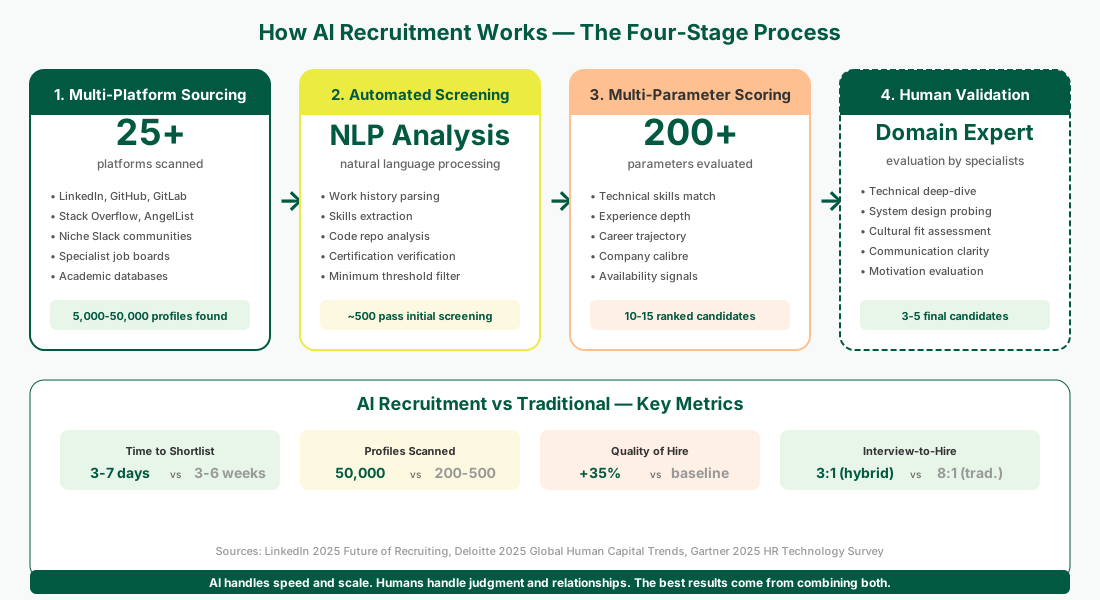
AI recruitment operates through four stages: sourcing, screening, scoring, and shortlisting. Each stage automates tasks that traditionally required weeks of manual recruiter effort, while maintaining or improving candidate quality.
Stage 1: Multi-platform sourcing. AI crawls professional profiles across 25+ platforms — LinkedIn, GitHub, GitLab, Stack Overflow, AngelList, niche Slack communities, and specialist job boards. Unlike a human recruiter who searches one platform at a time, AI queries all platforms simultaneously, identifying candidates who match technical requirements, experience levels, and geographic preferences. According to LinkedIn's 2025 Future of Recruiting report, AI-powered sourcing identifies 3x more qualified candidates per role than manual searching.
Stage 2: Automated screening. AI analyses each candidate's profile data — work history, skills endorsements, code repositories, open-source contributions, certifications, and published content. Natural language processing (NLP) extracts relevant information from unstructured data like project descriptions and recommendations. Candidates who meet minimum thresholds advance; those who don't are filtered out automatically.
Stage 3: Multi-parameter scoring. Quantalent AI evaluates candidates across 200+ parameters, including technical skills match, experience depth, career trajectory, company calibre, project complexity, and availability signals. Each parameter receives a weighted score based on the specific role requirements. The scoring model adapts to each search — a backend engineer search weights system design experience higher, while a frontend search prioritises UI/UX portfolio quality.
Stage 4: Ranked shortlist delivery. AI produces a confidence-scored shortlist ranking candidates by overall fit. The top candidates — typically 10-15 profiles from an initial pool of thousands — proceed to the next phase. In Quantalent AI's process, this AI shortlist then goes through human domain expert evaluation, creating a final shortlist of 3-5 candidates who have passed both AI and human assessment.
How Does AI Recruitment Compare to Traditional Hiring?
The difference between AI-powered and traditional recruitment is not just speed — AI fundamentally changes the quality and consistency of candidate evaluation. According to Deloitte's 2025 Global Human Capital Trends report, companies using AI in recruitment report 35% higher quality-of-hire scores and 25% lower cost-per-hire over 12 months.
| Factor | Traditional Recruitment | AI-Powered Recruitment |
|---|---|---|
| Candidate pool scanned | 200-500 per role | 5,000-50,000 per role |
| Platforms searched | 2-3 (LinkedIn, job boards) | 25+ (including niche communities) |
| Time to shortlist | 3-6 weeks | 3-7 days |
| Screening consistency | Variable (recruiter fatigue) | Identical criteria applied to all |
| Passive candidate reach | Limited (network-dependent) | Extensive (data-driven identification) |
| Cost per hire | AED 42,000-84,000 | Similar fee, 40-68% faster fill |
| Bias risk | Higher (unconscious bias) | Lower (objective criteria), requires auditing |
| Cultural fit assessment | Strong (human judgment) | Weak (needs human supplement) |
Traditional recruitment excels at relationship-building, cultural fit assessment, and nuanced judgment calls. AI recruitment excels at scale, speed, consistency, and identifying candidates human recruiters would miss. The optimal approach combines both — which is why Quantalent AI's dual-validation model pairs AI sourcing with domain expert human evaluation.
Why Can't AI Fully Replace Human Recruiters?
AI handles 80% of recruitment tasks faster and more consistently than humans, but the remaining 20% requires judgment that current AI cannot replicate. Understanding these limitations helps employers evaluate AI recruitment tools realistically and choose the right hybrid model.
Cultural fit assessment requires context. AI can match keywords and patterns, but cannot evaluate whether a candidate's working style, communication approach, and values align with a specific team's culture. A senior engineer who thrives in startup environments may struggle in a structured enterprise setting — AI sees the technical match, but a human recognises the cultural mismatch. According to Harvard Business Review's 2025 analysis, cultural mismatch is the leading cause of early-stage attrition, responsible for 42% of departures within the first year.
System design evaluation needs domain expertise. AI can verify that a candidate lists "distributed systems" on their profile, but cannot evaluate the depth of their architectural thinking. When Quantalent AI's domain experts interview candidates, they probe design decisions: "How would you scale this service to handle 10x traffic?" The quality of reasoning — not keyword matching — determines true capability.
Candidate motivation is invisible to algorithms. A candidate who is passively exploring options requires different engagement than one actively seeking to leave. Human recruiters read tone, urgency, and underlying motivations during conversations — signals that data analysis cannot capture. According to LinkedIn's 2025 Talent Trends data, 63% of successful placements involve candidates who were initially passive and required skilled human engagement to convert.
Offer negotiation is a relationship skill. Negotiating compensation packages, managing counter-offers, and coordinating notice period transitions require interpersonal skills, cultural awareness, and real-time judgment that AI cannot provide.
What Should Employers Look for in an AI Recruitment Partner?
Not all AI recruitment tools deliver equal value. The market includes everything from resume-parsing chatbots marketed as "AI recruitment" to sophisticated multi-platform sourcing engines with genuine machine learning capabilities. According to IDC's 2025 AI in HR Technology report, only 34% of tools marketed as "AI recruitment" use actual machine learning — the rest rely on keyword matching with an AI label.
Multi-platform sourcing, not just LinkedIn. True AI recruitment scans code repositories, technical forums, specialist communities, and niche platforms — not just LinkedIn profiles. Ask the provider how many platforms their AI sources from and which specific platforms are included.
Transparent scoring methodology. The AI should explain why a candidate scored highly, not just present a number. Look for providers that show which parameters contributed to each candidate's score, enabling your hiring team to validate the AI's reasoning.
Human expert layer. AI that produces a shortlist without any human validation sends the screening burden to the employer. The best AI recruitment partners include domain expert evaluation — where a qualified professional in the candidate's technology area conducts an assessment before presenting the candidate. Quantalent AI's process includes technical evaluation by domain experts who have built production systems in the candidate's specific technology stack.
Bias monitoring and auditing. According to the MIT Sloan Management Review's 2025 study on AI hiring, responsible AI recruitment providers conduct regular bias audits on their algorithms, testing for demographic skew in sourcing, screening, and scoring. Ask potential providers whether they audit their AI for bias and how frequently.
Integration with your workflow. The AI recruitment partner should deliver candidates into your existing ATS or interview workflow — not require you to adopt new tools. Look for providers that integrate with platforms like Greenhouse, Lever, Workday, or provide structured candidate reports compatible with your process.
Still Deciding Whether AI Recruitment Is Right for Your Team?
AI-powered recruitment works best for companies hiring multiple tech roles, seeking niche specialists, or struggling with long time-to-fill. Quantalent AI combines AI sourcing across 25+ platforms with human domain expert validation — delivering a 3:1 interview-to-hire ratio and 12-day average time-to-close.
Get started: Email contact@quantalent.ai or book a free consultation. We'll explain how our AI+human approach works for your specific roles and hiring volume.